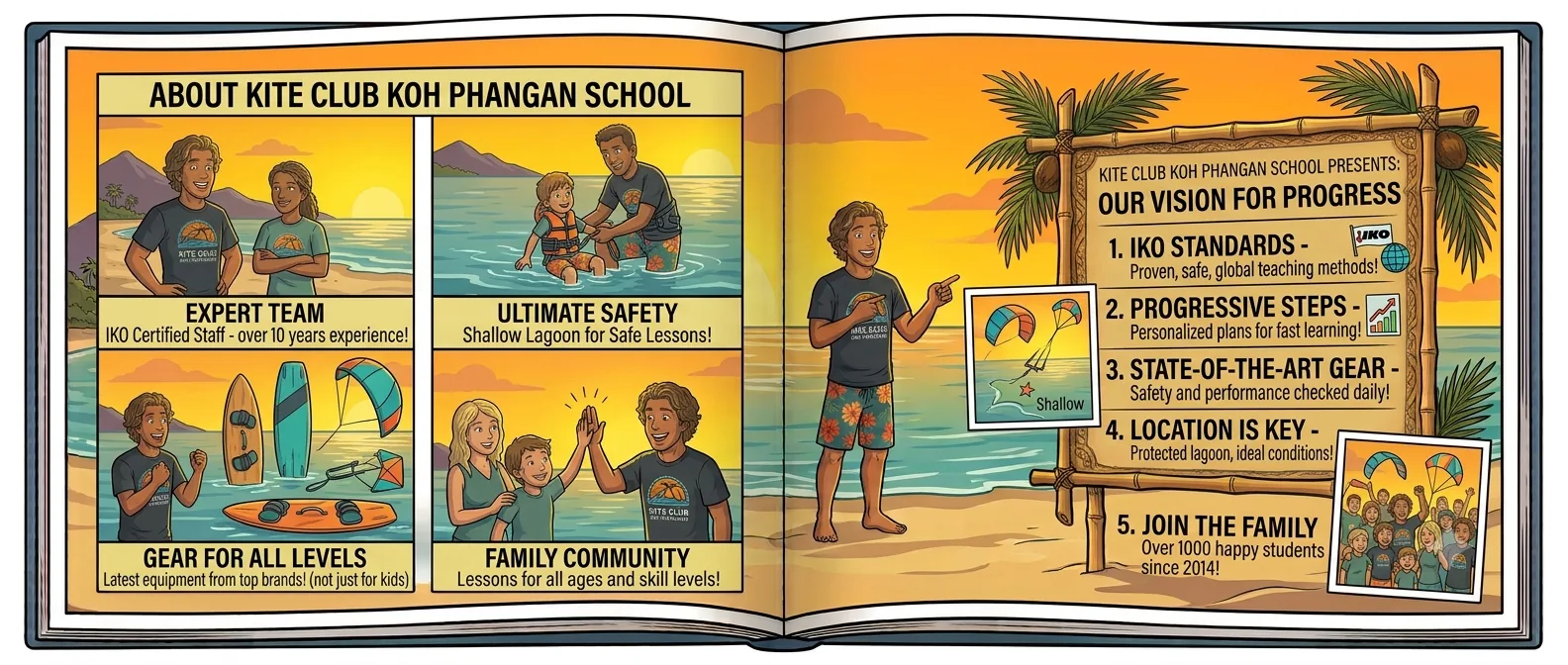
The instructors, certifications, equipment, location, courses, and philosophy behind Kite Club Koh Phangan — everything you need to know before booking your first session or assessing whether this is the right school for your goals.
📖 14 min read · Updated May 2026
Kite Club Koh Phangan is an IKO and IWO certified watersports school based on Thong Sala Beach, on the southwest coast of Koh Phangan island in the Gulf of Thailand. We operate year-round, teaching kitesurfing, wing foiling, windsurfing, and e-foiling, as well as offering kayak and stand-up paddleboard rentals. This page gives you an honest picture of who we are, how we teach, and what you can expect when you arrive.
Location: Thong Sala Beach
Our school operates from Thong Sala Beach, the main beach of Koh Phangan's administrative centre and largest town. Thong Sala is the island's primary ferry port — the main connection to Koh Samui, Surat Thani, and Bangkok via overnight ferry. This makes the school highly accessible: most visitors arrive directly by ferry and are within 5–15 minutes of the school.
The beach itself is one of the best learning kitesurfing spots in the Gulf of Thailand. The southwest orientation means the dominant SE trade winds (March–September) blow side-onshore — the ideal safety direction for beginner kitesurfing. The sandy bottom extends 80–100 metres at waist depth, providing a large, safe area for body drag and water start practice. The absence of reef and rocks in the lesson area distinguishes Thong Sala from other potential kite spots on the island.
Local Insight
The Thong Sala Beach lesson area is separated from the main beach by a natural tidal channel. This creates a defined space for kitesurfing that keeps students away from swimmers and beachgoers. The channel also means that beginners who drift downwind during body drag have a natural boundary before the pier.
Certifications: IKO and IWO
The school holds two international certifications that are recognised globally:
| Certification | Sport | Recognition | What it Means for Students |
|---|---|---|---|
| IKO (International Kiteboarding Organisation) | Kitesurfing, Windsurfing | Accepted worldwide; required for independent riding at many kite beaches | Your certification is valid at kite schools and rental operations globally |
| IWO (International Wing Foil Organisation) | Wing Foil | The leading certification body for the rapidly growing wing foil discipline | Internationally recognised wing foil certification |
IKO certification is the global standard for kitesurfing competence. An IKO Level 3 certificate from Kite Club Koh Phangan is accepted at rental operations and kite schools worldwide. You are not paying for a piece of paper — you are paying for the documented skills behind it, skills that any kite instructor anywhere in the world can verify and build upon.
Our Instructors
The school's primary instructor team holds current IKO and IWO certifications. Instructors receive ongoing training and certification renewal through the international IKO structure, which requires documented teaching hours and annual assessments. Beyond certifications, the school prioritises instructors who can teach — not just ride. The ability to demonstrate a skill correctly does not automatically transfer to the ability to explain it clearly or identify why a student is failing to replicate it.
Our instructors speak English, Russian, Arabic, German, and Ukrainian. This multilingual capacity matters in practice: kitesurfing instruction involves real-time feedback during physical activity. Nuanced communication in your preferred language significantly improves the feedback loop and reduces the time spent trying to interpret an instruction rather than applying it.
Equipment: What the School Provides
All lesson and rental equipment is maintained to IKO standards and replaced on a regular cycle. The school uses current-generation teaching kites known for reliability, easy relaunch, and forgiving power delivery — which matters for beginners who are still developing kite control. Using outdated or poorly maintained equipment is a false economy that adds hours to the learning curve and creates unnecessary safety risk.
| Equipment | Provided For | Notes |
|---|---|---|
| Teaching kites (9–12m) | All kitesurfing lessons | Size selected based on student weight and wind speed |
| Control bars and lines | All kitesurfing lessons | Inspected and replaced regularly; safety releases tested before each session |
| Twin-tip boards (133–144cm) | Board sessions and rentals | Selection of sizes matched to student weight and experience |
| Harnesses (seat and waist) | All lessons | Multiple sizes; students choose waist or seat style |
| Impact vest and helmet | All beginner lessons | Mandatory for first sessions; strongly recommended for all students |
| Wing foil equipment | Wing foil lessons | Wings, foil boards, and foil assemblies matched to student level |
| E-Foil boards | E-Foil sessions | Premium Fliteboard units; no wind required |
Course Structure and Philosophy
The school teaches the IKO curriculum — a structured, internationally standardised progression from first principles to independent riding. The curriculum exists because kitesurfing is a sport with genuine safety implications, and a standardised progression ensures that every skill is built on the correct foundation before the next skill is introduced.
The IKO curriculum is not a box-ticking exercise. It is a logical sequence: you cannot safely do a water start without being able to relaunch a kite from the water. You cannot safely ride independently without knowing self-rescue. The curriculum is the accumulated experience of the global IKO community about what order these skills should be taught in, and why.
What distinguishes good schools from average ones is how the curriculum is delivered — the quality of explanation, the quality of feedback, and the ability to adapt pace and emphasis to individual students. Rushing students through the curriculum to reach the "exciting" parts faster produces frustrated intermediate kitesurfers with gaps in their foundation that eventually cause problems.
Class Sizes and Student-to-Instructor Ratios
The school maintains a maximum ratio of 3 students per instructor for water sessions, and 1:1 for advanced technique work. Smaller ratios are not purely about safety — they are about learning quality. An instructor who is managing 5 students simultaneously cannot give each student the specific feedback they need at the moment they need it.
Private lessons are available and popular with students who prefer dedicated attention, have specific technique goals, or are working through a particular plateau. The private lesson rate is higher per hour but often produces faster progression, making the total cost for a given skill level comparable to or lower than group instruction.
Expert Tip
If you are arriving in peak season (December–April) with limited time, consider booking private lessons for the first two sessions and group lessons thereafter. The first two sessions — theory and kite control — are where the foundational patterns are set, and individual attention during this phase prevents the repetitive errors that slow progress in subsequent sessions.
Languages and Communication
We teach in English, Russian, Arabic, German, and Ukrainian. This is not a trivial point. Kitesurfing instruction involves real-time physical feedback in a dynamic environment. "Move the kite to the right" during a water start attempt is actionable information. "Bewegen Sie den Drachen nach rechts" is the same instruction — and if German is your primary language, you process and apply it significantly faster than the English version.
For Russian and Ukrainian speakers, in particular, Koh Phangan has a substantial community, and the school's ability to instruct in these languages is a genuine distinguishing factor. Many European schools cannot offer Russian-language instruction of the same quality.
Beyond Kitesurfing: The Full School Programme
While kitesurfing is the school's primary activity, the complete programme covers a range of watersports designed to complement each other and make full use of Koh Phangan's consistent conditions:
- Wing Foil: IWO-certified instruction; Intro at 4,000 THB; Beginner package at 11,900 THB; Advanced at 16,900 THB
- Windsurfing: certified instructors; Discovery at 4,000 THB; Beginner at 11,000 THB; Independent at 14,000 THB
- E-Foil: Intro at 2,000 THB; Foiling session at 3,000 THB; Freedom session at 3,500 THB
- Kayak rental: 1h 500 THB; 2h 900 THB; 3h 1,200 THB
- SUP rental: 1h 400 THB; 2h 700 THB; All-day 1,000 THB
Kite Safari: Extended Programme
For experienced kitesurfers who want to explore the Gulf of Thailand's best kite spots over multiple days, the school organises Kite Safari packages. These multi-day liveaboard trips visit spots not accessible from shore, including the pristine lagoons and uninhabited islands between Koh Phangan and the mainland.
| Package | Price | Duration | Includes |
|---|---|---|---|
| Standard | 1,300 EUR | 7 days | Liveaboard accommodation, all equipment, guide, meals |
| Comfort | 1,400 EUR | 7 days | As above + private cabin, upgraded catering |
| VIP | 1,500 EUR | 7 days | As above + exclusive boat, private instruction |
The Learning Environment at Thong Sala
The quality of a kitesurfing lesson depends significantly on the physical environment where it takes place. Thong Sala Beach offers a combination of conditions that is difficult to replicate at most other kite locations in Southeast Asia, and understanding why helps explain why the school chose this location and why students learn faster here than at many alternative sites.
The water depth gradient at Thong Sala is unusually shallow and consistent. A sandy bottom extends from the beach outward for approximately 80 to 100 metres before reaching chest depth, and beyond that the bottom continues to shallow out before dropping into the channel. This means that body drag practice, board introduction, and early water starts all take place in water where standing up is always possible — the student is never in over their head, literally or figuratively. This reduces anxiety and allows students to focus on technique rather than water management.
The wind at Thong Sala arrives from the southeast during the primary teaching season (March through September), which creates a side-onshore direction at the beach. This is the safest wind direction for beginners: if a student loses control of the kite or has an equipment problem, they drift toward shore rather than out to sea. This safety margin is significant and allows instructors to focus entirely on teaching rather than monitoring student distance from shore.
The absence of boat traffic in the lesson area during teaching hours is another advantage. Thong Sala pier generates some boat movement, but the school's lesson area is positioned north of the main pier traffic lane. Students can practice freely without the interruption and distraction of passing vessels. At crowded kite beaches in Europe or Australia, boat traffic is a constant teaching interruption. Here, the water in the lesson area is essentially private for the duration of the session.
What to Expect on Your First Visit
Most first-time visitors arrive with a mixture of excitement and nervousness. The excitement is appropriate — you are about to attempt something genuinely challenging and exhilarating. The nervousness is also appropriate, because the kite generates real forces and the sport has genuine consequences for careless practice. Understanding what the first visit looks like in detail helps manage both.
When you arrive at the school, you will be greeted by an instructor and asked a few brief questions about your experience and goals. If you have never tried kitesurfing, the first session begins with a 30-minute theory conversation on the beach. This covers the fundamental concepts that make every subsequent action meaningful: what the wind window is, why the kite behaves differently in different positions, and what the safety systems do. Students who engage with this session and ask questions learn faster in every subsequent stage of the curriculum.
The physical first steps are deliberately small. You will hold a trainer kite or a depowered large kite, standing on the sand in knee-deep water, and practice the basic steering movements. Pull the right side to move the kite right. Pull the left side to move it left. The goal is not to demonstrate athleticism — it is to develop the feel of bar tension that tells you what the kite is doing. This proprioceptive sense is the foundation of everything that follows.
The first water entry is guided. Your instructor enters the water with you and stays within reach throughout the first body drag attempts. You will feel the kite's pull through the water for the first time, and for most students this is a genuinely memorable sensation — the first physical encounter with the sport's fundamental energy. The instructor is watching your kite position, your bar grip, your body angle, and your response to unexpected power changes simultaneously, providing real-time corrections that are calibrated to exactly where you are in the learning process.
How the School Compares to Self-Teaching
A significant number of people who come to the school have previously attempted to teach themselves kitesurfing, either with borrowed equipment, YouTube videos, or informal help from a friend. The school sees the results of self-teaching regularly, and the pattern is consistent: self-taught students arrive with ingrained technique errors that take significant additional instruction time to correct, and they frequently have gaps in their safety knowledge that represent genuine risks.
The most common self-teaching problem is kite parking position. Self-taught riders often develop a habit of parking the kite at 12 o'clock (directly overhead) only during pauses, rather than understanding that this is the position to return to immediately in any moment of uncertainty. This sounds minor but it is the root cause of the most common beginner accident — the kite drifting into the power zone during a moment of inattention on land, resulting in unexpected drag or lofting.
The second most common self-teaching gap is safety release familiarity. Activating the chicken loop release must be reflexive — it must happen before conscious thought, because in the emergency situations where it is needed, there is no time for deliberate decision-making. Self-taught riders consistently have a version of this that is understood intellectually but not physically practiced to the point of automaticity. IKO-certified instruction specifically addresses this through repeated physical practice of the release on land before any water session.
Self-teaching is not impossible — people have done it. But the additional instruction hours required to unlearn incorrect habits and fill safety knowledge gaps typically cost more in total than a proper certified course would have cost at the beginning. The certified course is not just about learning to ride; it is about learning to ride safely and correctly, with habits and reflexes that will serve you throughout your entire kitesurfing life.
Student Reviews and Outcomes
The most reliable measure of a kitesurfing school's quality is not its website or its marketing — it is the outcomes of its students. The questions worth asking: what percentage of students who book the Beginner course achieve independent riding? What percentage complete IKO certification? What percentage return for advanced sessions? What do departing students say they wish had been different?
At Kite Club Koh Phangan, the majority of students who complete the full Independent course (10 hours) achieve IKO Level 3 certification. Students who do not complete certification within the booked course hours are offered additional sessions at reduced rates to reach their goals. We do not consider the job complete until the student can ride independently and safely, and the course structure is designed around that outcome rather than around a fixed number of sessions.
The school receives ongoing feedback from students through Google reviews, TripAdvisor, and direct conversation. The most consistent themes in positive feedback: the patience and clarity of instruction, the multilingual teaching capability, the quality of the equipment, and the location. The most consistent theme in constructive feedback: students wish they had booked more lessons up front rather than discovering halfway through the trip that they wanted to continue.
How to Get the Most From Your Instruction
The school provides the instruction, the equipment, and the conditions. What students bring to maximise the value of that investment is equally important. Three habits consistently distinguish students who progress fastest from those who struggle:
First, be specific in your feedback to the instructor. "That felt wrong" is much less useful than "I think the kite went past twelve o'clock when I was trying to do the figure-eight." The more precisely you can describe what you experienced, the more precisely the instructor can diagnose and correct it. Kite control is a proprioceptive skill — what you feel is more diagnostic than what you or the instructor saw from the outside.
Second, apply the lesson debrief before the next session begins. The end-of-session conversation is not closure — it is instruction for the next session. The two or three specific focus points your instructor identifies at the end of one session are the starting points for the beginning of the next. Reviewing these mentally before sleep and before the next session creates continuity between sessions that significantly accelerates skill consolidation.
Third, watch other students during your rest periods on the beach. Observation learning is a well-documented component of motor skill acquisition. Watching a more advanced student perform the water start correctly — seeing the kite position, the board angle, the timing — creates a visual template that your body can reference when attempting the same movement. Many students underutilise the observation learning opportunity that is available simply by watching the session from the shore during breaks.
Frequently Asked Questions
How do I book a lesson?
The simplest way is WhatsApp: +66 96 720 3910. You can also message via the contact form on this website. WhatsApp bookings typically receive a reply within a few hours during business hours (8 am – 6 pm Thailand time). Provide your preferred dates, which sport you want to learn, your current experience level, and the number of people in your group.
Do you offer group discounts?
Yes — groups of 4 or more people booking the same course at the same time receive a discount. Contact the school via WhatsApp with group size and preferred dates for a specific quote. Corporate and team-building packages are also available for groups of 8+.
Can beginners and experienced riders come together?
Yes — we frequently have groups where one person is a complete beginner and another is experienced. Beginners join the structured lesson programme while experienced riders can rent equipment independently or book refresher and technique sessions. The school accommodates both simultaneously.