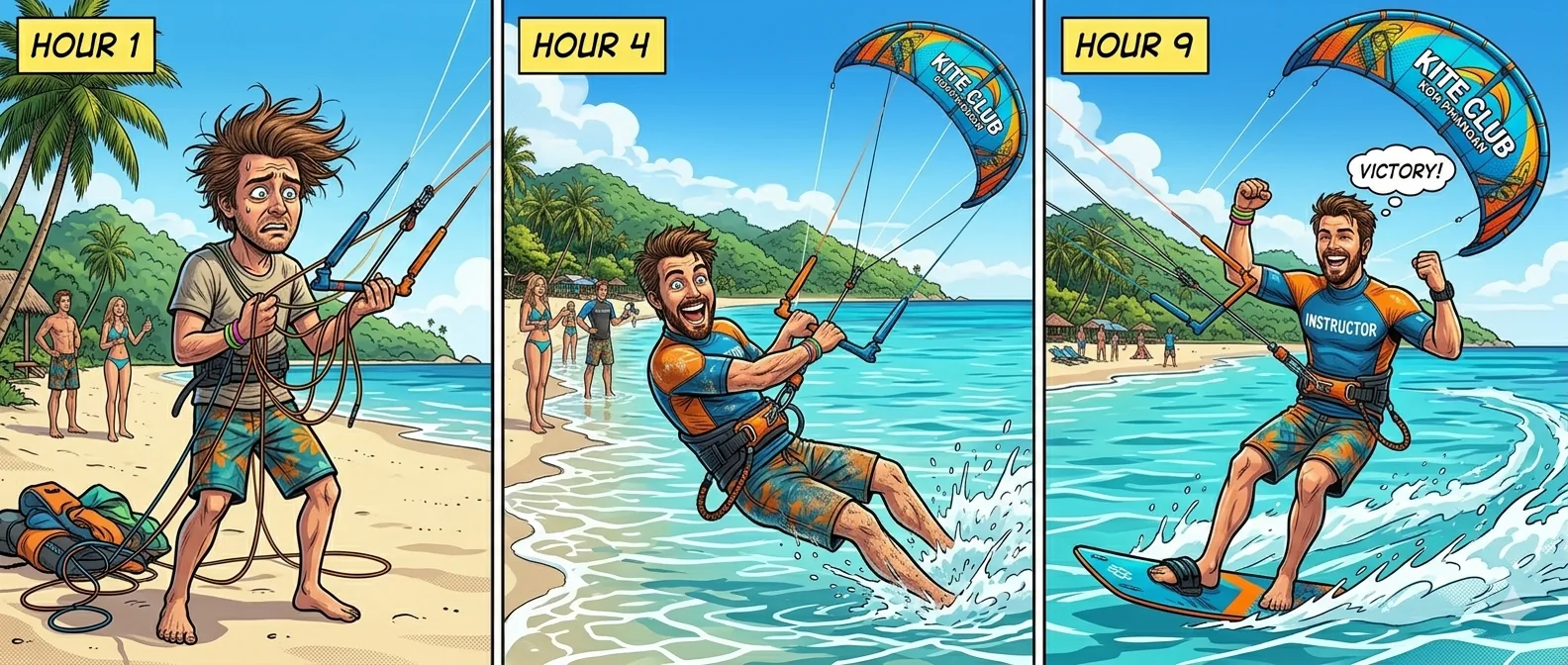
From your first hour on the beach to riding independently in 3–5 days. No experience required. Written by IKO-certified instructors who have taught hundreds of beginners at Thong Sala Beach.
📖 16 min read · Updated May 2026 · By Sergei Sharvarok · Founder & Head Instructor
- Prerequisites: What You Need Before Starting
- Day 1: Discovery Course (3,500 THB)
- Days 2–4: Beginner Course (11,000 THB)
- Days 5–8: Independent Course (18,000 THB)
- Equipment: What Is Provided
- The Physical Side: Fitness, Fatigue, and Pain
- Managing Fear and Building Confidence
- The 7 Most Common Beginner Mistakes
- When to Come: Best Conditions for Beginners
- After the Course: What Next?
- Frequently Asked Questions
Prerequisites: What You Need Before Starting
Kitesurfing has very few hard prerequisites. Here is the complete list:
- Swimming ability — you must be comfortable swimming in open water for 5–10 minutes without a flotation aid. You will spend time in the water away from the board. You do not need to be fast — just calm and confident.
- Age — minimum 12 years. No maximum age. The oldest student Kite Club has taught was 68.
- General health — no active back, shoulder, or wrist injuries. Mild issues can often be managed with technique — ask us when booking.
- Weight — no weight limit. We carry kites from 7m to 15m. Lighter riders use smaller kites; heavier riders use larger ones. All sizes are available.
No prior board sport experience is required. Surfing, snowboarding, and windsurfing backgrounds help — but students with zero board sport history routinely reach IKO Level 3 (basic riding) within the standard 12-hour beginner course.
What to bring on Day 1: board shorts or swimwear, long-sleeve rashguard (UV protection — strongly recommended), sunscreen SPF50+, water bottle, and a small towel. Everything else — kite, harness, helmet, impact vest — is provided by Kite Club.
WhatsApp us at +66 96 720 3910 before arriving to confirm your session. Tell us your dates, preferred time (we typically run 10am and 1pm sessions), whether you want private (1:1) or are comfortable with a small group (maximum 2:1), and your experience level. We confirm within a few hours.
Day 1: Discovery Course — 3,500 THB
The Discovery Course is 2 hours and covers the fundamental IKO Level 1 skills. Here is a detailed breakdown of what happens:
Hour 1: Theory and Land-Based Training (Beach)
You arrive at Thong Sala Beach. Your instructor introduces the wind window — the three-dimensional area in front of you where the kite can fly. The key concept: the closer to directly downwind the kite flies, the more power it generates. The neutral zone directly overhead (12 o'clock) has minimal power.
You learn all safety systems: the chicken loop quick release (disconnects bar from harness), the safety leash (keeps kite attached even after release), and the kite's self-landing ability when powered down. You practice activating the quick release on the ground until it is automatic.
The quick release is the most important thing you will learn. In 5 years of teaching, the students who stay safest are those who practise the release until it is instinctive — not those with the most natural kite ability.
Hour 1–2: Trainer Kite on the Beach
A 2–3m² trainer kite on 12-metre lines is launched. You begin flying it one-handed, two-handed, and with your eyes closed. The goal: kite position without looking, which is the core skill required for water starts. By the end of this session, most students can fly a trainer kite smoothly through the window.
Hour 2–3: Full-Size Kite in the Water (Body Dragging)
The full-size lesson kite (typically 10–12m²) is launched. You enter the water and allow the kite to pull you through the water in a body dragging position — no board, face in water, arms extended, hips forward. This is where you feel real kite power for the first time.
Body dragging develops: one-handed kite control, confidence with power, and recovery instincts. By the end of Day 1, you will have body-dragged 50–100 metres multiple times and experienced the kite pulling you at walking pace through the water.
Body dragging feels slow and unglamorous compared to what you imagine. It is actually the most important phase of the entire course. Every instructor at Kite Club agrees: the students who spend the most time body dragging get on the board the fastest.
Days 2–4: Beginner Course — 11,000 THB
The full Beginner Course is 6 hours (the Discovery Course counts as the first 2 hours if you choose to continue). Days 2 through 4 are typically 3-hour sessions each. Here is the progression:
| Session | Focus | Goal | IKO Level |
|---|---|---|---|
| Day 1 (3h) | Land kite, body drag | Comfortable with kite power in water | Level 1 |
| Day 2 (3h) | Upwind body drag, kite-assisted swimming | Drag yourself upwind to retrieve board | Level 2 |
| Day 3 (3h) | Board handling, first water starts | Standing up on the board for first time | Level 2→3 |
| Day 4 (3h) | First rides, directional control | Sustained riding downwind 50+ metres | Level 3 |
Day 2: Upwind Body Dragging
The single most underestimated skill in kitesurfing. Upwind body dragging means using the kite to pull yourself against the wind — not downwind. This is how you retrieve your board after falling. Without this skill, every fall means a long swim back.
The technique: kite at 11 or 1 o'clock (edge of power zone), one hand on bar, other arm extended forward into the water, angled across the wind. Done correctly, you move at 30–40° to the wind direction. It feels impossible on Day 2. By Day 4, it is automatic.
Day 3: The First Water Start
This is the day that stays with students forever. You put the board on your feet while in the water, position the kite at 12 o'clock, then bring it aggressively through the power zone (10 or 2 o'clock) while pushing your heels down on the board.
The sequence: dive the kite → feel power build → edge the board into the water → stand. Most students need 10–30 attempts before they stand up and stay there. The sensation of rising out of the water on a board powered by a kite is genuinely unlike anything else.
The most common reason Day 3 students don't stand up: the kite is not generating enough power at the moment they try to stand. A slow, tentative kite movement produces weak pull. The kite must be moved with commitment — a decisive arc from 12 o'clock to 10 or 2. Speed creates power.
Day 4: First Real Rides
If Day 3 produced water starts, Day 4 focuses on extending them. You learn to keep the kite flying after standing rather than parking it at 12 o'clock. Basic steering (push the bar right to go left, pull left to go left faster) is introduced. Most students finish Day 4 having ridden 50–150 metres in a sustained straight line.
Days 5–8: Independent Course — 18,000 THB
The Independent Course adds 6 more hours beyond the Beginner package, focusing on IKO Level 3→4 skills:
- Riding upwind — the ability to make ground against the wind, which allows you to start and finish at the same point on the beach
- Tacking and gybing — controlled directional changes without losing the board
- Self-rescue — recovering the kite and returning to shore independently in the event of equipment failure
- Independent launch and land — launching and landing the kite without assistance
- Reading conditions — identifying safe and unsafe wind patterns, recognising gusty vs. laminar wind
Students who complete the Independent Course reach IKO Level 3–4. At Level 4, you can rent equipment and ride independently at any IKO-affiliated school worldwide. This is the goal of the complete course progression.
Equipment: What Kite Club Provides
| Item | Included? | Notes |
|---|---|---|
| Trainer kite (2–3m²) | Yes | Used on Day 1 for land training |
| Full-size kite (7–15m², multiple sizes) | Yes | Instructor selects based on wind and student weight |
| Control bar and safety lines | Yes | Modern depower bar with chicken loop and quick release |
| Kiteboard (twin-tip, multiple sizes) | Yes | Various sizes for different weights |
| Harness (waist style) | Yes | Functional rental; bring your own for better fit |
| Impact vest | Yes | Mandatory for all beginner sessions |
| Helmet | Yes | Mandatory for all beginner sessions |
| Board leash (ankle) | Yes | Keeps board attached if it slips off feet |
What students commonly bring themselves: their own harness (strongly recommended for fit and comfort), their own helmet if they prefer, and their own impact vest for fit. All of these are available at Kite Club if you do not have them.
The Physical Side: Fitness, Fatigue, and Pain Points
Kitesurfing uses muscles that most people do not regularly train. Here is an honest breakdown:
What Gets Tired
- Forearms and hands — kite bar control requires constant grip. Day 1 forearm fatigue is normal and passes by Day 3.
- Lower back — the harness transfers kite load to your hips, but early water start attempts strain the lower back. Stretching before and after sessions helps significantly.
- Core muscles — balancing on the board in moving water engages the entire core. Most beginners are surprised by core soreness after Day 3.
- Legs (quads and calves) — board stance is a constant athletic squat position.
Managing Fatigue
Sessions are 2–3 hours maximum. Beyond 3 hours, fatigue leads to mistakes rather than progress. Kite Club does not offer or recommend "all-day" packages for beginners — short focused sessions produce faster learning than long exhausted ones.
Sleep is a significant component of kitesurfing progress. Motor learning (the muscle memory required for kite control) consolidates during sleep. A full night's rest between sessions produces measurably faster day-over-day progression than late nights.
Managing Fear and Building Confidence
Fear is a normal and healthy response to a high-power sport. Here is how to work with it rather than against it:
The most common fear points in the beginner progression:
| Fear Point | When It Occurs | How We Manage It |
|---|---|---|
| First full-size kite launch | Day 1, hour 2 | Gradual power introduction; instructor controls kite initially |
| First deep-water body drag | Day 1, hour 3 | Instructor swims alongside; clear signals established |
| First water start attempt | Day 3 | Multiple low-power attempts before full-power tries |
| First independent ride (no instructor) | Day 4–5 | Short supervised independence before full independence |
The most important mindset shift: the kite's safety systems are genuinely effective. Activating the quick release depowers the kite completely within 1–2 seconds. Students who practise this release until it is reflexive report significantly lower anxiety levels from Day 2 onwards.
The 7 Most Common Beginner Mistakes
- Rushing body dragging — wanting to get on the board before the kite is truly controlled one-handed. Body dragging IS the foundation.
- Looking at the board during water starts — eyes should stay on the kite until you are standing. Looking at the board disrupts the kite arc.
- Bending arms during water starts — arms must stay straight and locked. Bent arms mean the harness cannot transfer kite load to your hips, and your arms fatigue instantly.
- Pulling the bar too hard — overpowering the kite sends it into the water or overhead, not through the power zone.
- Upright board position — the board must be at 90° to the direction of pull (edged), not flat on the water. A flat board slides away instead of creating lift.
- Releasing the bar during a gust — sheeting out (pushing the bar away) is the correct response to overpowering. Releasing the bar often worsens the situation. Know the difference.
- Trying to ride upwind on Day 3 — riding upwind requires edge control that comes after basic riding is established. Students who try too early sabotage their progress.
When to Come: Best Conditions for Beginners
| Month | Conditions | For Beginners? | Notes |
|---|---|---|---|
| March | SE 18–24 kts, flat water | Excellent | Best wind, book early |
| April | SE 16–22 kts, flat water | Excellent | Peak quality, high demand |
| February | SE 14–18 kts, flat water | Very Good | Ideal for first lessons — not too strong |
| July | SW 14–20 kts, light chop | Good | Best SW month; slightly choppier water |
| August | SW 12–18 kts, light chop | Good | Lighter days mixed with strong days |
| June | SW 12–16 kts, flat | Good | Lighter wind — more manageable for first lessons |
| January | NE/SE 10–15 kts | OK | Building season — some light days |
| September | SW 8–14 kts, chop | Fair | Fading season — variable |
After the Course: What Comes Next?
You finish the Beginner Course at IKO Level 3. Here is what that unlocks and where most riders go next:
- Equipment rental — IKO Level 3 qualifies you for supervised use at most IKO schools. Level 4 unlocks independent rental. Rental at Kite Club starts from 1,800 THB/day for a full kite set.
- Return visit — most students return for a second holiday specifically to solidify riding and reach Level 4. The gap between visits (even months) has minimal impact — kite skills return quickly once you are back on the water.
- Take your IKO card — your instructor issues your IKO certification. Carry it to any IKO school worldwide — it identifies your level and streamlines the equipment rental process.
- Follow the Kite Club community — we have an active WhatsApp group for past students. It includes wind forecasts, session announcements, and a community of riders returning to Koh Phangan.
On average, students who return for a second holiday reach IKO Level 4 (full independence) within 3–5 additional sessions, regardless of how long they have been away. The foundation from the beginner course persists. The main thing that returns quickly is water confidence — the physical skills follow within 1–2 sessions.
Frequently Asked Questions
Most beginners reach IKO Level 3 (basic riding) in 10–14 hours. Board sport experience (surfing, snowboarding, wakeboarding) typically halves this time. The flat water at Koh Phangan accelerates progression compared to most other destinations.
Kitesurfing carries risk, but in a structured IKO lesson environment the risks are managed. The flat lagoon at Thong Sala Beach, mandatory safety equipment, and IKO-certified instruction significantly reduce the hazards. The most common beginner injuries are sunburn, chafing, and minor wrist fatigue — not dramatic kite accidents.
General fitness helps, but there is no minimum fitness requirement. You must be able to swim comfortably in open water. The key physical quality is not strength — it is the ability to stay calm and relaxed in the water.
You can reach IKO Level 2–3 in 3 days (9 hours of lessons). Whether you stand up and ride depends on conditions and aptitude. Most students get their first brief rides in 9–12 hours. Consistent riding typically takes 12–16 hours.
Long-sleeve rashguard (UPF 50+), board shorts or swimwear, and reef-safe sunscreen SPF50+. Water shoes are optional at Thong Sala (sandy bottom). All protective gear — harness, helmet, impact vest — is provided.
The Discovery Course (2 hours, 3,500 THB) is a first-taste session covering land kite, safety systems, and body dragging. The Beginner Course (6 hours, 11,000 THB) includes the Discovery content plus full water start progression to first rides and basic directional control.
Start Your Kitesurfing Journey
IKO-certified beginner courses at Thong Sala Beach, Koh Phangan.
Book Now →From Beginner to Independent Rider: The Complete Roadmap
The progression from complete beginner to independent rider in kitesurfing follows a well-defined path that IKO has systematized into three course levels, each building specifically on the skills and understanding developed in the previous level. The Discovery session establishes the wind window concept and basic kite control that underlie everything else — without a solid intuitive feel for how the kite generates power at different positions relative to the wind, every subsequent skill becomes harder to learn because the foundation is shaky. The Beginner course takes this foundation into the water, adding body drag, board mounting, and the first independent rides that represent the transition from student to practicing rider. The Independent course develops the riding consistency, directional control, and safety management needed for genuinely independent practice at any IKO-recognized kite spot worldwide, without requiring instructor supervision for standard riding conditions. Students who complete all three course levels at Koh Phangan leave the island with a comprehensive skill set and the internationally recognized IKO certification that documents that skill set to the standard expected by rental operations and competing schools worldwide. The total investment for all three courses — 3,500 THB for Discovery, 11,000 THB for Beginner, and 18,000 THB for Independent — represents approximately 32,500 THB, a sum that covers all equipment for all sessions and typically represents the most cost-efficient path to full independent rider competence available at any certified school in any global kite destination at comparable quality. Students who complete this full progression typically require between three and five weeks of active training spread across the three courses, though the timeline varies based on wind conditions during their visit and individual learning pace factors including prior board sport experience and physical fitness level. Contact the school via WhatsApp at +66 96 720 3910 to discuss the optimal scheduling of your beginner progression across your available holiday time.
The beginner guide to kitesurfing at Koh Phangan covers everything from your first step onto the beach to your first independent ride downwind. Contact Kite Club Koh Phangan via WhatsApp at +66 96 720 3910 to begin your journey through the IKO Beginner curriculum with certified instructors who speak English, Russian, Arabic, German, Ukrainian and Thai. Courses available daily throughout the peak January to April wind season at Thong Sala Beach.