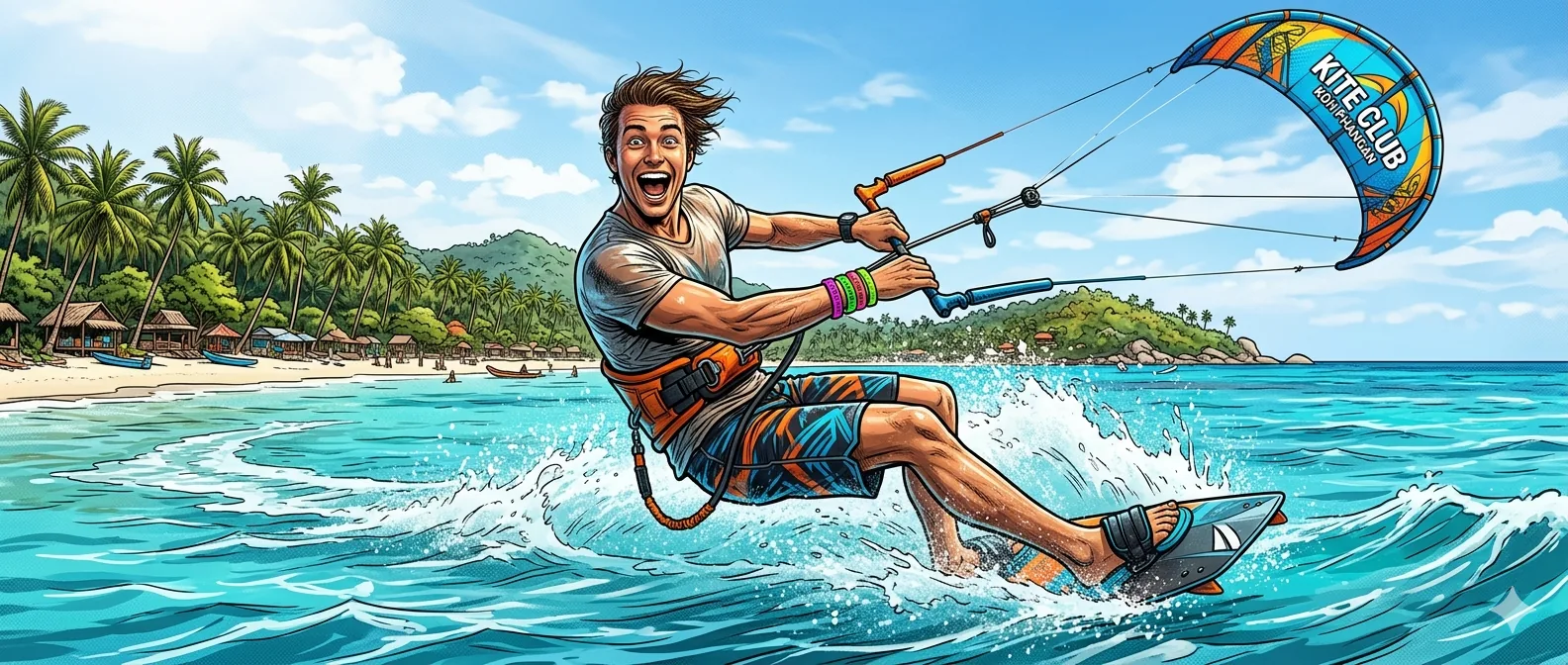
Everything you need to know in one place — wind seasons, kite spots, course progression, prices, travel logistics, accommodation, and local insider knowledge from instructors who teach here every day.
📖 22 min read · Updated May 2026 · By Sergei Sharvarok · Founder & Head Instructor
- Why Koh Phangan for Kitesurfing?
- Geography & What Makes It Special
- Wind Seasons in Full Detail
- The Three Kite Spots
- What to Expect from Your First Lesson
- Course Progression & Prices
- Equipment: What the School Provides
- Fitness & Physical Requirements
- Wing Foil & Other Disciplines
- Travel Logistics
- Accommodation Guide
- Food, Budget, and Daily Life
- What to Do on Windless Days
- Safety, Risks & How We Manage Them
- IKO Certification: What It Means
- Expert Tips from the Instructors
Why Koh Phangan for Kitesurfing?
There are over 200 active kitesurfing destinations worldwide. Koh Phangan consistently ranks in the top 10 — not because of hype, but because of a rare combination of physical geography, wind reliability, water quality, and cost efficiency that is genuinely difficult to replicate elsewhere.
Here is the short version: two wind seasons per year (7+ months of kiteable conditions), a natural flat-water lagoon at the main lesson beach, 28°C water year-round, IKO and IWO certification recognised globally, and a full beginner course for approximately 300 USD — roughly 40% cheaper than equivalent quality courses in Europe.
The longer version is what this guide covers.
Geography & What Makes It Special
Koh Phangan is a 167 km² island in the Gulf of Thailand, positioned at approximately 9.93°N, 100.06°E. It sits 15 km northeast of Koh Samui and 75 km east of Surat Thani on the mainland.
The Gulf of Thailand is a semi-enclosed body of water bordered by Thailand to the north and west, Cambodia and Vietnam to the east, and the Malay Peninsula to the south. This geography creates a wind tunnel effect during both the northeast monsoon (November–April) and the southwest monsoon (May–October). The result: reliable seasonal wind that operates on a predictable pattern year after year.
Unlike open-ocean kite destinations where wind is driven by thermal gradients (which are unpredictable), Koh Phangan's wind is primarily monsoonal — driven by large-scale pressure systems that are forecast-able 7–10 days in advance with high accuracy. This makes session planning significantly more reliable than, say, Caribbean or Mediterranean thermals.
Thong Sala Beach, where Kite Club is located, benefits from a natural reef approximately 300 metres offshore that breaks ocean swell before it reaches the launch. The lagoon between the beach and reef is 0.5–2 metres deep, sandy-bottomed, and calm even when wind reaches 20+ knots outside. It is, by any measure, an ideal natural teaching environment.
Wind Seasons in Full Detail
Koh Phangan has three wind seasons and one off-season. Understanding the difference is critical for planning:
SE Season — The Peak (Mid-January to April)
The northeast trade winds rotate to a southeast direction as they wrap around the Malay Peninsula. By mid-January, Thong Sala Beach starts receiving 10–14 knot SE winds. By March, these build to 18–24 knots — the peak of the entire year.
| Period | Wind Speed | Direction | Water Condition | Recommended Level |
|---|---|---|---|---|
| Mid-Jan – end Jan | 10–14 kts | NE→SE | Flat | Beginner (light wind) |
| February | 14–18 kts | SE | Flat | All levels |
| March | 18–24 kts | SE | Flat/Glassy | All levels — peak month |
| April | 16–22 kts | SE/E | Flat | All levels |
March is consistently the best month. Afternoon sessions routinely hit 20–22 knots in a clean SE direction. Water remains flat and glassy. Wind builds gradually through the morning, peaks at noon–3pm, and drops in the evening — a perfect session rhythm.
Book your SE season trip before January if possible. March and April are the first sessions to fill. Most Kite Club instructors are fully booked by February for the April peak period.
SW Season — The Second Window (June to October)
The Southwest monsoon replaces the SE trade winds in late April or early May. At Thong Sala, the SW angle is usable — side-onshore at approximately 210°–230°. Sessions continue through the summer, though the water is choppier than the SE season.
| Period | Wind Speed | Direction | Water Condition | Recommended Level |
|---|---|---|---|---|
| May | 8–14 kts | Variable | Light chop | Intermediate (variable) |
| June | 12–16 kts | SW | Light–mod chop | All levels |
| July | 14–20 kts | SW | Moderate chop | All levels — best SW month |
| August | 12–18 kts | SW | Moderate chop | All levels |
| September | 8–14 kts | SW | Chop | Intermediate |
July is the best month of the SW season. Wind regularly reaches 18–20 knots in the afternoon. Baan Tai beach (3 km south of Thong Sala) often has a cleaner wind angle in July and August for more advanced freeriding sessions.
Instructors at Kite Club regularly observe that students who come for the SW season progress differently than SE season students. The choppier water forces earlier development of balance and board control — SW season students often emerge with slightly better raw riding skills, while SE season students master kite control faster due to the more forgiving conditions.
NE Season — Advanced North Shore (December to January)
Before the SE season fully establishes at Thong Sala, NE winds deliver sessions at Chaloklum on the north shore. This is an advanced spot — more exposed water, stronger gusts, and no beginner services. If you are IKO Level 3+ and arrive in December, Chaloklum is worth the 25-minute scooter ride.
Off-Season (October to November)
October and November are genuinely off-season for kite and wing foil. Wind is light, variable, and often from the east or northeast at under 10 knots. No regular lessons are possible. E-foil, kayak, SUP, and yoga fill the schedule. The island is quieter, prices drop significantly, and it is a peaceful time to visit for non-kite activities.
The Three Main Kite Spots
Thong Sala Beach — All Lessons Here
GPS: 9.932°N, 100.065°E. The primary lesson location for Kite Club. 400-metre beach with a protected flat-water lagoon. Works in both SE and SW seasons. The beach runs NE–SW, and during the SE season, wind arrives from the southeast (110–140°) — creating a perfect cross-shore angle where a rider drifting downwind stays parallel to the beach rather than going offshore.
No shore break. No dangerous currents. Sandy bottom throughout. Depth ranges from 0.5 m at the shoreline to 2–3 m at the far edge of the lagoon. This is the physical reason Thong Sala produces faster learners than most destinations — mistakes are gentle.
Baan Tai — Intermediate Freeriding
GPS: 9.915°N, 100.073°E. Three kilometres south of Thong Sala pier. The preferred spot for intermediate and advanced riders during the SW season. The beach orientation gives a truer side-shore SW wind angle, and the longer beach run allows for extended downwind sessions. Chop increases further south — good for intermediate skill development.
Chaloklum — Advanced North Shore
GPS: 10.008°N, 100.058°E. The north coast village with a small fishing harbour. During the NE season (December–January), NE winds arrive here before they reach the south of the island. Open water, deeper beach, stronger gusts. Advanced riders only. 25 minutes from Thong Sala by scooter.
What to Expect from Your First Lesson
First lessons at Kite Club follow the IKO Discover Kiteboarding program. Here is a detailed breakdown of what happens from arrival at the beach:
- Equipment check (15 min) — Your instructor goes through the kite, bar, lines, and safety systems. You learn how to activate the quick release, what it does, and when to use it. This is the most important safety briefing of the course.
- Wind assessment (5 min) — The instructor checks wind direction and speed with an anemometer. This sets kite size selection (7m in 20+ knots, 12m in 12–14 knots, etc.).
- Ground school on the beach (30–45 min) — You learn the wind window (the 3D area where the kite can fly), power zones, safety systems, and right-of-way rules. A trainer kite (2–4 m) is used first.
- Kite flying on the beach (30–60 min) — You fly the full-size kite from the beach in the safety zone, learning to park it at 12 o'clock and trace figure-8 patterns through the power zone.
- Body dragging in the water (45–90 min) — The kite pulls you through the water. No board. This teaches one-handed kite control, body position, and recovery from crashes.
- Upwind body dragging — One of the most critical skills. You learn to drag yourself against the wind direction, which is how you recover your board after falling.
The body dragging phase feels slow compared to what you see on Instagram. Resist the urge to rush. Every hour of body dragging translates directly to faster water starts when the board comes out. Students who skip or rush body dragging consistently take longer to ride independently.
Course Progression & Prices
| Course | Hours | IKO Levels | Price | Typical Duration | Best For |
|---|---|---|---|---|---|
| Discovery | 2h | Level 1 | 3,500 THB | 1 day | First taste — not sure if you'll continue |
| Beginner | 6h | Levels 1–2 | 11,000 THB | 3 days | Holiday visitors, starting from zero |
| Independent | 10h | Levels 3–4 | 18,000 THB | 5 days | Committed learners, board sport background |
All course prices include the full kite set (kite, bar, lines), board, harness, impact vest, helmet, and safety leash. There are no hidden equipment charges.
The Beginner course (6 hours) is the most popular for holiday visitors. It is calibrated to a 4–5 day schedule at 2–3 hours per session. Most students who complete it reach IKO Level 3 — standing up, riding downwind, and making basic directional changes. Some reach Level 3+ (riding upwind) within the same 12 hours if conditions and aptitude align.
Kite Club instructors keep a private progression log for every student. If you return for a second visit, your instructor picks up exactly where you left off. Students who return for a second holiday consistently reach Level 4 (full independence) within 3–5 additional sessions, regardless of the gap between visits.
Equipment: What the School Provides
| Item | Provided? | Notes |
|---|---|---|
| Kite (full size, 7–14m) | Yes | Multiple sizes; instructor selects based on wind and student weight |
| Control bar and lines | Yes | Modern depower systems with safety releases |
| Kiteboard (twin-tip) | Yes | Various sizes for different weight/skill combinations |
| Harness | Yes (rental) | Functional but bring your own if you have one |
| Impact vest | Yes | Mandatory in all lessons |
| Helmet | Yes | Mandatory in all lessons |
| Safety leash | Yes | Board leash attached to ankle |
What you need to bring yourself: swimwear, rashguard or long-sleeve top (sun protection is critical), water shoes optional, sunscreen SPF50+ (essential), water bottle. Your harness if you own one.
Fitness & Physical Requirements
Kitesurfing is more physically accessible than most people expect. There is no minimum fitness requirement for the discovery lesson or beginner course. That said, a higher baseline fitness level does accelerate learning:
- Swimming ability: Essential. You must be a confident swimmer — you will spend time in the water without the board. You do not need to be fast, just comfortable.
- Upper body strength: Useful for kite handling, but not critical — the harness transfers most kite load to your hips. Women and lighter riders routinely outperform heavier men in early lessons.
- Core strength: Relevant for water starts and riding. Yoga practitioners and surfers often have excellent natural posture for kitesurfing.
- Age: Kite Club has taught students from age 12 to 68. The primary factor is not physical age but mental focus and willingness to follow instructor guidance.
The biggest predictor of learning speed is not fitness — it is the ability to relax in the water under a powerful kite. Swimmers who can float calmly and trust the equipment consistently progress faster than physically stronger students who tense up.
Wing Foil, Windsurf & E-Foil at Koh Phangan
Kite Club teaches four disciplines at Thong Sala Beach. Each has a different wind requirement and learning profile:
| Discipline | Min Wind | Board Sport Background? | Entry Course | Price |
|---|---|---|---|---|
| Kitesurfing | 12 kts | Not required | Discovery (3h) | 3,500 THB |
| Wing Foil | 12 kts | Helpful | Discovery (3h) | 4,000 THB |
| Windsurfing | 8 kts | Not required | Discovery (3h) | 4,000 THB |
| E-Foil | 0 kts | Not required | Intro (45min) | 2,000 THB |
Wing foiling is the fastest-growing discipline at the school. It shares many fundamentals with kitesurfing — wind window awareness, balance on a foil board, and reading gusts — but uses a handheld inflatable wing instead of a kite. The IWO (International Wing Organisation) certification from Koh Phangan is recognised globally.
E-foil is available every day regardless of wind, making it the only Kite Club activity that runs during the off-season (October–November). The electric foil board requires no wind and operates silently at 25–30 km/h. It is the fastest gateway to understanding foil board dynamics before attempting wing foil.
Travel Logistics: Getting to Koh Phangan
From Bangkok (4 hours, recommended)
- Bangkok Suvarnabhumi (BKK) → Koh Samui Airport (USM) — Bangkok Airways, 1 hour, multiple daily departures
- Koh Samui → Koh Phangan by Lomprayah ferry — 30 minutes, departs every 2 hours
- Arrive at Thong Sala pier — Kite Club beach is 5 minutes walk
From Bangkok (budget route, 8–10 hours)
- Bangkok Suvarnabhumi → Surat Thani Airport (URT) — AirAsia or Nok Air, 1 hour
- Surat Thani Airport → Surat Thani Pier by shuttle — 45 minutes
- Surat Thani → Koh Phangan by Raja or Seatran ferry — 3.5–4 hours (overnight ferry also available)
From International Destinations
Most European visitors route through Bangkok (BKK). Direct flights from Singapore to Koh Samui (Silk Air) and from Kuala Lumpur to Koh Samui (AirAsia) are available. Check baggage allowances carefully if bringing a harness — this is the only piece of personal kite equipment worth bringing.
Accommodation Guide
Koh Phangan has accommodation across a wide price range. For kite students, proximity to Thong Sala Beach is the primary consideration:
| Area | Distance to Beach | Budget/Night | Vibe |
|---|---|---|---|
| Thong Sala town | Walking | 500–1,500 THB | Convenient, urban, near restaurants |
| Ban Tai | 5 min scooter | 800–2,500 THB | Beachfront or near-beach, quiet, great for kiting |
| Srithanu | 10 min scooter | 600–3,000 THB | Yoga community, healthy cafes, relaxed |
| Haad Yao | 15 min scooter | 800–4,000 THB | Beautiful beach, resort options |
| Haad Rin | 25 min scooter | 500–2,500 THB | Party area — avoid for early morning sessions |
Ban Tai is the single best base for kite students. You can walk to the beach in 5–10 minutes, scooter rental is available on-site at most guesthouses, and Ban Tai has excellent local restaurants without the Thong Sala town noise and traffic.
Food, Budget & Daily Life
Koh Phangan is excellent value for daily expenses:
| Expense | Budget | Mid-Range | Comfortable |
|---|---|---|---|
| Accommodation (per night) | 500 THB | 1,200 THB | 2,500+ THB |
| Meal at local restaurant | 80–150 THB | 200–400 THB | 400–800 THB |
| Coconut water on beach | 40 THB | 60 THB | — |
| Scooter rental (per day) | 200 THB | 250 THB | 300 THB (newer bike) |
| Taxi (cross-island) | 200–400 THB | — | — |
| Daily total (food + transport) | 400–700 THB | 700–1,500 THB | 1,500–3,000 THB |
The local Thong Sala market (open 5–10am daily) sells fresh fruit, smoothies, and Thai breakfast for 50–100 THB. Ban Tai has excellent Thai restaurants within 5 minutes walk of most guesthouses. The walking street near Thong Sala pier has night market vendors from 5pm daily.
What to Do on Windless Days
Forecast accuracy at Koh Phangan is high — 80%+ reliability 3 days in advance during peak season. But some days will be below kite threshold. Here are the best alternatives:
- E-foil lesson — zero wind required; 2,000–3,500 THB for 45–60 min at Kite Club
- Koh Tao diving — 1 hour by speedboat; Open Water certification 9,500 THB at most dive schools
- Ang Thong Marine Park — day trip speedboat 1,200–1,500 THB; 42 uninhabited islands with kayaking and snorkelling
- Thai cooking class — half-day classes from 1,200 THB in Thong Sala
- Yoga at Agama or The Dome — drop-in classes from 300–500 THB in Srithanu
- Waterfall trek to Than Sadet — Thailand royal waterfall, accessible by scooter from anywhere on the island
- Scooter tour — rent for 200 THB/day and explore the entire island; the north coast roads are dramatic and usually uncrowded
Safety, Risks & How We Manage Them
Kitesurfing carries real risks — it is a power sport involving large kites, high speeds, and open water. At Kite Club, safety is managed at three levels:
Environment Management
- Daily wind and weather assessment before each session
- Defined kite zone at Thong Sala with flags — no longtail boat traffic inside the zone
- Sessions cancelled when wind exceeds 25 knots for beginner lessons
- Sessions cancelled when wind direction goes offshore
Equipment Safety
- All kites equipped with IKO-standard depower systems and quick-release mechanisms
- Safety leash tested and replaced regularly
- Impact vests and helmets mandatory for all students
Instructor Coverage
- Maximum 2:1 student-to-instructor ratio in beginner sessions
- All instructors hold IKO certification and water rescue qualifications
- Instructors carry waterproof communication devices during all water sessions
What students can do: wear a rashguard (reduces jellyfish irritation and sun exposure), stay hydrated before and during sessions, and always activate the safety release as practised — never try to fight the kite.
IKO Certification: What It Means
The IKO (International Kiteboarding Organization) system has five levels. Most students complete Levels 1–3 in a beginner course and reach Level 4 after return visits or an extended Independent course:
| Level | Name | Key Achievement | What It Unlocks |
|---|---|---|---|
| 1 | Assisted Practice | Safety systems, land kite control | Supervised water sessions at any IKO school |
| 2 | Supervised Practice | Body dragging, water start attempts | Guided open-water sessions |
| 3 | Independent Practice | Water starts, riding downwind | Independent use in calm, defined areas |
| 4 | Proficient | Riding upwind, tacking, gybing | Equipment rental, open-water riding |
| 5 | Advanced | Jumps, transitions, freestyle | Unrestricted access to all IKO facilities |
IKO Level 3 is the critical threshold. Below Level 3, you need supervision. Above Level 3, you can rent equipment and ride independently at any IKO-affiliated school worldwide — this covers 800+ schools in 70+ countries. Your certificate from Koh Phangan is exactly as valid in Fuerteventura, Cape Town, or Cabarete.
Expert Tips from the Instructors
Check the wind forecast the night before using Windguru or Windy with the ECMWF model. At Koh Phangan, forecasts are accurate 3–5 days out. If your session day shows 15–20 kts from the SE, it is almost certain to happen. This lets you plan rest days, dive trips, and activities around the best kite days.
Do not eat a full meal within 1.5 hours of a session. A heavy stomach in the water is uncomfortable and reduces focus. A light breakfast with coconut water 30 minutes before arriving at the beach is the standard instructor recommendation.
Record your first water start on video. Ask your instructor or a fellow student to film from the beach. Reviewing the footage that evening teaches more in 5 minutes than an hour of in-water analysis — you will immediately see your kite angle errors, body position, and timing.
The most common reason beginners don't stand up in the first few sessions isn't technique — it's over-eagerness. Students who try to stand up before the kite is fully powered, or who look at their feet instead of the kite, delay their own progress. When in doubt, wait one more second.
Frequently Asked Questions
Yes — it is one of the best in the world for beginners. The flat-water lagoon at Thong Sala Beach, shallow depth (0.5–2m), no shore break, no dangerous currents, and IKO-certified instruction make it as safe and progressive as possible.
March is the peak month — 18–24 knots of consistent SE wind, flat glassy water. February and April are excellent second choices. July is the best month of the SW season (June–October) if you can only visit in summer.
Most beginners reach IKO Level 3 (basic riding) in 10–14 hours. A 7-day holiday gives you 5–6 session days. Board sport experience (surfing, snowboarding) typically halves learning time. Expect 12 hours as a realistic average.
Budget roughly: flights (400–600 USD return from Europe), accommodation 7 nights (100–200 USD budget/mid), beginner course 300 USD, food and transport 100–150 USD. Total: ~900–1,250 USD for a full week including the beginner course.
No. All kite equipment is included in course prices. We recommend bringing your own harness for fit comfort, but it is not required. Gear rental is available separately for independent riders.
Yes — the minimum age is 12. Younger students require enhanced supervision and lighter-wind conditions. We have taught students from age 12 to 68. The main requirement is confident swimming and willingness to follow instructor guidance.
Book Your Koh Phangan Kite Course
IKO-certified lessons on the best flat-water lagoon in Thailand.
Book Now →