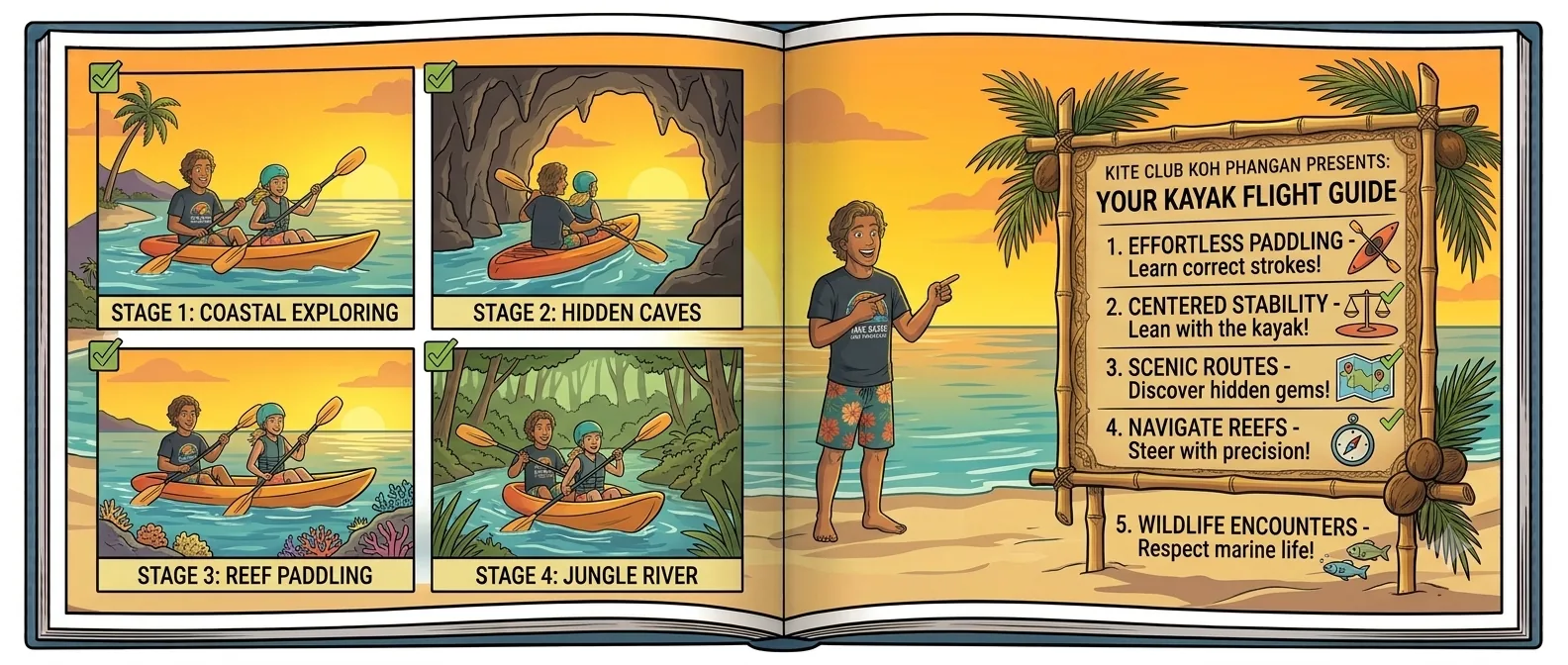
Kayaking Directly from Thong Sala Beach
Kite Club rents kayaks by the hour or for a full day from Thong Sala Beach. The immediate area around Thong Sala is calm — the west coast faces away from the open ocean swell, and there's no wind-driven chop in the early morning. You can be in the water within minutes of collecting your equipment.
From Thong Sala, the coastline runs north toward Hin Kong and south toward Baan Tai — both within comfortable paddling distance on a calm day. The southern stretch passes a few small rocky headlands with coral below — snorkel gear and an inflatable kayak paddle across glass-flat water before 9am is one of the better versions of a morning on this island.
Practical Information: What's Available
Kayak rental rates: 500 THB for 1 hour, 900 THB for 2 hours, 1,200 THB for 3 hours. Equipment included: paddle, life jacket, and dry bag for your phone. Single and double kayaks available. No experience necessary — staff give a 5-minute briefing before you head out.
The water in front of Thong Sala Beach is shallow for the first 150 metres from shore — waist-deep in most areas, sandy bottom. This means if you capsize, you can stand up. It's one of the few kayaking spots in Thailand where absolute beginners can paddle confidently without worrying about open water.
What You'll Actually See
The coastline between Thong Sala and Baan Tai has a mix of sandy beach, palm grove, and rocky sections where coral grows. The water is clear enough to see the bottom in 2–3 metres depth without needing to get in. Sea life in this area includes parrotfish, small reef fish around the rocks, and the occasional sea turtle passing through the deeper water.
Further north, the coast toward Hin Kong has a more rocky character — narrower beach, more shade, and you occasionally find the beach empty if you get out early. Round trip from Thong Sala is about 3 km and takes 1.5–2 hours at a comfortable pace with stops.
Best Time to Kayak on Koh Phangan
Kayaking works year-round on Koh Phangan because it's not wind-dependent. The best conditions are early morning (7–10am) when the sea surface is flat before the trade wind fills in. In the afternoon, especially during the SE season (February–April) and SW season (June–October), the wind builds to 15–25 knots — still kayakable but more physical.
If you're visiting during the off-season (October–November), when kite and wing foil lessons pause due to light and variable wind, kayaking is one of the best things to do. The island is quiet, the sea is calm, and you have the beach largely to yourself.
Rain-season note: May and early June can bring afternoon rain as the SW monsoon establishes. Morning kayaking still works fine. The rest of the SW season (July–September) is typically manageable with rain coming in short bursts rather than all day.
FAQ
No. The water in front of Thong Sala Beach is shallow and calm, especially in the morning before the trade wind builds. A short briefing from staff is all you need. Children and first-time paddlers manage fine here.
Some coral grows on the rocky sections of the coastline south of Thong Sala, accessible by kayak in 20–30 minutes. For more extensive reef, the north of the island (around Chaloklum) and the east coast have more developed underwater life — those trips are better done with guided tours as the distances are longer.
Light rain while kayaking is generally fine — you're getting wet anyway. If a heavier squall moves in, the west coast has shelter options along the shore. We advise going out early morning when conditions are calmest and rain is least likely.
Rent a Kayak at Thong Sala Beach
Kite Club Koh Phangan · Thong Sala Beach · Available daily · From 500 THB/hour
Book via WhatsAppThe Coastline You Can Only Reach by Kayak
Koh Phangan's coastline stretches for approximately 45 kilometres, and a significant portion of it is accessible only by water. The road network follows the inland contours of the island, leaving the western and northwestern coast — punctuated by mangrove estuaries, rocky headlands, small sea caves, and uninhabited beaches — reachable only by sea. Kayaking is the ideal way to explore this territory because it moves at the speed of discovery: slow enough to notice the detail, quiet enough not to disturb the wildlife, and shallow enough to reach areas where motor boats cannot go.
The mangrove estuaries on the southwest coast are particularly rewarding for morning kayak expeditions. The mangrove root systems support a dense community of small fish, crabs, monitor lizards, and migratory bird species that are completely invisible from the road. Paddling through the channels between mangrove roots at low tide, with the water still and the light filtered through the canopy, is one of the genuinely meditative experiences available on the island. No prior kayaking experience is needed to navigate flat mangrove channels, and the enclosed nature of the estuary means there are no currents or waves to manage.
The rock formations along the headlands between Thong Sala and the southern tip of the island include several small sea caves and arch formations that are paddleable during calm conditions at low tide. These require more experience and judgement to navigate safely — the surge inside even small caves can be powerful — and should only be attempted with an experienced guide or after developing your own sea kayaking skills in calmer environments first. However, even passing by these formations at a respectful distance in a standard rental kayak provides views that are impossible to access any other way.
Kayak Rentals: Options and Pricing
The school offers sit-on-top kayak rentals by the hour or for half and full days. Sit-on-top kayaks are the appropriate choice for tropical recreational kayaking — they are stable, easy to remount if you fall off, and require no cockpit entry technique. Single kayaks are available for solo paddlers, and double kayaks are popular for couples and parents with children.
| Duration | Price | Best Use |
|---|---|---|
| 1 hour | 500 THB | Introduction, short coastal paddle, beach exploration |
| 2 hours | 900 THB | Mangrove estuary exploration, longer coastal route |
| 3 hours | 1,200 THB | Half-day expedition, multiple stops, proper coastal exploration |
Equipment included with all rentals: paddle, life jacket, waterproof bag for personal items. A basic paddling briefing is provided for first-time kayakers covering proper paddle technique, turning, and water safety guidelines. This takes approximately 10 minutes and is sufficient to get most people confidently on the water.
Physical Benefits and Cross-Training Value
Kayaking builds upper body and core strength that translates directly to kitesurfing and wing foiling performance. The pulling motion of paddling develops the latissimus dorsi and rhomboid muscles that stabilise the shoulder joint during extended kite bar holding. The rotational component of each paddle stroke develops the oblique core muscles that provide stability during water starts and gybes. Students who add two or three kayaking sessions to their week of kitesurfing instruction consistently report less shoulder fatigue and better core stability in their kite sessions compared to students who rest completely on non-kite days.
The balance skills developed on a sit-on-top kayak in choppy conditions also transfer to board sports. Adjusting your weight and body position continuously to maintain stability on a moving platform in moving water is fundamentally the same skill required for kite board riding, e-foiling, and wing foiling. Kayaking provides a low-stress environment to practise this balance skill without the cognitive load of managing a kite or a motor simultaneously.
Local Insight
The best kayaking conditions at Koh Phangan are early morning (7–10 am) before the sea breeze builds. The water is typically flat and glassy, the light is beautiful for photography, and the absence of wind makes paddling effortless. Afternoons can be choppy and paddling against a 20-knot headwind on the return leg is exhausting. Plan your route so that the morning leg goes against any slight current and the return is downwind.
Combining Kayaking With Other Activities
Kayaking pairs naturally with snorkelling at several offshore reef locations that are 15–25 minutes from the school beach by kayak. The school can advise on current reef conditions and specific spots worth visiting. Bringing a snorkel mask and fins in the waterproof bag provided with the kayak rental transforms a standard paddle into a combined water sports session. The reef diversity around Koh Phangan is not as spectacular as it was before widespread coral bleaching events, but there are still active sections with good fish populations, particularly on the eastern side of the southern headlands where the water is cleaner and the current brings nutrients from the open Gulf.
On days when the wind is too light for kitesurfing lessons but too strong for comfortable flat-water kayaking, stand-up paddleboarding offers an intermediate option that provides similar benefits. The school offers SUP rentals from 400 THB per hour on the same beach, allowing a mixed activity day when conditions are between ideal for both sports. Many visitors structure their non-kite days around a kayak exploration in the morning and a SUP session in the afternoon, creating a full day of water-based activity with completely different character across the two sessions.
Kayaking FAQs
Do I need kayaking experience to rent?
No experience is required for a standard sit-on-top kayak rental on calm coastal water. The briefing provided covers everything needed for a safe enjoyable paddle. Children from approximately 8 years upward can paddle independently in double kayaks with an adult. Children under 8 should share a double kayak with a parent.
Is it safe to paddle alone?
Solo paddling in calm conditions close to shore is safe and common. Stay within 200–300 metres of shore on solo paddles and keep a life jacket on at all times. If paddling to more exposed headlands or the mangrove areas further from the school, paddling with a partner is advisable.
The Fauna of the Coastal Waters: What You Will Encounter
The Gulf of Thailand waters around Koh Phangan support a remarkable range of marine life that is often encountered on coastal kayak paddles. The most commonly observed species are not the dramatic headline animals of the deep ocean, but the abundant and accessible creatures of the nearshore environment: schools of mullet breaking the surface ahead of your kayak, reef herons standing motionless on exposed rocks, egrets patrolling the mangrove edges, and the occasional sea turtle surfacing to breathe before diving again.
Bioluminescent plankton is an experience specific to after-dark paddling that visitors who manage to arrange an evening session consistently describe as the most memorable water experience of their trip. When the water around Koh Phangan has good plankton concentrations — typically June through September — every paddle stroke in the darkness produces bursts of blue-green light as the disturbed water triggers the organisms' bioluminescence response. The kayak hull leaves a glowing wake. Swimming during a bioluminescent paddling session produces an effect that photographs cannot capture and descriptions cannot fully prepare you for. The school can advise whether current conditions are good for bioluminescent evening paddles during your visit.
Monitor lizards are frequently seen in the mangrove areas on the southwest coast. These can reach 1.5 metres in length and are occasionally startling when they emerge from the vegetation near your kayak, but they are entirely harmless and typically flee in the opposite direction. Macaque monkeys can be heard in the forest behind the coastal mangrove fringe on the quieter southwestern sections of the coast. Dolphin sightings occur occasionally in the channel between Koh Phangan and Koh Samui, particularly in the early morning before boat traffic builds.
Route Planning for Different Duration Rentals
The one-hour rental is best suited for a simple coastal paddle along the beach in front of the school, possibly extending to the nearest headland and returning. The primary purpose is introduction and enjoyment rather than destination-focused exploration. The one-hour paddle is excellent for children, for people who want to try kayaking for the first time in a safe environment, and for riders who want a gentle physical session on a rest day from kitesurfing.
The two-hour rental allows a meaningful coastal exploration: paddling approximately 2–3 kilometres in one direction, with time at a destination point before returning. Good two-hour routes include the paddle to the mangrove estuary mouth on the south side of Thong Sala bay, with time to explore the estuary entrance before returning. A return journey to a small beach to the north of the school with a swimming stop is another popular option. The instructor at the school can draw a simple map of current recommended routes depending on tide and wind conditions at the time of your rental.
The three-hour rental is for people who want a genuine exploration rather than a casual paddle. Routes of 5–8 kilometres are achievable in 3 hours while maintaining a relaxed pace with stops. The most rewarding three-hour route heads south along the west coast from Thong Sala, rounds the southern headland, and returns along the sheltered eastern edge of the bay — a loop that covers varied coastline including rocky headlands, sandy coves, and the entrance to a small estuary. This route is tide-dependent and should be confirmed with the school before setting out.
Local Insight
The best single piece of kayaking advice for Koh Phangan is this: go earlier than you think you need to. The window before 9 am has the flattest water, the best light for the coastal scenery, the most birdlife activity, and the fewest motor boats. The school opens for rentals at 8 am during peak season. An 8 am departure means you are on the water before the wind builds and back at the school in time for a 10 am kitesurfing session.
Booking and Availability
Kayak rentals are available any day of the year regardless of wind conditions, which makes them a valuable option on the days when kitesurfing and wing foiling are not possible. Advance booking is recommended during peak season (December–April) when demand for all water activities at the school is highest. To book, contact the school via WhatsApp at +66 96 720 3910. Same-day bookings are accepted when availability allows.
Frequently Asked Questions
Do I need to book kayaks in advance?
During peak season (December–April) advance booking is recommended as demand is high. For other months, same-day booking is usually possible. Contact the school via WhatsApp (+66 96 720 3910) to check availability and confirm your preferred time slot.
Can I take a kayak to another beach?
Yes — coastal kayak trips to nearby beaches are popular and allowed within the conditions of the rental. The school will advise on current sea conditions and recommend suitable routes based on your experience level and the time available. One-way trips to a specific destination with transport back by road are possible with some organisation.
Are life jackets provided?
Yes — a life jacket is included with every rental and wearing it is required for all rentals. The life jackets are buoyancy aid style, appropriate for calm water paddling, and do not restrict arm movement significantly. Children's sizes are available for younger paddlers.
What should I bring on a kayak rental?
Bring sunscreen (and reapply it), a waterproof case or bag for your phone and valuables, water, and snacks for longer rentals. The waterproof bag provided with the rental is sufficient for keeping items dry during normal paddling. Wear clothing you are comfortable getting wet in — capsizes are unlikely on calm days but possible.
Kayaking at Koh Phangan is available year-round and requires no advance booking in most months. The school is located at Thong Sala Beach and kayaks are launched directly from the school area. All equipment is included in the rental price and equipment orientation takes approximately ten minutes. The school team monitors sea conditions and will advise on whether your planned route is appropriate for current conditions — their local knowledge of tides, wind patterns, and current positions is a valuable resource that complements any route planning you do independently. For multi-day visitors, combining one or two kayak sessions with kitesurfing lessons creates a balanced programme that develops different but complementary physical skills and provides variety when the primary activity is weather-dependent. The school welcomes enquiries about custom combinations and multi-day packages that mix different water activities.
Kayak rental at Koh Phangan: one hour at 500 THB, two hours at 900 THB, three hours at 1200 THB. The island coastline offers extraordinary paddling routes accessible only from the water, from mangrove channels and sea caves to hidden beaches that remain pristine because they have no road access. Book via WhatsApp +66 96 720 3910. The school provides all equipment including paddle, life jacket, and waterproof bag for valuables.
Koh Phangan kayaking combines world-class coastal scenery with the quiet intimacy of human-powered exploration. The island is best appreciated from the water, where the perspective reveals beach accesses, rock formations, and marine life invisible from the shore. All paddlers receive a brief safety orientation and route recommendations tailored to their fitness level and available rental time.
Rentals available daily.