Contents
Who Can Rent Equipment
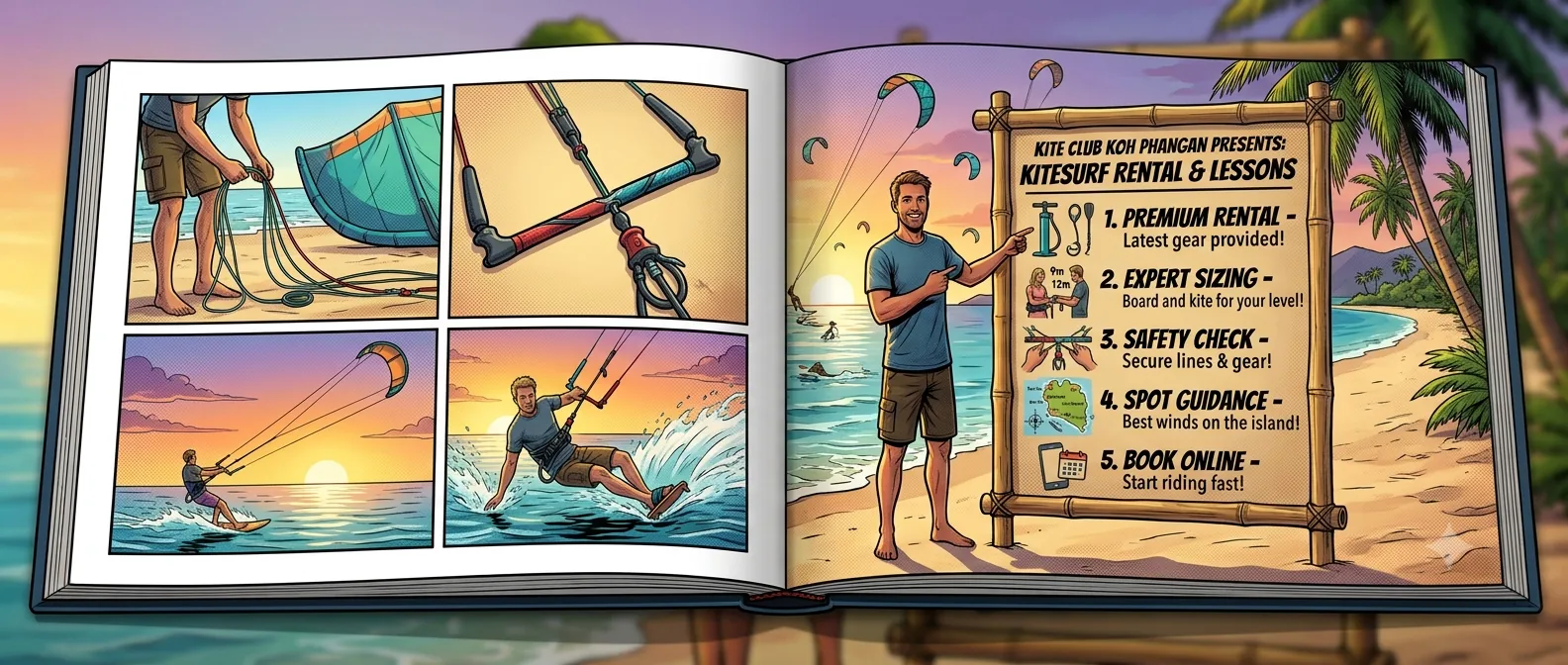
Equipment rental at Kite Club Koh Phangan is available to riders who hold at least an IKO Level 3 (Independent Rider) certification. This standard exists for safety — at IKO Level 3 you can self-rescue, relaunch a downed kite, and manage standard beach and water hazards without instructor support. If you do not yet have IKO Level 3, a lesson package is the right starting point.
Available Equipment and Prices
| Equipment | Condition | Price/Day | IKO Level Required |
|---|---|---|---|
| Kite (9m–14m) | Mint / good | 800–1,200 THB | Level 3 |
| Kite + bar + lines | Full set | 1,000–1,500 THB | Level 3 |
| Twintip board | Various sizes | 400 THB | Level 3 |
| Full kite package | Kite + board + harness | 1,500–2,000 THB | Level 3 |
| Wing (3m–6m) | Various sizes | 500–800 THB | IWO Beginner |
| Wing + board | Full set | 1,000–1,300 THB | IWO Beginner |
What You Need Before Renting Independently
Before collecting any rental equipment you will need to show:
- Valid IKO or IWO certification (physical card or digital)
- A damage deposit (variable by equipment value)
- Basic equipment check-out: demonstrating kite launch and land procedure to the on-duty instructor
The equipment check-out takes 5 minutes and is primarily to confirm you are comfortable with the specific kite model you are renting.
Conditions at Thong Sala for Rental
Thong Sala Beach is a flat-water bay with consistent side-shore wind. This is ideal for independent riding: drift puts you along the beach rather than offshore, relaunch in shallow water is straightforward, and the bay is wide enough for long runs without turning every 30 seconds. Peak season (February–April) delivers 15–22 knots most days. The second season (June–August) averages 12–18 knots — slightly lighter but still rentable conditions for most kite sizes.
Rental vs Lesson: What to Choose
If you are an experienced rider from another location, rental is often your fastest path to water time. If you have not kitesurfed in 6+ months or want to practise a specific skill, booking an hour of coaching alongside rental gets you much more out of your session. Kite Club offers both as standalone services.
How to Book
Contact Kite Club via WhatsApp (+66 96 720 3910) with your planned date, IKO level, and preferred kite size range. For peak season rentals, booking 24–48 hours in advance is recommended as popular kite sizes (12m–14m) are in high demand. Walk-in rental is often available in the morning before 9:00 if equipment is not pre-booked.
Frequently Asked Questions
Ask About Rental
Kite Club Koh Phangan · Thong Sala Beach · +66 96 720 3910
Book via WhatsAppWhat to Expect from Kite Equipment Rental
Kite equipment rental on Koh Phangan serves two distinct groups of riders: certified kiters visiting the island who want to session without transporting their own gear, and students who have recently completed a course and want supervised independent practice time to consolidate their newly learned skills. Understanding which category you fall into determines how to approach the rental conversation, what equipment will be selected for you, and what level of beach support you should expect during your session. For visiting certified riders, the rental process begins with a brief assessment of your certification level, years of experience, and preferred kite sizes, allowing the team to match you with appropriately sized equipment from the school's rental fleet. The fleet at Kite Club Koh Phangan includes current-generation kites from leading brands in sizes covering the full wind range typically encountered during the March-April peak season, from seven-meter kites for the occasional stronger day to fourteen-meter kites for the lighter twelve-to-fifteen knot days that characterize some mornings in January and February. Board selection follows kite selection and depends on your preferred riding style — beginners and recent graduates benefit from the larger, more stable twin-tip boards that provide a forgiving platform for building water-start consistency, while intermediate riders comfortable with directional riding may request dedicated surf-style shapes available in the rental fleet. All equipment is rigged by the school team before your session, checked for safety, and unrigged after, eliminating the time and technical knowledge requirement of self-rigging that can be a barrier for visiting riders unfamiliar with specific equipment brands or connection systems. The rental fee includes bar and lines, harness, board, and the brief pre-session equipment orientation that ensures you are comfortable with the specific safety release mechanisms before entering the water.
The rental equipment at the school is maintained to lesson-quality standards rather than the reduced standard sometimes applied to rental fleets at less rigorous operations — kites are inspected for bladder integrity and canopy damage before each session, lines are checked for length discrepancy and wear, and bars are verified to have functional safety release systems before any rental rider takes equipment into the water. This maintenance standard adds to operational costs but reflects the school's position that rental riders deserve the same safety assurance as students receiving formal instruction. A kite that depowers inconsistently, a bar with sluggish release, or a board with damaged fins can turn a pleasant rental session into a dangerous one, and the investment in preventive maintenance avoids the situations that create both injury risk and reputational damage. Rental riders are asked to report any equipment issue immediately after their session, including minor items like a stiff quick release, a leaking bladder valve, or fin screws that have worked loose — this feedback system ensures that small issues are addressed before they become significant problems that compromise the next user's session. The team at the school can also assist visiting riders with equipment decisions if they are considering purchasing their own gear, offering honest advice about which kite and board combinations suit Koh Phangan conditions specifically and which brands offer the best value-to-quality ratio at the price points that fit a given rider's budget.
Kite Sizes and Conditions for Rental Sessions
Choosing the right kite size for rental sessions requires understanding how Koh Phangan's wind conditions differ from the home spots where visiting riders have developed their intuition about size selection. The Gulf of Thailand wind at Thong Sala Beach is predominantly offshore in direction during the peak season, creating a clean and consistent pressure that feels different from the gusty, cross-shore winds that characterize many European kite spots — many visiting riders initially underestimate how much kite power is available in what seems like moderate wind because the smoothness of the pressure disguises the real speed. Local instructors recommend that visiting riders use slightly smaller kites than they would at home for their first session on the island, allowing time to calibrate to the local wind character before increasing kite size. The wind at Thong Sala also tends to increase through the morning as the land heats up and the thermal effect reinforces the trade wind, meaning that a kite session started in fifteen knots at nine in the morning can develop into twenty-knot conditions by eleven — oversizing your kite for expected morning wind can create an overpowered situation by midday that ruins the session and potentially creates safety issues. Our team checks the morning forecast and current anemometer readings before every rental session and communicates this information clearly, helping visiting riders make informed size decisions based on actual rather than estimated conditions. The typical peak season rental session uses a ten-or eleven-meter kite in fifteen to twenty knot winds, providing a comfortable power level for riders of average body weight who have standard intermediate-level skills and want to focus on riding enjoyment rather than maximum performance.
Expert Tip
Always ask about the wind trend before selecting your kite size — is it building, steady, or dropping? A steady fifteen knots at session start might be eighteen by the time you're on the water and twenty by midday. Sizing for the peak rather than the start prevents the overpowered middle-session situation that is both uncomfortable and increases risk significantly.
Post-Course Practice Rental for New Graduates
Students who have recently completed an IKO Beginner or Independent course at the school have access to a supervised practice rental structure designed specifically to bridge the gap between formal instruction and fully independent riding. This structure recognizes that newly certified riders have demonstrated sufficient competence to ride independently but often benefit from having an instructor available on the beach to observe their sessions, identify technique issues that were not evident during lessons, and provide targeted feedback that accelerates progress beyond what unsupervised practice alone can achieve. Post-course practice sessions are scheduled in advance and are typically available in two-hour blocks during the main wind window, with the instructor positioned on the beach and available for consultation rather than standing next to the student as during formal lessons. The instructor-observation model mimics the learning environment of more advanced riding stages where self-assessment and feedback from watching coaches becomes more important than direct hands-on instruction. Recent graduates who participate in three to five post-course practice sessions before their next formal lesson typically show significantly more consistent water starts, more stable riding position, and more confident kite control than graduates who return home immediately after their course and do not practice again until their next visit. Equipment for post-course practice rental is the same beginner-appropriate gear used during lessons — stable kites with forgiving power delivery and large twin-tip boards that maximize water-start success rate — allowing the rider to focus on skill development rather than managing challenging equipment before their technique is ready for it.
Frequently Asked Questions — Kite Rental Koh Phangan
What certification do I need to rent equipment independently? We require a valid IKO Level 2 certification or equivalent from a recognized certifying body for fully independent equipment rental. Riders with other certification types or self-taught background are assessed with a brief water check before equipment is issued, ensuring that independent rental riders have the safety-release competence and kite control standard needed to manage themselves without direct instructor supervision on the water. Contact us via WhatsApp at +66 96 720 3910 to discuss your specific certification and experience before arriving.
Can I rent equipment by the hour rather than per session? Our standard rental unit is a full session of approximately two hours, which represents the minimum practical time for a meaningful riding experience including rigging, session, and de-rigging. Hourly rental is not offered as a separate format since the logistics of equipment preparation and post-session inspection make sub-two-hour rentals impractical for both the rider and the operations team. Sessions can extend beyond two hours when wind and conditions allow, and the team will communicate any scheduling constraints that affect the available window for your rental block.
Is it possible to try different kite brands during rental sessions? Yes, within the constraints of the current fleet inventory. The rental fleet includes kites from multiple leading brands, and visiting riders who want to evaluate different models as part of a gear purchase decision can request specific brands when booking. We recommend mentioning your equipment evaluation intent when booking so the team can ensure your preferred demo models are available and properly prepared for the session date you have in mind.
Choosing the Right Session for Your Level
The rental experience on Koh Phangan varies substantially depending on whether you are a visiting certified rider, a recent course graduate, or an intermediate rider returning after time away from the sport. For visiting riders with solid intermediate skills, the school's rental fleet offers a genuine progression opportunity — access to high-performance kites and smaller boards in a location where consistent peak-season winds allow you to push your limits safely within a familiar supervised environment. Intermediate riders who have been riding twin-tip boards at home and want to try a directional board or experiment with a smaller kite size for the first time can use rental sessions as low-pressure testing opportunities before committing to equipment purchases. The team at Kite Club can recommend specific kite-and-board combinations from the rental fleet that address particular skill goals, whether that is developing carving technique, practicing jumps in the shallow-water zone, or experimenting with the boosted power delivery of newer kite designs compared to older equipment you may have at home. Advanced rental riders who are confident in their self-rescue ability and kite management can also access the deeper water zones further from the immediate beach area, where longer rides and more consistent wind allow higher-intensity practice without the interruptions common in the crowded beginner zone near shore. The rental team assesses each rider's skill level before issuing equipment and applies appropriate size recommendations based on both the rider's stated experience and the observed quality of their beach rigging and pre-launch safety checks — riders who demonstrate solid safety awareness receive more flexibility in their equipment selection than those whose pre-launch behavior suggests limited experience.
The most common rental mistake is choosing equipment that is too small or too advanced for the rider's actual current skill level, typically driven by the understandable desire to use the same equipment sizes as the local advanced riders who make the sport look effortless. Koh Phangan's peak season wind averages eighteen to twenty-two knots during prime conditions, and a rider who normally sessions in twelve to fifteen knots at their home spot will find this noticeably more powerful even on equipment they would normally consider a comfortable size. Starting one kite size larger than your instinct suggests for the first session on the island is consistently good advice from the local team, allowing you to calibrate to the local wind character before pushing your limits with smaller high-performance equipment. The same principle applies to board selection — riders transitioning to smaller boards or directional shapes should do so on days with moderate rather than maximum wind, giving themselves the bandwidth to manage the equipment learning curve without the additional challenge of overpowered conditions. Our rental team has seen enough visiting riders learn this lesson the hard way to be genuinely invested in helping you avoid the frustrating session that comes from equipment mismatched to both your skill level and the specific conditions of the day.
Booking Your Rental Session
Booking a rental session at Kite Club Koh Phangan requires only a brief WhatsApp message to +66 96 720 3910 stating your certification level, preferred date and time, and any equipment size preferences based on your experience. The team will confirm availability and advise on conditions for your preferred date based on the multi-day forecast, helping you identify the best sessions within your available window rather than booking slots that may turn out to be light wind or no-wind days. Same-day booking is sometimes possible for visiting riders who see good conditions and want to session immediately, though advance booking of at least twenty-four hours is strongly recommended during peak season when the school operates at full capacity and rental equipment availability is more limited. Payment is made on the day of the session in Thai baht, and the school can direct you to the nearest reliable ATM in Thong Sala if you need to arrange currency before your session begins. After your session, the team will de-rig and store equipment, giving you a brief window to ask any technique questions before the next group of students arrives for their lesson block. The rental experience at the school is designed to feel like a natural extension of the learning environment rather than a commercial transaction — the team genuinely wants every session to be productive and enjoyable, and their interest in your session outcome extends well beyond the completion of the rental agreement.
Rental sessions are available daily during peak season. Contact us via WhatsApp at +66 96 720 3910 to confirm your certification level, check current equipment availability, and book your preferred session time with at least twenty-four hours advance notice whenever possible.