Contents
Age and Weight Requirements
Kite Club Koh Phangan accepts students from age 14 for standard kitesurfing lessons. The minimum is based on physical requirements — kite control requires enough upper body strength to manage bar tension and enough weight to resist the kite's pull in the water. A 14-year-old at 45+ kg can typically manage a trainer kite and progress to small full kites.
Students under 16 must have a parent or guardian present on the beach during all lessons. They do not need to participate, but they must be visible and contactable throughout the session.
Why Young Riders Learn Quickly
Teenagers and young adults consistently learn kitesurfing faster than adults. The main reasons:
- Fear factor: younger riders have less accumulated fear response to falling — they fall, laugh, and try again
- Balance: younger riders have lower centre of gravity and stronger proprioception development
- Neuroplasticity: motor learning is faster in teenagers than adults over 30
- Energy: 2 hours of kitesurfing is tiring; younger riders recover faster between attempts
Safety Considerations for Junior Riders
Safety protocols for junior students are identical to adults with three additional steps:
- The emergency release and self-rescue sequence is practised on land at least twice before water entry
- A designated beach spotter is assigned to junior sessions in addition to the in-water instructor
- Junior riders use slightly smaller kites than their weight would normally suggest, reducing power in gusty conditions
Equipment Adjustments for Younger Students
Kite size is the primary adjustment. A 45 kg student in 15 knots who would normally use a 9m kite will be started on a 7m–8m to give more margin for gust response. Boards are also adjusted — lighter riders use smaller boards as the extra volume of a full-size beginner board is unnecessary and makes carrying the equipment more difficult.
Lesson Format for Kids and Teenagers
The lesson format is identical to adult lessons — beach theory, trainer kite, body drag, board attempts — with two adjustments: more frequent breaks (every 25 minutes instead of 40) and slightly slower pacing through the body drag phase. The IKO teaching framework specifies minimum competency standards at each level regardless of age, so junior students receive the same certification as adult students when they complete each level.
After the Course: Riding Independently
A junior student who completes the Independent Rider Course (IKO Level 3) can rent equipment independently at any IKO-affiliated school worldwide. This is useful for families who travel: a teenager certified on Koh Phangan can rent equipment in Brazil, Egypt, or South Africa on the same certification card.
Other Activities for Younger Children
For children under 14 or those not yet ready for kitesurfing, Kite Club offers e-foil sessions (minimum age 14 for solo operation, younger with instructor in tandem) and kayaking or SUP rental with no age restriction. The beach itself is safe for swimming and the area around Thong Sala is family-friendly year-round.
Frequently Asked Questions
Book a Kids Kite Lesson
Kite Club Koh Phangan · Thong Sala Beach · +66 96 720 3910
Book via WhatsAppLearning Progression for Young Riders
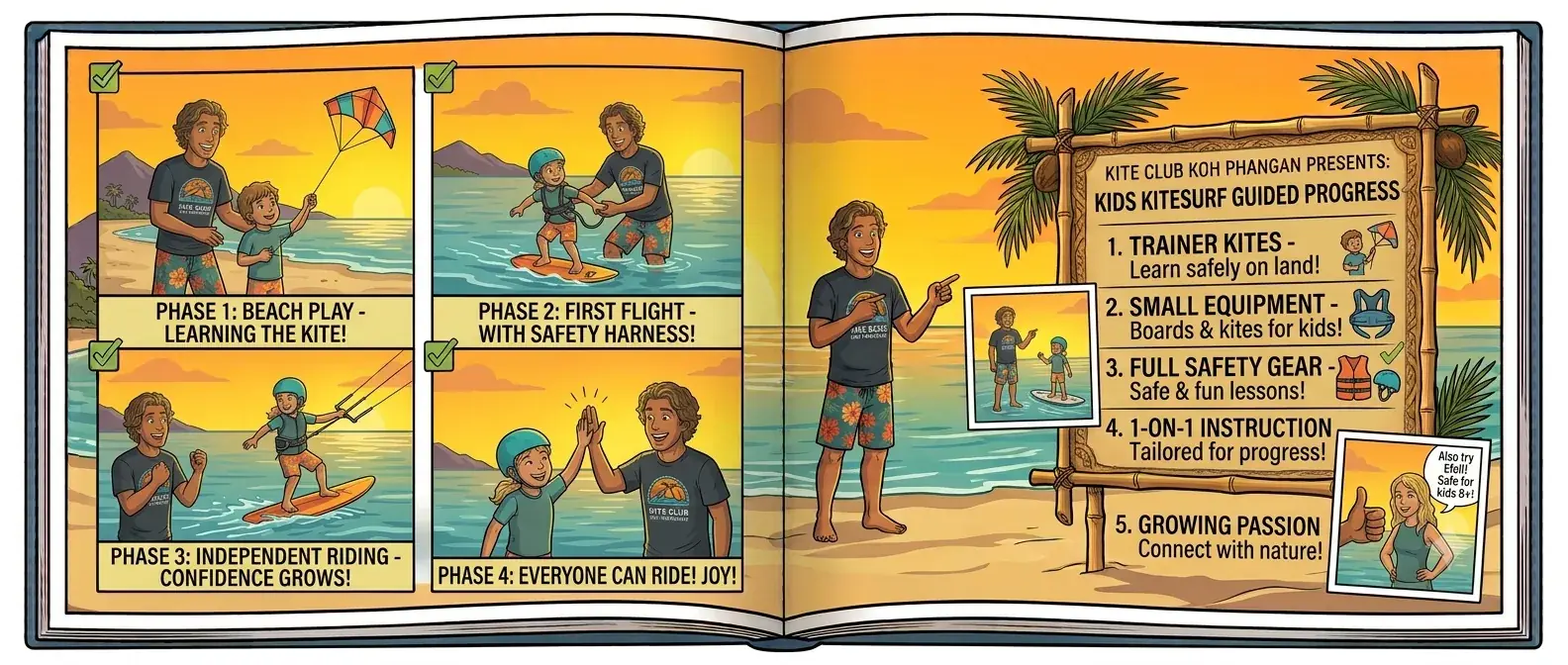
Children progress through kitesurfing differently from adults, and understanding that progression helps parents set realistic expectations and keeps young riders motivated throughout their journey. The typical young student begins with ground-based kite control using a small two-line trainer kite, spending the first session entirely on the beach learning how wind interacts with a kite through feeling rather than through verbal theory. Young learners are remarkably tactile and intuitive, often developing bar pressure sensitivity faster than adult students who overthink every input. What they lack in upper-body strength they make up for in flexibility, low center of gravity, and the fearlessness that comes from not fully understanding consequence — a genuine advantage in water sports learning environments. The beach phase for young students usually takes one full session before they are ready to handle a real four-line kite with a qualified instructor directly beside them in shallow water. Our instructors at Koh Phangan use assistant kite handles during this phase, meaning they can intervene instantly if the kite develops unexpected power, allowing the young student to experience real kite feel without genuine risk. Parents watching from the beach often remark that their children look completely natural in the water within the first thirty minutes of this critical phase.
The body drag phase represents a major milestone for young kite students, and the shallow sandy bottom at Thong Sala Beach makes it particularly suitable for children of all sizes. Water depth of sixty to ninety centimeters in the training zone means young students can stand at any moment, eliminating the anxiety that comes with deep water and allowing them to focus entirely on kite control rather than self-preservation instincts. The body drag itself teaches children how to use kite power for directional movement without the complication of a board underfoot, building the foundational skill of redirecting generated force through their body rather than resisting it. Most young students complete their first intentional body drag across fifty meters of water by their second or third lesson, generating genuine excitement and accomplishment that fuels continued motivation. The instructor positions themselves within three meters at all times during this phase, ready to grab the safety leash if the kite generates unexpected power during a gust or sudden direction change. Young riders who successfully complete the body drag phase have effectively learned the hardest single skill in kitesurfing — everything after this point builds incrementally on that demonstrated capability. By the end of the body drag phase, most children between ten and fourteen have accumulated enough kite feel to attempt their first board mounting attempts in very light wind conditions.
The board stage for young riders requires careful calibration of equipment size to physical capabilities. Standard beginner boards used for adults are often too large and heavy for younger students, reducing their ability to manipulate the board during water starts and slowing their progress significantly. We use shorter, lighter boards for young students that are easier to position correctly during the water start sequence and respond more sensitively to weight distribution once the rider is standing. Foot binding placement is also adjusted closer together than the adult standard, accommodating the shorter leg span of young riders and creating a more stable platform for their first independent rides. The water start itself, which involves coordinating board position, foot pressure, and kite power simultaneously, takes most young students between two and five attempts before the mechanics click into place. Once the water start is achieved, young riders typically progress to riding consistently within two to three additional sessions, as their natural balance and low center of gravity work significantly in their favor. The sensation of riding independently for the first time produces a level of joy and pride in young students that is one of the most rewarding things an instructor can witness across an entire teaching career.
Family Kitesurfing at Koh Phangan
Koh Phangan has quietly become one of Southeast Asia's best destinations for families who want to learn watersports together, and kitesurfing specifically benefits from the island's combination of consistent wind, warm shallow water, and relaxed beach culture that accommodates all age groups. Families travelling together can structure their holiday so that adults take intensive lessons while children receive age-appropriate instruction at the same beach, then come together in the afternoons for supervised practice sessions where everyone demonstrates their progress to each other. Our school accommodates family bookings with flexible scheduling that accounts for the reality that children often need shorter sessions with more rest between activities, typically capping young student water time at ninety minutes before transitioning to beach games, snorkeling, or exploring the nearby tidal pools. Parents learning simultaneously with their children creates a powerful motivational dynamic — young riders are often more determined to progress when they can see their parents also struggling with the same equipment and techniques they are mastering. Several families have told us that their kitesurfing holidays represented the most connected time they had spent together in years, partly because the shared challenge of learning stripped away the usual digital distractions and created genuine common ground. The island's compact geography means the kite beach, accommodation, restaurants, and other activities are all within a short tuk-tuk ride, reducing the logistics stress that makes family travel exhausting in larger destinations. Evenings on the island offer family-friendly dining along the beach road, with many restaurants catering specifically to the international families and long-stay visitors who form a significant part of Koh Phangan's non-full-moon-party tourism segment.
Practical planning for a family kitesurfing holiday starts with honest assessment of each family member's physical readiness for the sport. Children under ten typically lack the upper-body endurance and sustained attention required for productive kite lessons and are better served by the school's other offerings including paddleboarding, kayaking, and e-foil introductions, which require less continuous physical effort and are equally exciting for young visitors. Teenagers between fourteen and eighteen are often the fastest learners in the family group, combining the physical capability of adults with the risk tolerance and adaptability of young people, and frequently progress faster than their parents within the same number of lesson hours — a dynamic that parents often find both humbling and delightful. For the adults in the family, the key consideration is managing energy levels across a multi-day holiday — kite lessons are more physically and mentally demanding than they appear, and the temptation to schedule daily lessons can lead to fatigue that slows rather than accelerates overall learning progression. We recommend families structure their week with lessons on alternating days, using rest days for island exploration, snorkeling, or lighter activities that still keep the family connected to the water environment. Contact us via WhatsApp at +66 96 720 3910 to discuss a custom family schedule based on your holiday dates, the ages of all family members, and the experience levels of any who have previous watersports background. Our team speaks English, Russian, German, and Arabic, covering the majority of families who visit from Europe and the Middle East throughout the year.
Safety Framework for Young Riders
Safety protocols for young kite students extend beyond equipment modifications and encompass a complete operational framework governing how sessions are structured, supervised, and terminated when conditions change unexpectedly. Every young student session begins with a weather check that goes beyond assessing current wind — instructors evaluate the forecast for the entire lesson window to ensure approaching squalls, shifting wind direction, or building sea state will not create unsafe conditions mid-session when the student is already in the water and away from shore. Thong Sala Beach faces southeast and is protected from the dominant southwest swell by the island's geography, making it genuinely calmer than most Thailand kite spots, but local thermal effects can create short-duration gusts in the early afternoon that require instructors to monitor conditions continuously throughout each session. The instructor-to-student ratio for young students is always one-to-one, never the one-to-two or one-to-three ratios sometimes used for adult group lessons, ensuring the adult responsible for the student's safety is never distracted by another rider's simultaneous needs. Our rescue watercraft is always positioned within visual range of young student sessions, crewed by a qualified team member who monitors from the water and can respond within ninety seconds to any situation that develops in the teaching zone. Emergency procedures are reviewed with both the student and the accompanying parent before each session begins, including the specific actions the parent should take if they observe their child in apparent distress from the beach observation area. This operational framework adds time overhead to each session but represents non-negotiable standard practice for all young rider instruction at our school regardless of conditions.
Local Insight
Koh Phangan's water temperature stays between 28°C and 31°C year-round, meaning young riders stay comfortable in the water for full ninety-minute sessions without thermal fatigue or cold-water hesitation. This warmth, combined with the shallow sandy training area, makes the learning environment genuinely pleasant rather than endurance-focused — a significant advantage when working with young students whose motivation is easily affected by physical discomfort or cold stress.
Frequently Asked Questions About Kids Kitesurfing
What is the minimum age to start kite lessons at your school? We accept students from ten years old for formal kite instruction, though we assess each young student individually during an initial consultation before committing to a lesson plan. A ten-year-old who regularly swims, surfs, or practices other board sports will typically have the coordination and sustained attention capacity needed to make productive progress. Children under ten are very welcome for paddleboarding, kayaking, and e-foil introduction sessions, all of which are physically less demanding and equally exciting experiences for young visitors to the island.
Do parents need to be present during lessons? We require a parent or responsible adult to be present at the beach during all sessions for students under sixteen years of age. This serves several purposes: it allows immediate communication if session conditions change, ensures the parent can respond if their child needs assistance, and creates the motivational audience that young riders consistently benefit from during skill development. Parents are welcome to watch from the designated beach area and photograph or film sessions from a zone that does not interfere with the instructional process or create distractions for the student on the water.
Can a family book consecutive lessons throughout an entire week? Yes, and we actively encourage multi-day family bookings because sustained practice over several days produces dramatically faster progress than isolated single sessions separated by long gaps. We offer flexible scheduling that accounts for rest days and can combine kite lessons for some family members with paddleboard or kayak sessions for others on the same day, allowing the whole family to be active simultaneously even if interests vary. Contact us via WhatsApp at +66 96 720 3910 to discuss a custom family schedule based on your specific holiday dates and the ages and experience levels of all participating family members.
What happens if my child decides they do not want to continue mid-lesson? We follow the student, not the lesson plan, without exception. If a young rider loses motivation or becomes anxious during any part of a session, the instructor transitions immediately to a less demanding activity rather than pushing through resistance or anxiety. In practice this almost never results in stopping completely — usually a brief beach break, a change of activity from water to beach work, or simply letting the student rest in shallow water for ten minutes resets their motivation and willingness to continue. Our instructors have specific training in managing young students' emotional and motivational states and are genuinely skilled at rebuilding confidence after a difficult moment without making the student feel they have failed.
Building Long-Term Passion for the Sport
The most successful young kitesurfers are those who develop a genuine relationship with the ocean and wind beyond their formal lesson structure, treating each session as exploration rather than merely fulfilling a curriculum requirement. Encouraging young riders to spend time at the beach observing the wind, watching experienced riders, and asking questions about equipment and technique between lessons accelerates their development far more than simply accumulating instructed hours. Many of the world's best professional kite athletes began their journey as young teenagers who spent more time watching and discussing kite sessions than they did receiving formal instruction, developing a deep intuitive understanding of the wind environment before their physical skills had fully developed. The social dimension of kite culture is particularly important for young riders — connecting with other young students at the school, joining the WhatsApp group where riders share session reports and wind forecasts, and participating in the informal beach community creates lasting motivation that extends far beyond the holiday itself. Parents can support this process by treating the kite school not just as a lesson provider but as a community to which their child now belongs, encouraging continued engagement with that community through social media, online tutorials, and the eventual goal of returning to Koh Phangan for the next progression step when wind season arrives again.