Head-to-Head Comparison Table
| Factor | Koh Phangan | Koh Samui |
|---|---|---|
| Flat-water spot | Yes — Thong Sala lagoon | No dedicated flat-water kite beach |
| Peak season | Feb–Apr (SE), Jun–Aug (SW) | Similar, but windier spots exposed to swell |
| Beginner-friendly | Excellent — flat lagoon, sandy bottom | Limited — most spots have chop or obstacles |
| IKO schools | Yes — Kite Club KP (IKO + IWO) | Some schools, varying quality |
| Accommodation cost | Lower — budget from 400 THB/night | Higher — resort-heavy, 1,200+ THB/night typical |
| Vibe | Relaxed, backpacker-friendly, kite community | More tourist infrastructure, busier |
| Other water sports | Kite, wing, windsurf, e-foil, kayak, SUP | Mainly kite and motorised sports |
Kite Spots: Thong Sala vs Koh Samui
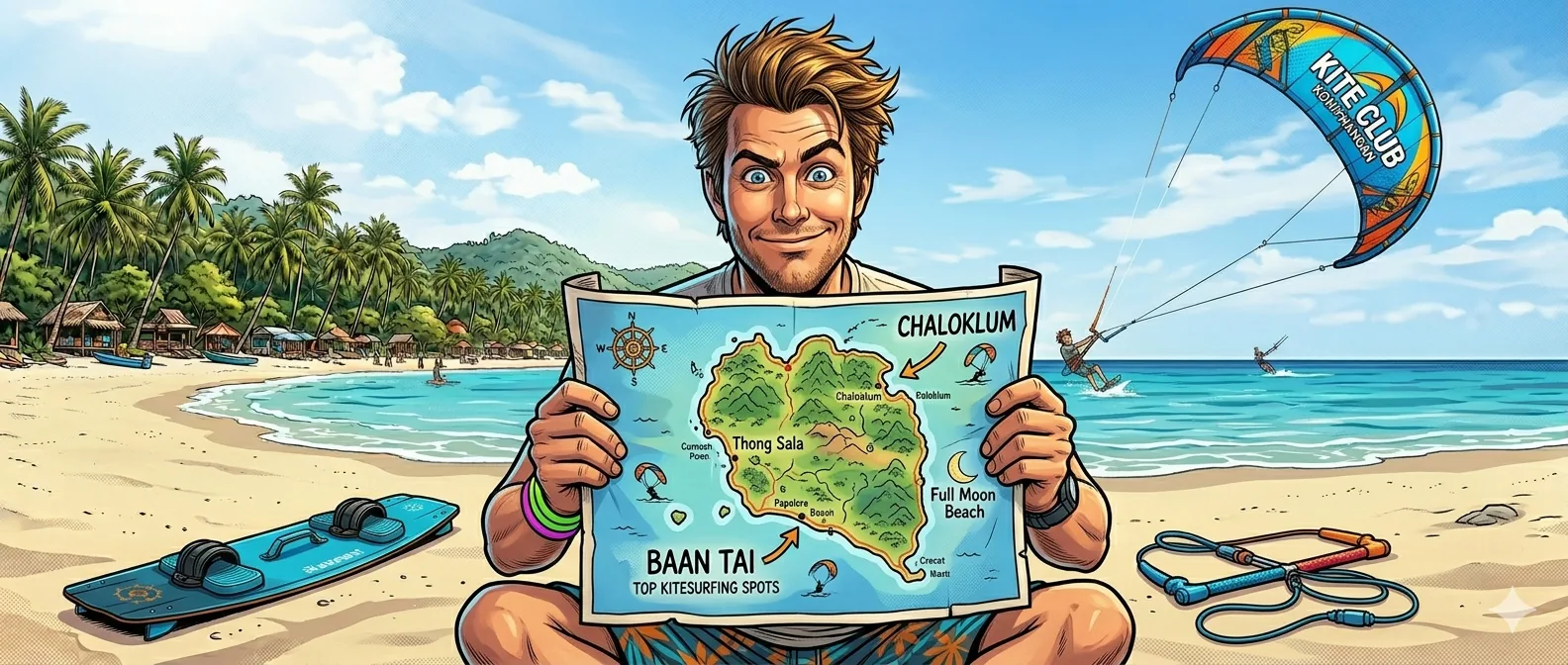
Koh Phangan has Thong Sala Beach on the west coast — a protected flat-water lagoon ideal for learning. Shallow (0.5–2m), sandy bottom, no boat traffic in the kite zone. It works in both the SE season (February–April) and the SW season (June–August). Two additional spots exist for advanced riders: Baan Tai (SW season) and Chaloklum (NE season).
Koh Samui does not have a comparable flat-water learning beach. The kitesurfing that does happen on Samui takes place at Bophut Beach (north coast) and occasionally Lipa Noi (west). Both have varying chop and more obstacles than Thong Sala. Kite schools exist on Samui but the conditions for beginners are less consistent than on Koh Phangan.
Wind Conditions
The two islands are close enough (30 km apart) that they share the same broad wind patterns — SE trade winds from January through April, and SW monsoon from June through August. In practice the wind at Thong Sala Beach is slightly more consistent than Samui's north coast because of the geography.
Peak wind speeds are similar: 14–22 knots in the SE season, 12–20 knots in the SW season. The key advantage at Koh Phangan is not the wind itself — it is what the wind blows across. Flat water at Thong Sala makes every knot of wind more usable for learning than the same wind over choppy conditions.
Learning Environment
For a beginner course, the physical environment matters as much as the instruction. Flat water shortens the time it takes to nail the waterstart — the hardest skill in the course. Chop adds unpredictability and exhaustion. The sandy shallow lagoon at Thong Sala is one of the best beginner learning environments in Southeast Asia.
At Koh Phangan, Kite Club operates an IKO and IWO certified school — you get a permanent internationally recognised certificate at the end of your course. If you need to stop mid-course (between trips), you continue from exactly where you left off at any IKO school worldwide.
Cost of Lessons and Accommodation
Lesson prices are broadly similar between the two islands — kitesurfing instruction costs roughly the same wherever you go in Thailand. The real cost difference is accommodation and food.
Koh Phangan remains significantly cheaper than Koh Samui. Budget guesthouses on Phangan start around 400–600 THB/night; mid-range bungalows 800–1,500 THB. On Samui, the same budget gets you noticeably less due to the higher density of resort hotels. A 10-day course trip to Koh Phangan will cost meaningfully less in total than the same trip to Koh Samui.
Getting There
Koh Phangan: fly to Koh Samui airport, then take the Lomprayah ferry (45 minutes). Or fly to Surat Thani on the mainland and take the ferry (2–3 hours). The ferry lands directly at Thong Sala pier — a 5-minute walk from the school.
Koh Samui: fly directly into Koh Samui airport (Bangkok Airways hub). More convenient if you are arriving internationally, but more expensive flight-wise. From Samui airport you need a taxi or songthaew to reach the kite beaches (20–40 minutes).
The Verdict: Which Island?
If your primary goal is to learn kitesurfing: choose Koh Phangan. Thong Sala Beach is a better beginner learning environment than anything Koh Samui offers, accommodation is cheaper, the atmosphere is more relaxed, and the IKO school infrastructure is stronger.
If you are already an experienced rider who wants a base with better international flight connections and does not need a flat-water beginner spot: Koh Samui is more convenient for transit. But for a dedicated kite trip — learning or progression — Koh Phangan wins on every practical measure.
FAQ
Koh Phangan is better for kitesurfing, especially for beginners. Thong Sala Beach offers a flat-water lagoon that Koh Samui does not have. Conditions are more consistent for learning, accommodation is cheaper, and the IKO school infrastructure is stronger on Koh Phangan.
Yes, there are kite schools on Koh Samui, primarily at Bophut Beach on the north coast. However, the conditions are less ideal for beginners than Koh Phangan — more chop, less consistent flat water. Many people fly into Samui and take the 45-minute ferry to Koh Phangan specifically for better kite conditions.
Lomprayah or Raja Ferry from Nathon Pier (Samui) to Thong Sala Pier (Koh Phangan) — approximately 45 minutes, multiple departures per day. The school at Thong Sala Beach is a 5-minute walk from the pier arrival point.
Koh Phangan is significantly cheaper for accommodation and food. Budget guesthouses start around 400–600 THB/night compared to 1,200+ THB on Samui for comparable quality. For a 10-day kite trip, the total cost difference is substantial.
Kitesurf at Thong Sala Beach
Kite Club Koh Phangan · Thong Sala Beach · +66 96 720 3910
Book via WhatsAppThe Detailed Comparison: Koh Phangan vs Koh Samui
The comparison between Koh Phangan and Koh Samui for kitesurfing visitors is fundamentally a comparison between two adjacent islands that share similar geography and wind patterns but have developed in very different directions as tourism destinations, producing an experience quality gap in the specific context of kite learning that is larger than the islands' physical proximity might suggest. Koh Samui is the region's major tourist hub with direct international flights from Singapore, Kuala Lumpur, and several Asian cities, five-star resort infrastructure, shopping centers, and the commercial services expected by the package holiday market that forms the majority of its visitor base. Koh Phangan is smaller, less developed, more focused on specific interest visitors — wellness seekers, long-stay travelers, backpackers, and increasingly serious wind sport students — and has maintained a character of genuine island culture rather than the resort-ification that makes Samui feel increasingly similar to other Asian beach destinations standardized for mass international tourism. For kite learning specifically, the infrastructure advantage lies entirely with Koh Phangan: the dedicated IKO and IWO certified school at Thong Sala Beach, the consistent access to the northeast trade wind that channels effectively into the southern bay, and the shallow sandy bottom of the training area combine to create a learning environment specifically suited to beginner and intermediate instruction that Samui's less consistent wind and more mixed coastal geography cannot match. The price differential reinforces the kite learning advantage: accommodation, food, transport, and activities on Koh Phangan are consistently twenty to forty percent cheaper than equivalent options on Koh Samui, making the island a significantly more cost-efficient base for visitors whose primary goal is maximizing kite session quality rather than resort amenity access.
Koh Samui's advantages over Koh Phangan are real but category-specific in ways that matter less to kite-focused visitors than to general beach holiday travelers. The airport infrastructure at Koh Samui USM reduces travel time significantly compared to the bus-and-ferry route to Koh Phangan, which matters for time-constrained business travelers or those connecting onward to other Asian destinations. The resort hotel range on Samui includes globally recognized luxury brands that provide a service standard and physical infrastructure Koh Phangan's accommodation market cannot fully match, relevant for visitors whose accommodation quality expectations align with that tier. The nightlife, shopping, and commercial entertainment on Samui serves travelers seeking the organized resort experience, while Koh Phangan's nightlife is either famously hedonistic at the full moon party end or genuinely quiet at the accommodation areas where serious kite students typically stay — neither extreme is a good fit for the mainstream resort holidaymaker who wants a moderate commercial entertainment scene. The medical and emergency services on Samui are more developed than on Koh Phangan, providing important comfort for visitors who have specific health concerns or who feel more comfortable knowing that comprehensive medical care is readily accessible if needed. None of these Samui advantages are relevant to the core kitesurfing experience, but for visitors who are considering kite learning as one component of a broader holiday that includes significant resort time, the specific combination of Koh Phangan for kite sessions and Koh Samui for resort days is entirely feasible given the forty-five minute ferry connection between the two islands.
Practical Logistics for Island Comparison
| Factor | Koh Phangan | Koh Samui |
|---|---|---|
| Access | Ferry from Surat Thani (2h) | Direct international flights |
| Kite school quality | IKO+IWO certified, dedicated | Limited options, seasonal |
| Wind consistency | Excellent Jan–Apr | Good but more variable |
| Water bottom | Sandy, shallow, ideal | Mixed, less consistent |
| Accommodation cost | 500–4000 THB/night | 800–8000+ THB/night |
| Food cost | 150–500 THB/meal | 200–800 THB/meal |
The practical reality for most kite-focused visitors choosing between the two islands is that Koh Phangan dominates on every dimension that directly affects kite session quality and learning progression. The ferry journey from Surat Thani to Koh Phangan, while longer than a flight to Samui, is comfortable, affordable, and scenically pleasant in ways that domestic flights rarely are — the boat ride through the Gulf of Thailand with its gradually appearing island silhouettes is itself a memorable component of the journey rather than a logistical inconvenience to minimize. Visitors coming from Europe via Bangkok can reach Koh Phangan by overnight train to Surat Thani and morning ferry without any additional domestic flights, reducing both cost and the carbon footprint of the internal Thailand segment of the journey. The arrival at Koh Phangan's Thong Sala pier deposits visitors directly into the main commercial hub of the island, within walking distance of multiple accommodation options, the kite school, and the restaurant and market infrastructure needed for daily life — a logistically convenient arrival that requires no additional transfer to reach your destination. For visitors committed to kitesurfing as their primary holiday activity, the decision between Koh Phangan and Koh Samui is genuinely straightforward: Koh Phangan offers better conditions, better instruction, better value, and a more authentic island environment, while requiring slightly more effort to reach. That trade-off is universally considered worthwhile by visitors who have made it.
Frequently Asked Questions — Koh Phangan vs Samui
Can I fly into Samui and take the ferry to Koh Phangan? Yes, this is one of the most popular arrival routes. The Koh Samui to Koh Phangan ferry takes approximately forty-five minutes and runs multiple times daily. Flying into Samui and taking the ferry to Koh Phangan adds approximately two to three hours to the journey compared to going directly to Koh Phangan via Surat Thani, but opens up the Bangkok-Samui domestic flight option that significantly reduces total travel time from Bangkok compared to the overland Surat Thani route.
Is the kite beach on Koh Phangan visible from Koh Samui? Koh Samui is visible as a low green silhouette on the southern horizon from Thong Sala Beach on clear days, giving some sense of the geographical proximity. The two islands are close enough that kite riders from Samui occasionally take the ferry to Koh Phangan specifically for kite sessions when conditions at Phangan are superior, and the forty-five-minute crossing is considered a worthwhile commute for a quality session during peak season.
Should I stay on both islands during a single holiday? Splitting a holiday between both islands is feasible and occasionally recommended for visitors who want the kite learning environment of Koh Phangan and the resort infrastructure of Koh Samui. However, frequent island changes add logistical complexity and accommodation setup time that can disrupt the consistent daily routine that optimizes kite learning progress. For visitors whose primary goal is kite learning, staying on Koh Phangan for the duration and making day trips to Samui for any specific activities available there is generally more efficient than dividing accommodation between both islands.
The Bottom Line for Kitesurfing Visitors
Visitors specifically seeking the best kitesurfing holiday experience in the Gulf of Thailand will find that the comparison between Koh Phangan and Koh Samui resolves quickly once the kite-specific factors are given appropriate weight. The dedicated IKO and IWO certified instruction infrastructure, the superior wind consistency and training environment conditions, the lower overall trip cost, and the more authentic island atmosphere of Koh Phangan make it the objectively better choice for anyone whose primary holiday objective is kitesurfing or wing foil learning and progression. Koh Samui's advantages in transportation access, resort accommodation quality, and commercial infrastructure are genuine but irrelevant to the core kite experience, and represent trade-offs that most kite students are happy to make in exchange for the superior conditions and value available on Koh Phangan. The simple test: ask yourself whether your primary reason for booking this holiday is beach resort relaxation with some kite sessions added, or serious kite learning with some island lifestyle added. If the answer is the first, Samui's resort options may serve your overall holiday needs better. If the answer is the second — as it is for the vast majority of students who contact Kite Club Koh Phangan — the decision is clear. The school team is available via WhatsApp at +66 96 720 3910 to answer specific questions about conditions, scheduling, accommodation recommendations, and any other aspects of planning your Koh Phangan kite holiday that this comparison has not addressed. Their local knowledge of the island, built through years of hosting students from dozens of countries, provides a practical planning resource that no general travel guide can fully replicate for the specific requirements of a wind sport focused visit to the Gulf of Thailand.
Students who have experienced both islands consistently describe the trade-off as overwhelmingly in Koh Phangan's favor for kite purposes. The experience of traveling to a destination that is genuinely oriented toward your specific activity, rather than one where your activity is an afterthought in a broader resort offering, translates into daily quality-of-life differences that accumulate into a substantially better overall holiday experience. The kite beach is the center of the social world rather than a peripheral amenity. The school team knows the regular students rather than processing anonymous visitors. The local restaurant operators know that kite students have specific meal timing needs around session schedules. The accommodation operators understand early departure for morning sessions. These small contextual adaptations of daily island life to the specific rhythms of active wind sport travel are invisible as individual items but collectively create a hospitality environment that makes kite visitors feel genuinely welcomed rather than merely accommodated, and that quality of welcome is ultimately what brings students back to the same island and the same school year after year.
Koh Phangan versus Koh Samui for kitesurfing comes down to a clear choice: Koh Phangan offers superior wind conditions, dedicated certified instruction infrastructure, lower costs, and a more authentic island culture centered around active pursuits rather than resort consumption. The ferry connection between the two islands means that combining the kite learning environment of Phangan with selected activities or rest days on Samui is entirely practical for visitors with sufficient time. For most kite-focused visitors, however, Koh Phangan provides everything needed for an outstanding holiday without any need to split time between islands. Reach the school directly via WhatsApp at +66 96 720 3910 to confirm lesson availability, ask about current conditions forecasts for your target travel dates, and get personalized accommodation recommendations in the areas of the island that best suit your specific combination of activity goals and lifestyle preferences during your stay on the island.
Koh Phangan consistently outperforms Koh Samui for kitesurfing instruction, conditions quality, and overall value. The island is accessible by comfortable ferry from Surat Thani or via short crossing from Koh Samui airport. Book via WhatsApp +66 96 720 3910. IKO and IWO certified courses available January through April at Thong Sala Beach.
Discovery session 3500 THB. Beginner course 11000 THB. Independent course 18000 THB. All equipment included. Certified instruction available from January through April.
School languages: English, Russian, Arabic, German.
IKO certified kitesurfing, IWO certified wing foiling.