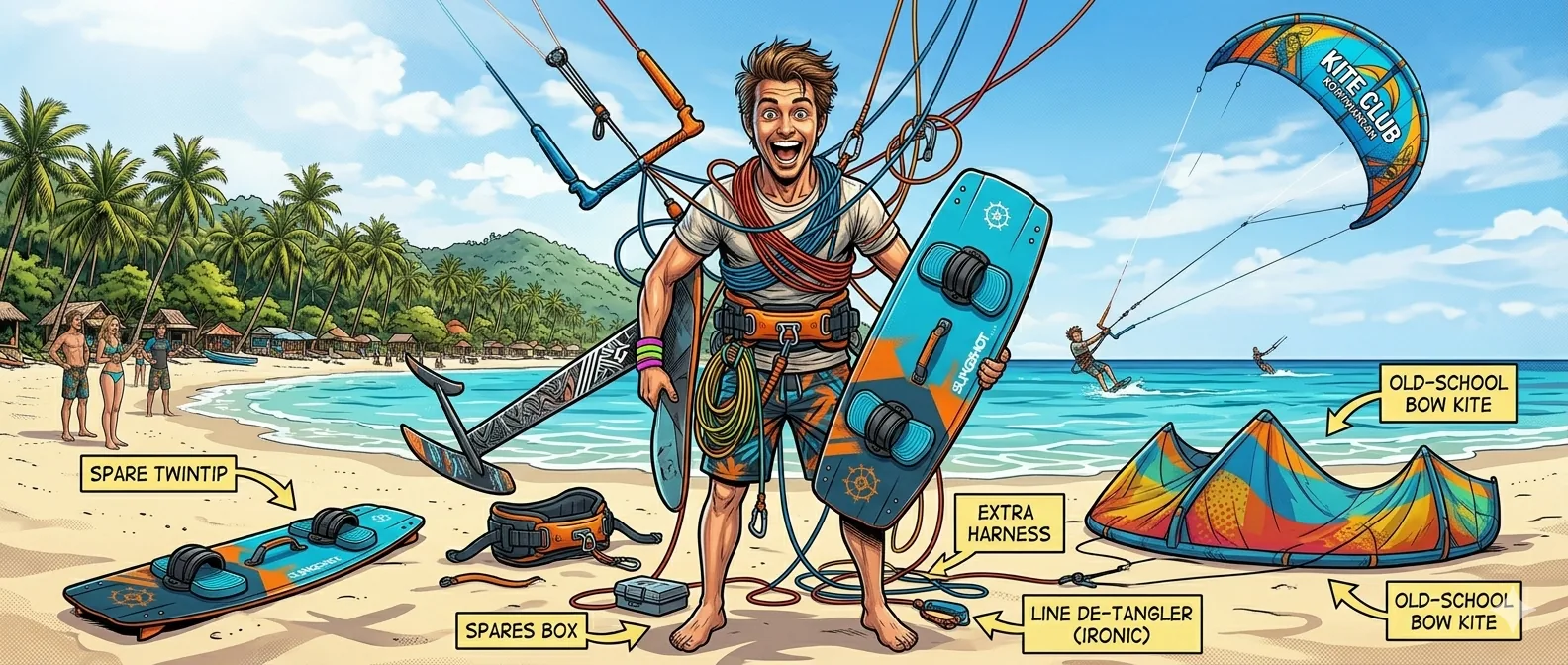
Full Equipment List — Kitesurfing Lessons
Every kitesurfing lesson price at Kite Club Koh Phangan includes the following, at no extra charge:
| Item | Details | Included? |
|---|---|---|
| Kite | Sized to your weight and wind conditions | Yes |
| Bar and lines | Full safety release system | Yes |
| Twin-tip board | Large learner board with foot straps | Yes |
| Seat harness | Fitted to your size before each session | Yes |
| Helmet | Radio helmet for instructor coaching | Yes |
| Impact vest | Buoyancy + impact protection | Yes |
| IKO certification | Digital card at course completion | Yes |
| Beach safety cover | Instructor on beach during all water sessions | Yes |
The Kite
We use Cabrinha and Eleveight kites — current production models, well-maintained and inspected before each session. Kite size is selected by your instructor based on your weight and the wind speed of the day.
- Lighter riders or lighter wind: larger kite (12–14m²) to generate sufficient pull
- Heavier riders or stronger wind: smaller kite (9–10m²) for control
- All kites used in lessons are LEI (Leading Edge Inflatable) — the safest and most common kite type for learning
You do not need to buy a kite to take lessons. The provided kite is appropriate for your level at every stage of training.
The Bar, Lines and Safety Systems
The control bar connects you to the kite via four 20–25m lines (two front lines, two back lines). Steering is done by pulling one side of the bar. Power is controlled by pushing the bar away (depower) or pulling it in (power).
The bar includes two safety systems you will learn on Day 1:
- Chicken loop quick-release: pulling the red handle disconnects the bar from the kite entirely. The kite falls to the water and depowers immediately. This is the primary safety release.
- Leash release: a secondary release that disconnects the leash from your harness — used if the chicken loop release fails or the kite is still flying after the first release.
All safety releases are tested on land before every water session.
The Board
Beginner lessons use a large twin-tip board — typically 140–155cm long and 45–48cm wide. The large surface area makes waterstarts easier (more float) and is more forgiving if your foot position is not perfect. Foot straps are pre-set to a neutral position appropriate for learning.
As you progress through the Independent Rider Course, the instructor may introduce a smaller board (130–140cm) to develop better edge control and upwind technique. The board change happens when you are ready — it is not imposed.
Safety Equipment: Helmet, Vest and Harness
Helmet: All water sessions use a helmet. Kite Club uses radio helmets — your instructor can talk to you from the beach in real time while you are in the water. This is one of the most effective coaching tools in kite instruction and significantly speeds up the waterstart phase.
Impact vest: A buoyancy aid worn at all times in the water. It adds approximately 5–7kg of buoyancy and absorbs impact from falls. Not a full life jacket — it is designed for active water sport, not passive flotation.
Harness: We use seat harnesses for all beginner and intermediate lessons. A seat harness distributes kite load across your hips and thighs — more stable and comfortable for learning than a waist harness. It is fitted before each session and adjusted to your size.
What You Need to Bring
You do not need to buy or hire anything before your lesson. Bring:
- Board shorts or swimsuit — any swimwear is fine
- Rash guard — strongly recommended. The sun at Koh Phangan during kite season (10am–2pm) is intense. A 2-hour session in exposed swimwear leaves most people very sunburned. A rash guard covers your arms and torso.
- Sunscreen — apply before arriving. Reef-safe sunscreen preferred.
- Water shoes — optional but useful. Protects feet on the sandy bottom entry and exit.
- Water bottle — stay hydrated during the lesson. We have drinking water at the school.
Equipment for Other Sports
All equipment is also provided for other activities at Kite Club:
- Wing foil lessons: wing, foil board, mast, front wing, impact vest, helmet. IWO certification included.
- E-foil sessions: Fliteboard or Lift e-foil, wireless remote, impact vest, helmet. No prior experience needed.
- Windsurfing lessons: board, sail, mast, boom, impact vest. certification upon course completion.
- Kayaking and SUP: kayak or board, paddle, life vest. No experience needed.
FAQ
No. Everything is included in the lesson price: kite, bar, lines, board, harness, helmet, and impact vest. You only need to bring swimwear and sunscreen. There is nothing to buy or hire before your lesson.
Your instructor selects the kite size based on your weight and the wind speed on the day. Lighter riders or lighter wind days use larger kites (12–14m²). Heavier riders or stronger wind use smaller kites (9–10m²). You do not need to know kite sizes — the instructor handles this.
Not required but strongly recommended. The sun at Koh Phangan during kite season (10am–2pm peak wind hours) is intense. A 2-hour lesson in just board shorts leaves most people badly sunburned on their arms and shoulders. A rash guard is the single most practical thing to bring.
No. Kite Club Koh Phangan offers kite equipment rental for IKO Level 3+ certified riders. A complete session rental (kite, bar, board) is available directly at Thong Sala Beach. You do not need to own equipment to continue riding after completing the course.
Book a Lesson
Kite Club Koh Phangan · Thong Sala Beach · +66 96 720 3910
Book via WhatsAppFull Equipment List for Each Course and Session
Understanding exactly what equipment is included in your kite or wing foil course eliminates the uncertainty that prevents some prospective students from booking and ensures that you arrive at the school prepared with only the personal items needed rather than over-packing gear that is already provided. Every kitesurfing and wing foiling course at Kite Club Koh Phangan includes all equipment required for the session: for kitesurfing this means the kite itself sized appropriately for your body weight and current wind conditions, the control bar with lines and safety systems, the harness fitted to your body dimensions, the twin-tip board appropriate for your skill level, a wetsuit rash guard for sun and abrasion protection, and a helmet. For wing foiling sessions, equipment includes the inflatable wing in the appropriate size for wind conditions and student experience level, the foil board in the beginner-appropriate size that maximizes stability during initial learning, the foil assembly with mast, fuselage, front wing, and stabilizer, an impact vest rated for watersport use, and a helmet. The equipment is selected and prepared by the school team before each session based on the day's wind conditions and the specific phase of the lesson curriculum being addressed — students do not need to make equipment selection decisions, a process that would require technical knowledge they are in the process of acquiring. This full equipment provision is one of the primary reasons that courses at the school are genuinely self-contained — arrive at the beach with a swimsuit, adequate sun protection, and the willingness to learn, and the school provides everything else.
The quality and age of included equipment reflects the school's operational philosophy that student safety and learning quality depend on reliable, well-maintained gear rather than the cost savings that come from using equipment beyond its safe service life. Kites in the school fleet are typically two to three years old at most, within the period when bladder integrity, leading edge structure, and line compatibility are all reliably within manufacturer performance specifications. Bar and line sets are inspected before every session for line wear, trim system function, and safety release operation — bar components that show signs of wear exceeding the manufacturer's wear indicators are replaced rather than being used until visible failure occurs. Harnesses are fitted individually to each student before use, with the sizing and padding adjusted to distribute load appropriately across the hips for the duration of the session. Students who have specific harness preferences or medical considerations that affect harness fitting should mention these when booking so that the team can ensure appropriate equipment is available and properly configured before the session begins. The board fleet spans a range of sizes from the large, high-volume beginner boards that maximize success rate in early water starts through the medium-size boards used by advancing beginners developing consistent riding, with the specific board assigned to each student reflecting the instructor's assessment of their current technical level and the conditions of the day.
What Students Need to Bring Personally
The school's comprehensive equipment provision means that the personal items required for a productive kite session are minimal and focused on personal comfort and sun protection rather than technical equipment. Swimwear and board shorts or bikini bottoms are the primary clothing requirement — the school provides the rash guard that goes over swimwear, so arriving in appropriate swimwear underneath is all that is needed from a clothing perspective. Sunscreen applied before leaving your accommodation rather than at the beach saves time and ensures full coverage before sun exposure begins, and bringing a second application in a waterproof container for reapplication after water exit is strongly recommended given the intensity of tropical UV radiation reflected from the water surface during sessions. Polarized sunglasses that wrap closely around the face protect both from UV and from the wind glare that can cause eye fatigue during extended sessions, and bringing a strap that attaches to the temple arms prevents loss during falls and body drag. A hat or cap for use between water phases protects the scalp during beach instruction time, and a towel for drying off between sessions and for beach sitting is a practical comfort item that improves the overall experience of a multi-phase lesson day. Water in a refillable bottle ensures hydration throughout the session — kitesurfing is more physically demanding than it appears and the combination of exertion, sun exposure, and saltwater immersion creates dehydration risk that plain sea water immersion obscures because students do not feel hot or sweaty in the conventional sense. Food before a session should be adequate but not so recent that a vigorous session creates nausea — most students find that a medium-sized meal two to three hours before the session start, with a light snack thirty minutes before, provides optimal energy without the stomach discomfort that a full meal consumed immediately before physical exertion can produce.
Personal medical equipment and prescription items should be assessed before booking and communicated to the school team at the time of booking rather than discovered mid-session. Students who wear prescription glasses or contact lenses for vision correction should discuss this with the instructor before the water phase, as both glasses and soft contact lenses have specific interaction effects with salt water that affect both lens integrity and rider safety. Prescription goggles are available from some water sports suppliers and provide the cleanest solution for riders who require significant vision correction, while disposable contact lenses provide a practical alternative for riders with mild to moderate correction needs who can tolerate the occasional salt water exposure that beach sports involve. Students with specific medical conditions including cardiovascular concerns, seizure disorders, respiratory conditions, or musculoskeletal injuries should discuss these proactively with both their physician and the school team before booking, as both parties need to understand the specific risk profile and any equipment or procedure modifications that would address those risks appropriately. The school's first aid provision covers standard injuries and health emergencies competently, and the proximity to the Thong Sala medical facilities ensures that any situation requiring professional medical assessment can be managed with acceptable response time.
Expert Tip
Arrive at the school ten to fifteen minutes before your scheduled session to allow adequate time for equipment fitting, the pre-session safety briefing, and the initial conversation with your instructor about your specific goals and any questions from previous sessions. Students who rush to the water without this orientation period consistently experience lower session quality because they are processing logistics during the instruction time that should be fully dedicated to learning.
Frequently Asked Questions — Equipment Included
Can I use my own equipment during lessons if I have already purchased gear? Students who own their own equipment are welcome to use it during lessons provided it meets the safety standards required for school instruction — specifically, that the kite has functional safety release systems, that lines are within specification length and show no wear beyond acceptable thresholds, and that the harness fits correctly. The instructor will assess personal equipment at the start of the first session and may recommend switching to school equipment if any aspect of the personal gear does not meet safety standards. Using personal equipment during early lessons also has the advantage of developing familiarity with your own specific system rather than adapting later from rental equipment to personal gear.
Is the equipment the same quality as professional riders use? The lesson fleet equipment is mainstream recreational-grade gear from established manufacturers — functional, reliable, and appropriate for learning and recreational riding, but not the specialist competition or performance equipment that professional riders select for specific performance objectives. This distinction is entirely appropriate for the learning context: high-performance equipment is more demanding to operate correctly and less forgiving of the technique errors that are normal in early learning, making recreational-grade gear genuinely better suited to the learning process even if it is not the most technically advanced equipment available. Students who develop strong preferences for specific equipment types or sizes during their course are welcome to discuss these preferences with the team as guidance for their eventual personal equipment purchases.
What happens if equipment is damaged during my session? Normal wear and minor damage from falls that occur during learning is expected and is not charged to students — this type of equipment wear is factored into the school's operational costs. Damage resulting from deliberate misuse or from ignoring specific safety instructions from the instructor is handled differently, with the school's damage policy communicated clearly at the time of booking. The vast majority of students complete their entire course without causing any equipment damage beyond the normal learning-related wear that the school accepts as part of providing instruction to beginners.
Equipment for Each Specific Course Level
The equipment provided varies slightly by course level to match the specific technical requirements of each programme's curriculum objectives. Discovery session students (3,500 THB) receive trainer kite for beach work and a larger, more stable four-line lesson kite with extended safety handles for water work, paired with the widest and most buoyant beginner board in the school fleet that maximizes body drag stability and early water start success rate. Beginner course students (11,000 THB) progress through the same initial equipment before transitioning to more responsive kites and standard twin-tip boards as their skill level advances through the nine-hour curriculum, with equipment adjustments made at each phase transition to match growing capability with appropriately challenging gear. Independent course students (18,000 THB) use the full range of intermediate equipment including smaller kites that require more precise technique management, narrower twin-tip boards that respond more sensitively to weight distribution, and harness and bar configurations that support the higher power levels and longer sessions characteristic of this competence level. Wing foil course students receive equipment scaled to the IWO curriculum phase: large, slow-flying foil wings for initial water surface riding, transitioning to more responsive wing sizes as water start capability develops, paired consistently with the large stable foil boards that provide the platform stability needed for the first foil flights that represent the breakthrough moment of the course. Equipment rental for post-certification independent practice includes the intermediate gear from the school fleet appropriate to the rider's certified level, with the option to request specific sizes within the available range to suit personal preference or current wind conditions.
The maintenance and inspection regime for all school equipment follows a three-tier system designed to catch both the obvious issues that simple visual inspection reveals and the less visible degradation that careful hands-on assessment identifies before it produces in-session failures. Daily inspection covers visible damage from the previous session, line tangles or abrasion wear visible on the surface, and hardware functional checks on bar release mechanisms and board fin security. Weekly inspection includes bladder pressure tests that identify slow leaks before they manifest as mid-session deflation, line length comparison that catches the gradual stretching of older lines that affects kite steering accuracy, and harness hardware checks that assess buckle security and padding integrity. Monthly inspection includes full equipment teardown, internal component assessment, and comparison against manufacturer wear indicators that define the service life limits for each component. Equipment that fails any inspection tier is removed from service immediately and either repaired to specification or replaced, ensuring that the fleet students use represents consistently maintained standard rather than the progressive degradation that un-maintained rental equipment inevitably experiences. The investment in this inspection regime adds to operational costs but reflects the school's position that the equipment students use is the foundation of both their safety and their learning quality, and that compromising equipment maintenance to reduce costs is a false economy that creates both safety risks and the session failures that erode student confidence and slow learning progress. Contact the school via WhatsApp at +66 96 720 3910 for any equipment-specific questions about what will be provided for your specific session type and how the equipment for your course level has been selected and maintained.