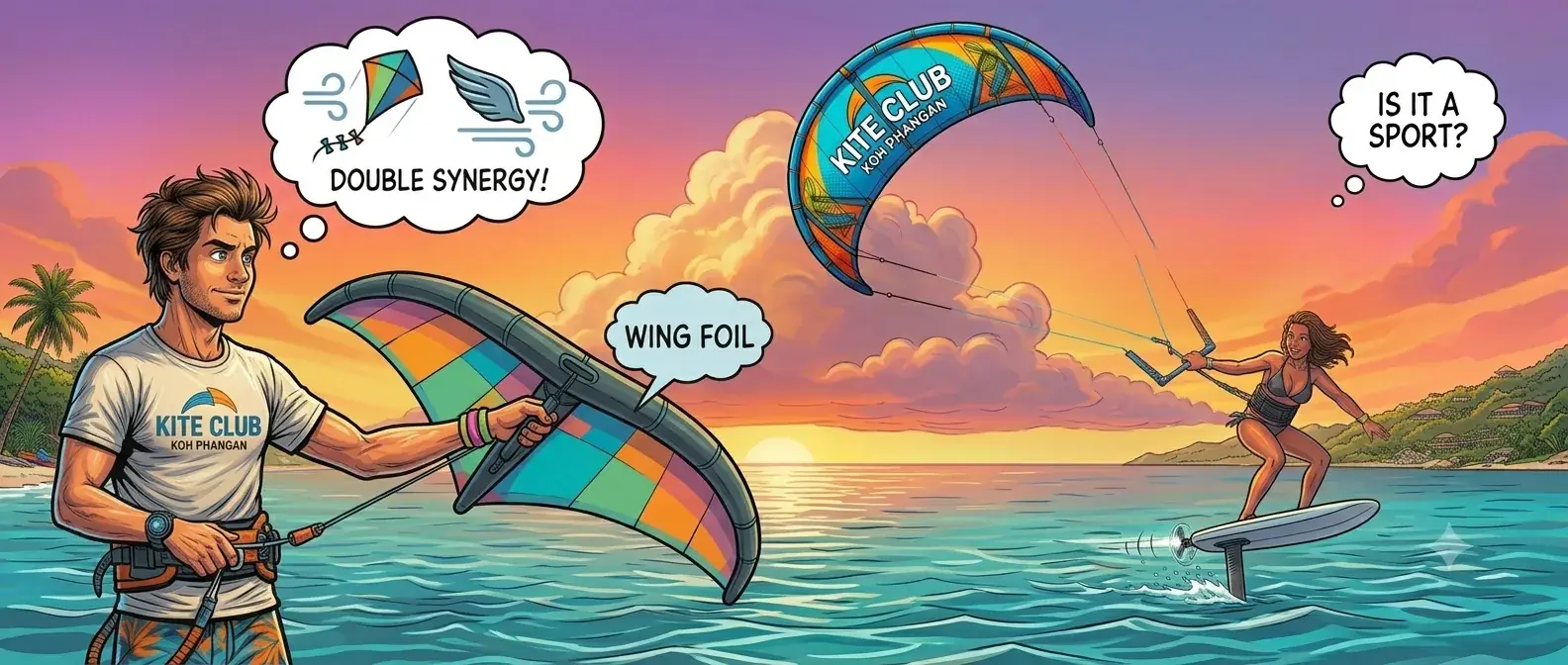
Everything about wing foiling in Koh Phangan — what it is, how long it takes to learn, equipment overview, wind conditions, IWO certification, prices, and how it compares to kitesurfing.
📖 17 min read · Updated May 2026 · By Sergei Sharvarok · Founder & Head Instructor
- What Wing Foiling Actually Is
- Equipment: Wing, Board, Mast & Foil
- How Long Does It Take to Learn?
- Day-by-Day Progression at Koh Phangan
- Wind Conditions for Wing Foil in Koh Phangan
- IWO Certification: Levels and What You Get
- Wing Foil Courses: Prices & Curriculum
- Wing Foil vs Kitesurfing: Which Should You Learn?
- Wing Foil vs Windsurfing: Key Differences
- Expert Tips from Kite Club Instructors
What Wing Foiling Actually Is
Wing foiling (also called wing surfing or winging) is a water sport where you ride a hydrofoil board powered by a handheld inflatable wing. The wing looks like an inflatable kite with handles — you hold it with both hands and use it to catch the wind, which lifts you onto the foil and propels you forward. Once on foil, the board rises above the water surface and you glide on the mast tip, generating very low drag.
The sport emerged around 2018–2019 and has grown faster than any wind sport in recorded history. It combines elements of kitesurfing (using wind power), surfing (board feel), and stand-up paddleboarding (starting position). At Koh Phangan, it is now the second most popular discipline after kitesurfing.
| Factor | Wing Foil | Kitesurfing |
|---|---|---|
| Equipment setup | 5–10 minutes | 15–25 minutes |
| Lines and rigging | None | Bar + 4 lines required |
| Bystander risk | Low (no lines) | Higher (20m lines) |
| Minimum usable wind | 10–12 kts | 13–15 kts for beginners |
| Speed ceiling | 30–50 km/h | 40–70+ km/h |
| Jump height | Low (0.5–2m foil jumps) | High (5–15m kite jumps) |
| Upwind efficiency | Good | Excellent |
The no-lines factor is the biggest practical difference for new riders. Wing foil can be set up and launched on a small beach, a boat, a pier, or even in a parking lot next to a lake. Kitesurfing requires 30–50m of clear downwind space for launch — a serious constraint in crowded spots.
Equipment: Wing, Board, Mast & Foil Assembly
The Wing
The wing is an inflatable structure 4–7m² in size. It has a leading edge strut (inflated hard) and a canopy that catches wind. Two boom handles allow the rider to hold the wing at various angles to the wind. Unlike a kite, the wing is held in the hands — there are no bars, lines, or harness connections.
| Wing Size | Wind Range | Rider Weight | Use Case |
|---|---|---|---|
| 4m² | 20–30+ kts | 60–90 kg | Strong wind sessions |
| 5m² | 16–25 kts | 60–90 kg | Mid-range workhorse size |
| 6m² | 13–20 kts | 70–100 kg | Light to medium wind |
| 7m² | 10–16 kts | 70–100 kg | Light wind, larger riders |
The Foil Board
Wing foil boards are larger and more stable than kite foil boards, specifically to aid beginners who need to stand and balance before the foil lifts. Beginner boards are typically 80–120L (litres of volume). Intermediate and advanced boards drop to 40–70L. At Kite Club, beginner students use 90–110L boards that are stable enough to paddle on and stand up from without the wing generating full power.
The Foil Assembly
The foil is attached to the underside of the board via a mast (70–90cm typically). The front wing generates lift; the stabiliser at the tail controls pitch. Wing foil setups use softer, more forgiving foil geometries than kite foil — better suited to the slower, less powered flight of early sessions.
Kite Club provides all equipment in lesson prices. For your first trip to Koh Phangan, there is no need to purchase or travel with wing equipment. The school's fleet covers all sizes for all rider weights and conditions.
How Long Does It Take to Learn?
Wing foiling has a reputation for being harder than kitesurfing to start — and easier once you are on foil. The reason: the initial challenge is standing on a large board while holding a wing that is trying to pull you sideways, without the kite's powerful pull to pop you up. It requires balance, timing, and wing angle control simultaneously.
| Stage | Typical Time | What You Can Do |
|---|---|---|
| Wing control on land | Day 1, 0–1h | Hold wing at neutral, feel the draft, basic steering |
| Knee riding in water | Day 1–2, 1–3h | Riding on knees on foil board, wing generating pull |
| First standing rides | Day 2–4, 3–8h | Standing on board, riding downwind at low speed |
| First foil (board off water) | Day 3–6, 6–14h | Brief moments of foil flight |
| Sustained foiling | Day 5–10, 10–20h | Riding 100+ metres on foil consistently |
| Upwind foiling | Season 2+, 20–40h | Making consistent upwind ground on foil |
The range is wide because physical and prior board sport backgrounds vary enormously. A kitesurfer transitioning to wing foil typically foils within 4–6 hours because they already understand kite wind dynamics. A complete beginner with no board sport background typically takes 10–20 hours to foil consistently.
Day-by-Day Progression at Koh Phangan
Day 1: Wing Handling and Knee Riding
The session begins on the beach with a 4–5m² trainer wing. You learn the "neutral position" (wing overhead, both hands on the boom, sail luffing) — this is your recovery position whenever you feel overpowered. You then learn to steer the wing to generate pull in a specific direction.
In the water, you start on your knees on the board. The lower centre of gravity makes balance dramatically easier. You ride on knees for 20–40 metres, learning to steer the wing and the board simultaneously. By the end of Day 1, most students are knee-riding with confidence.
Day 1 feels slow but it is not. Wing handle position on a kneeling rider builds muscle memory that makes the standing progression 3–4x faster than if you had tried to stand on Day 1. Trust the progression.
Day 2: Transition to Standing
The transition from kneeling to standing is the most technically demanding step. You need to: 1) establish the wing in a stable neutral position, 2) push up to your feet quickly, 3) find balance before the wing generates enough power to move you. Most students spend 50–80% of Day 2 attempting this transition.
By the end of Day 2, most students are achieving brief standing rides of 5–20 metres. The specific quality that unlocks this is relaxing the arm holding the back boom — tension keeps riders kneeling or causes them to fall immediately.
Day 3–5: First Foil
The foil is a transformation in the feel of the sport. Riding on the board surface is bumpy and resistance-heavy. The moment the foil lifts you above the surface, all resistance disappears and speed increases dramatically. Students who foil for the first time routinely describe it as one of the most memorable moments in their water sport history.
Foiling requires both weight distribution control (lean forward to stay low, lean back to rise) and wing power control (sheet in to accelerate, sheet out to slow down). Balancing both simultaneously is the core challenge of Days 3–5.
Wind Conditions for Wing Foil in Koh Phangan
Wing foil operates in slightly lighter wind than kitesurfing — the wing generates power at lower speeds, making it more usable in the 10–14 knot range where kites struggle.
| Wind Speed | Wing Foil | Kite (for reference) |
|---|---|---|
| 8–10 kts | Possible with 7m² wing (experienced only) | Not usable for most riders |
| 10–12 kts | Good with 6–7m² wing | Marginal for beginners |
| 12–16 kts | Ideal for learning — good control | Good beginner conditions with large kite |
| 16–22 kts | Excellent — all skill levels | Peak conditions |
| 22–28 kts | Smaller wing needed (4–5m²) | Advanced conditions |
| 28+ kts | Expert only with small wing | Expert / advanced only |
At Koh Phangan, the SE season (February–April) delivers optimal wing foil conditions: 15–22 knots of consistent wind, flat water at Thong Sala. The SW season (June–October) is also excellent, though the choppier water at the main beach makes some aspects of early learning harder.
Wind at Thong Sala typically arrives between 10am and noon. Morning sessions (8–10am) often run in lighter wind — better for first wing foil lessons where you want the wing manageable rather than overpowering. Afternoon sessions are stronger and better for experienced riders.
IWO Certification: Levels and What You Get
The IWO (International Wing Organisation) is the wing foil equivalent of the IKO kitesurfing certification system. Kite Club Koh Phangan is IWO certified. Your IWO card is recognised at IWO-affiliated schools and rental centres worldwide.
| IWO Level | Skills | What It Unlocks |
|---|---|---|
| Level 1 — Discovery | Wing control, knee riding, safety | Supervised sessions |
| Level 2 — Beginner | Standing rides, basic steering | Supervised independent practice |
| Level 3 — Intermediate | Consistent foiling, direction control | Supervised equipment rental |
| Level 4 — Advanced | Upwind foiling, gybes, wave riding | Full independent rental and riding |
The beginner course at Kite Club (12,000 THB) targets IWO Levels 1–2. The independent course (19,000 THB) adds IWO Levels 2–3 skills and is aimed at students who already have basic standing rides.
Wing Foil Courses: Prices & Curriculum
| Course | Price | Hours | IWO Level | Who It Suits |
|---|---|---|---|---|
| Wing Foil Discovery Course | 3,500 THB | 2h | Level 1 | First taste — not sure if you will continue |
| Wing Foil Beginner | 12,000 THB | 6h | Levels 1–2 | Holiday visitors, building to first foil |
| Wing Foil Independent | 19,000 THB | 10h | Levels 2–3 | Riders with basic stands, targeting foiling |
All courses include wing, foil board, mast assembly, impact vest, helmet, and IWO-certified instruction. No equipment to rent or purchase separately.
Wing Foil vs Kitesurfing: Which Should You Learn?
The most common question from visitors to Koh Phangan who want to start a wind sport. The honest answer: it depends on your goals.
- Choose wing foil if: you want a compact, no-lines setup you can travel with easily, prefer lighter-wind sessions, or have an interest in wave wing and surf disciplines
- Choose kitesurfing if: you want the highest speed potential, the most established global community, and the most powerful upwind performance
- Try both if: you have 10+ days — the two skills complement each other, and many Koh Phangan students do a Discovery session in each discipline before committing to a full course
Read the full comparison: Wing Foil vs Windsurfing.
Wing Foil vs Windsurfing: Key Differences
| Factor | Wing Foil | Windsurfing |
|---|---|---|
| Setup time | 5–10 min | 10–20 min |
| Equipment size | Compact — wing folds | Large — mast, boom, sail |
| Learning curve | Steeper initially | Gentler first day |
| Light wind use | Needs 10+ kts | Usable from 8 kts |
| Equipment cost | 2,500–6,000 EUR | 700–2,500 EUR (non-foil) |
| Global community | Growing fast | Established, large |
Expert Tips from Kite Club Wing Foil Instructors
Spend at least 2 full sessions on the knee-riding phase. Students who try to stand too early create bad habits that take sessions to correct. The knee-riding phase is not wasted time — it is building the exact muscle memory you need.
The single most common foiling mistake is looking down at the water. Keep your eyes on the horizon. Your weight shifts follow your eyes — if you look down, you pitch forward, the foil catches, and you crash. Horizon gaze = stable flight.
On days with 10–12 kts, wing foil is often better than kitesurfing at Thong Sala. The lighter conditions make wing control much more manageable for students in their first 2 sessions. Don't write off low-wind days — they can be perfect wing foil teaching days.
Frequently Asked Questions
The first session is harder — standing on a board while managing a wing requires simultaneous balance and wind control. But foiling (riding above the water) typically comes faster than kitesurfing riding. Most wing foil students foil within 8–15 hours; most kitesurfing students ride within 10–14 hours.
Beginners need 12–16 knots for the most manageable learning conditions. Experienced riders can use 10 knots with a large wing. Strong wind (22+ knots) requires a smaller wing (4–5m²) and more experience.
The Discovery Course is 3,500 THB (~95 USD). The full beginner course (6 hours, IWO Levels 1–2) is 12,000 THB (~330 USD). The independent course (10 hours) is 19,000 THB (~515 USD).
Yes — and it helps significantly. Kitesurfers already understand the wind window, power zones, and how to read gusts. Most kitesurfers achieve foiling in 4–6 hours, roughly half the average time for complete beginners.
The International Wing Organisation certification is the global standard for wing foil. It has 4 levels. An IWO card from Koh Phangan is recognised at IWO-affiliated schools worldwide, allowing you to rent equipment and continue progression at any certified centre.
Book Your Wing Foil Course
IWO-certified wing foil instruction at Thong Sala Beach, Koh Phangan.
Book Now →Wing Foiling in Thailand: Conditions, Schools, and Seasons
Thailand's wing foiling scene has expanded rapidly over the past three years, with dedicated instruction infrastructure now established at several locations across both the Gulf of Thailand coast and the Andaman coast, catering to a growing international student population that has recognized Southeast Asia as one of the world's most accessible and enjoyable wing foil learning destinations. The Gulf of Thailand coast — particularly Koh Phangan and to a lesser extent Hua Hin — offers its best wing foiling conditions from January through April when the northeast trade wind provides consistent twelve to twenty-five knot sessions that suit beginner through advanced riders across all conditions within a single peak season period. The Andaman coast destinations including Phuket's Nai Yang Beach offer complementary May-to-October southwest monsoon wing foiling that creates a year-round Thai wing foil circuit for riders who want to follow the wind between the two coasts rather than concentrating their entire activity within a single seasonal window. The warm water temperature that characterizes both coasts year-round — ranging from twenty-eight to thirty-two Celsius depending on location and month — eliminates the wetsuit requirement that adds cost, discomfort, and logistics complexity to wing foiling in European and temperate zone destinations, making sustained multi-hour sessions in simple boardshorts and a rash guard the normal experience for all visitors regardless of their cold-water tolerance at home. Thailand's IWO-certified instruction infrastructure at Koh Phangan provides the professional quality assurance that motivates serious students to prioritize this destination over the many self-styled wing foil schools that exist at popular beach destinations worldwide without the certification credentials that protect students from instruction quality variation. The comprehensive package of conditions, certified instruction, value, and island lifestyle that Koh Phangan specifically provides within the broader Thai wing foiling landscape is what distinguishes it as the primary recommendation for first-time visitors targeting serious wing foil skill development during a single focused holiday. Contact Kite Club Koh Phangan via WhatsApp at +66 96 720 3910 to discuss current conditions and course availability for your target travel dates during the upcoming peak season.
Thailand's regulatory environment for water sports is generally permissive compared to some European destinations where coastal activity regulations restrict the areas where wing foiling can be practiced. The absence of zone-based access restrictions at most Thai kite and wing foil beaches means that riders can freely explore the full range of coastal conditions available rather than being confined to designated launch corridors, creating greater flexibility for experienced riders who want to adapt their session to specific wind and wave conditions rather than operating within fixed boundaries. The local coast guard operates responsibly but with a light touch at established kite and wing destinations, and the longstanding presence of organized watersport operations at Thong Sala Beach has created a working relationship between the school community and local maritime authorities that ensures smooth operation of daily lessons and rental sessions without the regulatory friction that can complicate operations at less-established locations. Environmental awareness is growing within the Thai kite and wing foil community, with increasingly explicit respect for coral reef areas, protected marine zones, and the nesting grounds of sea turtles that inhabit several Gulf of Thailand islands including those in the Ang Thong Marine Park accessible by daytrip from Koh Phangan. This environmental consciousness reflects both the genuine conservation values of the local wing foil community and the practical understanding that the natural environment that makes Koh Phangan exceptional as a destination is worth protecting through behavioral standards that go beyond the minimum required by current regulations.
Start Your Thailand Wing Foil Journey
The IWO wing foil Discovery Course at 3,500 THB provides the ideal starting point for any visitor who wants to experience wing foiling in Thailand before committing to a full certification course. The comprehensive IWO Beginner course at 12,000 THB delivers the foundational skills and internationally recognized certification needed for independent practice at wing foil spots worldwide. Advanced riders can continue with the IWO Independent course at 19,000 THB to develop the higher-level technique including sustained foiling, direction changes, and basic maneuvers that define intermediate wing foil competence. All sessions include equipment, safety briefing, and beach supervision. Book via WhatsApp +66 96 720 3910 to confirm availability for your specific travel dates during the peak season at Koh Phangan.
Thailand wing foiling peak season on the Gulf coast: January through April. Peak season on the Andaman coast: May through October. Koh Phangan at Thong Sala Beach offers the best combination of certified instruction, beginner-friendly conditions, and tropical island lifestyle for wing foil learners targeting Southeast Asia.
IWO certification available. Languages: English, Russian, Arabic, German.
Thong Sala Beach, Koh Phangan, Thailand.