Before You Arrive: What to Bring
Swimwear, rash guard or long-sleeve swim top (mandatory — you're on reflective water at 9°N latitude), waterproof SPF 50, water in a reusable bottle, snacks or a light meal beforehand. The first session starts with 90+ minutes of active work. Don't arrive hungry.
What NOT to bring: watches, jewellery, flip flops (you'll go in the water). Leave valuables at your accommodation or in the school's bag storage.
The First Hour: Land-Based Kite Control
You will not get in the water in the first hour. That's intentional. The kite is the most complex part of kitesurfing — it generates significant force and has clear safety mechanisms you need to understand before anything else.
What you'll cover: how the wind window works (12 o'clock = no power, 3/9 o'clock = maximum power), how to launch and land the kite safely, how to use the bar (pull for power, push to depower), and most importantly — the chicken loop release. This is your emergency stop. You'll practice it 5–6 times on land until it's a reflex.
By the end of the first hour, most students are flying a trainer kite in controlled arcs and starting to feel the connection between bar input and kite movement.
Getting in the Water: Body Dragging
The kite goes up, you go in. Body dragging is exactly what it sounds like — the kite pulls you through the water while you learn to control direction with kite position. No board yet. This phase builds the muscle memory for kite control that you'll need when the board is added.
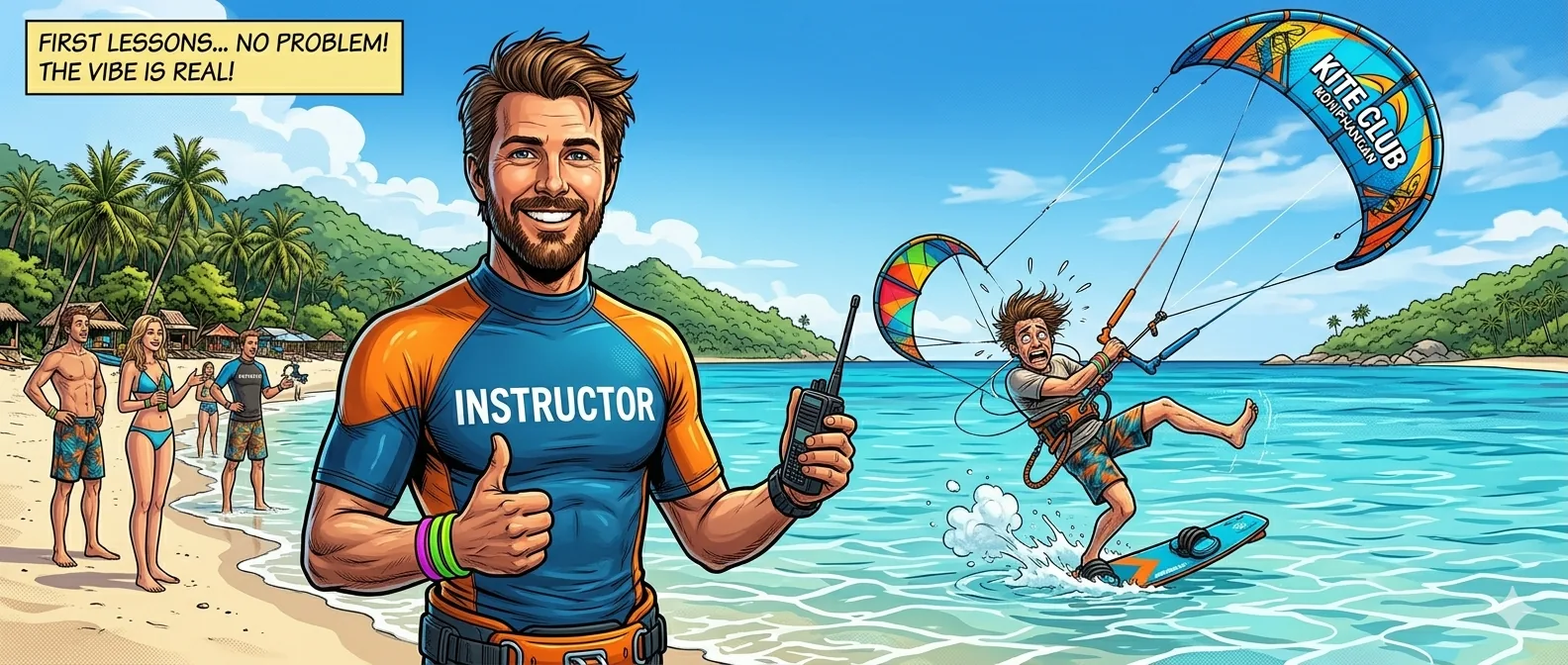
Body dragging might feel like a step back — 'I want to ride, why am I just being dragged?' — but it's the phase that separates students who struggle with the waterstart from those who nail it on the first attempt. Instructors give real-time feedback over a radio helmet worn by the student.
The Waterstart: Getting on the Board
The waterstart is the technical crux of kitesurfing — coordinating kite position, board position, and weight transfer simultaneously. In the Discovery Course (2 hours), most students attempt the waterstart but don't complete it successfully yet. That's expected. The Full Beginner Course (6 hours over 3 days) is where the waterstart clicks for most people.
The moment it works: kite at 11 or 1 o'clock, send it forward toward 12, feel the pull, stand up, edge the board. The first successful waterstart is one of the most memorable moments in the sport — the whole learning arc up to that point clicks into place at once.
After Your First Session
Expect muscle soreness in your lower back, forearms, and core — muscles you don't normally isolate in this way. This is normal. 24 hours of rest before the next session is ideal. Stretching your back and shoulders that evening accelerates recovery.
Review the day mentally: what did the kite feel like at different positions? Could you feel the wind window? Did the safety release work as expected? These reflections consolidate learning faster than any amount of extra time in the water while fatigued.
FAQ
Yes — the Discovery Course is 2 hours and can be scheduled any time during the wind window (typically 9am–4pm). Most students prefer morning when the wind is building rather than fully established.
Light-wind days still allow land-based practice, kite control, and body dragging in lighter conditions. If wind drops below 10 kts, we reschedule the session at no cost. This happens occasionally in the off-season.
Yes. The Discovery Course (2h) focuses on kite control and first body dragging. Standing up happens in the Beginner Course (days 2–3). Day one is about understanding the kite — not rushing the board.
Book Your Discovery Session
2-hour Discovery Course · 3,500 THB · all equipment included · Thong Sala Beach, Koh Phangan
Book via WhatsAppHour by Hour: Your First Day at the Kite School
Knowing what to expect during your first day at the kite school removes the uncertainty that can make new experiences feel more intimidating than they actually are, and replaces it with the confident anticipation of someone who has already mentally rehearsed the sequence of events before they begin. The day typically starts with arrival at Thong Sala Beach between eight and nine in the morning, when the trade wind has begun to build from its overnight low and the temperature is still comfortable enough for extended beach work without the heat fatigue that can accumulate later in the day. Your instructor will greet you and begin with a brief assessment conversation covering your swimming ability, any prior board sport experience, physical fitness level, and any medical considerations that might affect session structure or equipment selection. This conversation is casual rather than formal — it serves the practical purpose of customizing the session to your specific starting point rather than processing administrative requirements, and the best instructors use it to begin building the relationship with you as an individual learner rather than an anonymous beginner filling a scheduled slot. After the assessment, you will be fitted with your equipment: harness adjusted to sit correctly on the hips rather than the waist, helmet sized and secured, and appropriate footwear if needed for the specific conditions of the day. The equipment fitting phase is also an education in itself — your instructor will explain the function of each item as it is fitted, establishing the foundational knowledge about what each piece does and why it matters before any practical activity begins.
The beach phase of the first day begins with your trainer kite — a small two-line kite used to develop the fundamental muscle memory of kite flying without the power and complexity of the full four-line lesson kite used in water sessions. The trainer kite is typically between two and three square meters, generating very manageable forces that allow you to make mistakes, feel the consequences, and correct them without any safety concern. Your instructor will first demonstrate the wind window concept by flying the trainer kite in a clear arc from one side to the other, explaining how the kite generates more power in the direct overhead position and less power near the edge of the window where it approaches the wind. You will then take the handles and feel this power variation yourself, initially with the instructor guiding your hands and providing verbal feedback on your bar pressure and timing. The figure-eight pattern — the fundamental steering motion that underlies all kite control — will be the specific technical focus of the first thirty to forty-five minutes, and most students feel the beginning of automaticity developing in this pattern before the end of the first beach phase. The sensation of the kite responding smoothly to deliberate bar inputs, rather than the chaotic flapping and power surges of the first few minutes, is the first genuine milestone of kitesurfing learning and usually arrives with a visible moment of excitement that instructors recognize as the transition from struggle to engagement.
The transition to water happens when your instructor judges that your kite control is stable enough for body drag learning without creating safety issues in the water environment. This typically occurs between one and two hours into the first session for most beginners, though the transition timing varies based on individual progress and never feels rushed — there is no schedule pressure to advance to the water faster than your actual readiness supports. Walking into the water with the kite flying overhead for the first time produces a different quality of attention than beach flying — the sound changes, the sensation of the water against your legs adds sensory information, and the awareness of being in an environment that requires additional self-management beyond kite control activates a level of focus that most students describe as the most intensely present experience of their recent adult life. The first body drag moves toward the water, the kite pulling you gently across the surface as you learn to position your body as a lever that converts the kite's pull into directional movement rather than simply being dragged wherever the kite leads. The feeling of traveling through water purely by wind power, without any engine or paddle, is genuinely magical in a way that intellectual description cannot fully communicate — it must be felt directly to be understood. By the end of the first session, most students have experienced this sensation multiple times and are already planning how to describe it to the people waiting for them back on the beach.
Managing Expectations for Day One
Setting realistic expectations for your first day is the most important mental preparation you can do before arriving at the school, both because unrealistic expectations create frustration that undermines learning, and because realistic expectations allow you to fully appreciate the genuine progress that your first session delivers. Kitesurfing is not a sport where beginners ride on their first day — the progression from first beach session to independent board riding requires between nine and fifteen hours of instruction for the majority of students, and the first day is properly understood as the foundation-laying phase rather than the performance phase of that progression. What you will legitimately achieve on day one: a functional understanding of the wind window, demonstrable kite control in the beach phase, and the beginning of body drag capability that gives you the physical experience of being powered by a kite in water. What you should not expect on day one: riding a board, going upwind, performing any maneuvers, or demonstrating anything resembling the riding you have seen from experienced kitesurfers on social media. The intermediate progress milestones — consistent body drag, reliable water starts, basic riding — come in sessions two through eight for most students, and the patience to accumulate these hours without rushing the progression is the single most important psychological asset any beginner kite student can bring to their learning process. Our instructors have taught hundreds of students through this exact progression and consistently find that the students who achieve the fastest overall progress are those who fully commit to each phase before advancing to the next, rather than those who rush through the foundation-building work to reach the exciting parts before they are genuinely ready.
Expert Tip
Eat a proper breakfast before your first session — kite lessons are more physically demanding than they look, and low blood sugar is responsible for the concentration drops and frustration spikes that many beginners experience in the second hour of their first session. Bring water to the beach, apply sunscreen twice before entering the water, and tell your instructor immediately if you feel tired, anxious, or physically uncomfortable. The session belongs to your learning, not to an external schedule.
Frequently Asked Questions — First Day Kitesurfing
Should I take a Discovery session or go straight to the Beginner course? The Discovery session at 3,500 THB is three hours and provides a genuine sampling of kitesurfing learning that helps you confirm whether you want to commit to the full nine-hour Beginner course. It is the right choice if you have never tried wind sports, are unsure whether kitesurfing suits you physically, or simply want the experience without full commitment. The Beginner course at 11,000 THB is the right choice if you are already confident you want to learn kitesurfing and want the most efficient path to IKO certification with a continuous instructor relationship across all sessions. Students who complete a Discovery session and want to continue have the Discovery fee credited toward the Beginner course if they upgrade during the same visit.
How early should I arrive for my first lesson? Arrive fifteen minutes before your scheduled session time to allow for equipment fitting and the pre-session assessment conversation without rushing. Punctuality matters in kite school scheduling because sessions are often coordinated around specific wind windows, and late arrivals can result in reduced session time if the wind window closes before your full session is complete. If you are running late, contact the school via WhatsApp at +66 96 720 3910 so the team can assess whether the session can be rescheduled or whether the wind window still supports a shorter session on the same day.
What happens if the wind is too light or too strong on my lesson day? The school monitors wind conditions continuously using multiple forecast sources and local anemometer readings. If conditions are not suitable for your specific level of lesson, the team will contact you via WhatsApp to discuss options including rescheduling for a better wind day, adjusting the session content to match available conditions, or switching to an alternative activity like wing foiling or paddleboarding. We never conduct kite lessons in conditions that are unsafe or counterproductive for the student's current learning level — both your safety and your progress matter more than completing a scheduled session against unsuitable conditions.
The Social Dimension of Your First Session
One of the unexpected pleasures of a first kite session that many students do not anticipate is the immediate social connection with the kite school community that begins from the moment you arrive at the beach. The instructors, support staff, and other students present on any given day create a welcoming environment that is worlds away from the anonymity of a commercial gym or the competitive tension of many team sports — kite culture has a collaborative, encouraging quality that reflects the shared challenge that all kitesurfers have experienced at the beginning of their own learning journey and remember clearly enough to extend genuine encouragement to anyone starting theirs. Other students who are a few sessions ahead of you in the progression will often share encouragement and occasionally informal tips as you wait for the water phase of your session, and the informal debrief conversations at the beach bar after sessions provide a social context for processing the day's learning that adds a human warmth to the technical content of what you experienced. Many first-day students arrive at the kite school as solo travelers and leave having shared contact information with people from multiple countries who share both the kite interest and the particular sensibility that leads adventurous travelers to choose an island like Koh Phangan for their wind sport education. The WhatsApp communities maintained by the school connect students before, during, and after their visits, and the consistent character of these communities across years of operation reflects the genuine cohesion that develops when people share the specific experience of learning to fly a kite and feel the ocean for the first time.
First-day reflection after your session is a valuable and often underutilized part of the learning process. Finding twenty minutes in the evening after your first session to write or type a brief account of what you experienced, what you found difficult, and what questions emerged during the day creates a record that will be fascinating to read when you return to the same notes after your fifth or tenth session. The progression from the disoriented state of the first session to the fluent, natural control of a trained rider is one of the most dramatic skill development journeys available in any recreational sport, and having a personal record of the starting point makes the achievement of later milestones more vivid and satisfying than memory alone can provide. Your instructor will debrief you briefly after the first session to explain what you did well, what to focus on before the next session, and how to think about the wind window concepts you experienced during the beach phase — this debrief is worth writing down rather than simply listening to, because the specific technical points addressed will be relevant to every subsequent session in your learning journey and are easy to forget in the excitement of processing everything else from a first day in the water. Contact the school via WhatsApp at +66 96 720 3910 in the evening after your session if any questions emerge that you forgot to ask during the debrief, as the team is responsive to student questions outside of formal session hours and genuinely values the engagement of students who are thinking carefully about their learning between sessions.
Your first day at Kite Club Koh Phangan is the beginning of a journey that will reward every hour of attention and practice you invest in it. The Discovery session at 3,500 THB provides the essential foundation for everything that follows. The Beginner course at 11,000 THB builds systematically on that foundation toward IKO certification. Contact the school via WhatsApp at +66 96 720 3910 to book your first session, confirm the equipment that will be provided, and get any questions answered before you arrive at the beach. The team is genuinely enthusiastic about introducing new students to kitesurfing and will make every effort to ensure your first day is exactly the experience you came to the island hoping to have.
Book your Discovery session or Beginner course at Kite Club Koh Phangan via WhatsApp at +66 96 720 3910. The team looks forward to sharing the experience of your first day on the kite with you at Thong Sala Beach during the peak season at Koh Phangan, one of Asia best learning environments for kitesurfing instruction anywhere in the world.
IKO Discovery session available daily during peak season. School located at Thong Sala Beach, Koh Phangan, Thailand. WhatsApp +66 96 720 3910.