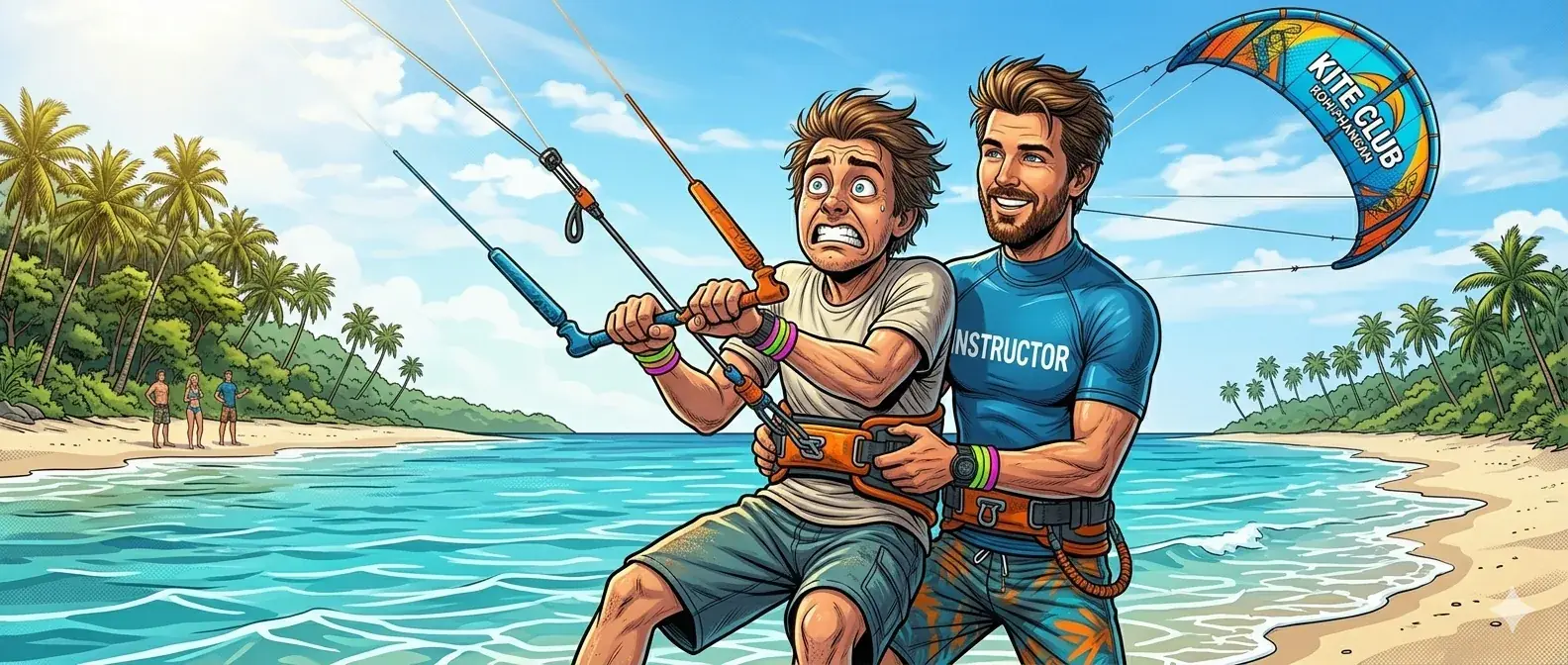
You have booked your first lesson and you have no idea what to expect. This guide walks you through every stage of the session — from arriving at Thong Sala Beach to the debrief at the end — so nothing is a surprise and you can focus entirely on learning.
📖 16 min read · Updated May 2026 · By Sergei Sharvarok · Founder & Head Instructor
Contents
- Before You Arrive: What to Prepare
- Arrival and Briefing (Minutes 0–20)
- Theory Session: The Wind Window (Minutes 20–50)
- Equipment Orientation (Minutes 50–70)
- First Kite Flying on the Beach (Minutes 70–110)
- Moving to the Water: Body Drag (Minutes 110–150)
- End of Session Debrief (Minutes 150–180)
- What Happens After the First Lesson
- Common Questions from First-Session Students
- Physical and Mental Preparation
- Frequently Asked Questions
Before You Arrive: What to Prepare
A little preparation before your first session makes the time on the beach significantly more productive. Here is what to sort out before arriving:
| Item | Bring / Prepare | Notes |
|---|---|---|
| Swimwear | Bring | Wear it under your clothes — you will be in the water |
| Rash guard / thin wetsuit | Strongly recommended | Prevents sunburn, rash from harness, and jellyfish contact; available for rent at school |
| Sunscreen SPF 50+ | Essential | Apply before arriving; 3 hours in water and wind wears it down fast |
| Water bottle | Bring | Physical lesson in Thai heat; bring at least 1 litre |
| Secure footwear | Optional | Water shoes or flip-flops for walking; go barefoot in the water |
| Glasses / contacts | Leave behind or secure | Wind and water spray make contacts uncomfortable; leave glasses ashore |
The school provides: kite, bar, lines, harness, impact vest, helmet, and board. You do not need to bring any kitesurfing equipment for your first lesson.
Local Insight
Thong Sala Beach faces southwest. Sessions typically run from 11 am to 3 pm to catch the reliable sea breeze. Arriving 10 minutes early lets you get fitted for your harness and helmet without rushing, which sets a calm tone for the whole session.
Arrival and Briefing (Minutes 0–20)
When you arrive at the school, your instructor will meet you and start with a brief conversation about your background: have you tried any board sports? Do you have experience with kites, paragliders, or other traction activities? Do you have any physical limitations? This is not a test — it helps the instructor calibrate the pace and emphasis of your session.
The Equipment Walkthrough
Before any theory, the instructor will walk you around the equipment that you will be using today and explain what each piece does at a high level. Kite, control bar, lines, harness, chicken loop, safety release. You will not need to remember all of this immediately — the goal is to build a mental map before details are added in the theory session.
The Safety Release Test
One of the first things you will do — even before theory — is test your own safety release. You will put on the harness, connect the chicken loop, and pull the red handle to release it. Then reconnect and do it again. Your instructor needs to see that you can operate this system under zero stress before you ever get near a powered kite.
Theory Session: The Wind Window (Minutes 20–50)
The theory session covers three core concepts: the wind window, the power zones, and the right-of-way rules. Most students think this will be dry and boring. It is not — it directly explains every physical sensation you are about to experience.
The Wind Window
The wind window is the three-dimensional hemisphere of space downwind of you in which the kite can fly. Picture a dome: you stand at the edge, the kite moves within the dome. The dome is divided into three zones:
- Neutral Zone (12 o'clock position): kite directly overhead, kite flies but generates very little pull. This is the "safe" parking position.
- Active Zone (10–11 o'clock, 1–2 o'clock): kite at the edge of the wind window, moderate power. This is where you ride.
- Power Zone (9 o'clock, 3 o'clock): kite directly downwind of you, maximum power. Moving the kite through this zone generates the pull used for water starts.
Understanding the wind window explains every kite control action you will take. Moving the kite toward the power zone generates pull. Moving it toward neutral depowers it. The bar controls the kite direction; the depower strap controls how deep the kite sits in the window.
Right-of-Way Overview
The theory session includes a brief version of IKO right-of-way rules. You will not need to apply all of them in your first session, but you need to know the most basic one: starboard tack (wind from your right) has priority over port tack. Your instructor will remind you of this again at the water.
Expert Tip
During the theory session, ask questions freely. There are no stupid questions about the wind window or the safety systems — these are non-obvious concepts and your instructor has explained them hundreds of times. Students who ask questions during theory absorb the information faster and apply it more confidently at the kite.
Equipment Orientation (Minutes 50–70)
Before the first kite goes up, your instructor walks you through the specific equipment you will be using today. This is more detailed than the initial walkthrough:
The Control Bar
You will hold the control bar and practice the basic movements: pull the right side to steer the kite right; pull the left side to steer left. Move the bar toward you (sheet in) to increase power; push the bar away (sheet out) to decrease power. These four movements control everything about the kite.
You will also operate the depower strap while your instructor shows you how it changes the angle of attack of the kite. Understanding this now prevents a common beginner mistake: trying to reduce kite power by pushing the bar away when the depower strap is what you actually need.
The Harness Fit
A correctly fitted harness is important for both comfort and safety. The harness hook should sit at approximately your belly button height. A hook too high pulls you forward; too low strains your lower back. Your instructor will check the fit and adjust it before you put on the kite.
Helmet and Impact Vest
All students at Kite Club wear a helmet and impact vest for their first sessions. The helmet protects against board strikes during falls — which are common in early sessions — and the impact vest provides both buoyancy and cushioning. You will feel restricted at first; this feeling disappears after a few minutes.
First Kite Flying on the Beach (Minutes 70–110)
This is the part most first-time students find surprising: you spend the first 40 minutes of actual kite flying on the beach, not in the water. This is deliberate and important.
The Trainer Kite
Depending on wind conditions and your instructor's assessment, you may start with a smaller trainer kite (typically 3–4 metres) rather than a full-sized lesson kite (9–12 metres). A trainer kite has a fraction of the power of a full kite, which means mistakes have smaller consequences while you are building the fundamental control movements.
The Figure-Eight
The core exercise for the first land session is the figure-eight: flying the kite continuously through a repeating left-right-left pattern across the wind window. This sounds simple. It is not. The challenge is maintaining smooth, equal movements and keeping the kite in the active zone rather than accidentally driving it through the power zone.
Your instructor will stand beside you, giving real-time feedback. Expect to over-steer, to accidentally power up, and to occasionally need to release the bar as the kite dives. This is completely normal. Every student does it.
Power Strokes
Once you can complete a basic figure-eight, your instructor will introduce power strokes: deliberately driving the kite through the power zone in a controlled arc. This is the movement that generates the pull for water starts. On land, you will feel the kite give you a significant tug. This is intentional — understanding how power strokes feel on land prepares you for using them in the water.
Parking the Kite
Parking — holding the kite at 12 o'clock overhead — is the neutral, safe position you return to between manoeuvres. You need to be able to park the kite reliably before moving to the water. The test: can you park the kite and hold it there for 30 seconds without it drifting toward the power zone?
Local Insight
At Thong Sala Beach, the wind comes in from the left as you face the sea. This means your first figure-eights will be with the wind on your left — port tack. After 20 minutes on one side, your instructor will rotate you 180 degrees to practice with the wind on your right. Many students find one direction easier than the other initially; this is normal and corrects quickly.
Moving to the Water: Body Drag (Minutes 110–150)
After beach kite flying, you and your instructor move to shallow water. At this stage, you are flying a full-sized lesson kite in waist-deep water. The goal for the rest of this first session is body drag: being pulled through the water by the kite, without a board.
Why No Board Yet?
First-time students consistently ask why the board does not come out in the first session. The answer: you cannot control both the kite and the board simultaneously until you can control the kite without thinking about it. The board adds enough cognitive load that students who introduce it too early spend most of their time falling and almost no time progressing.
Body drag removes the board variable entirely. You focus completely on kite control in a dynamic environment (water movement, chop, varying wind) without the additional challenge of staying on the board.
First Body Drag Attempt
Your instructor will demonstrate, then you attempt: kite parked at 12, walk into waist-deep water, initiate a figure-eight, let the kite generate pull, and let it drag you downwind. The first successful body drag — feeling the kite actually pulling you through the water — is a memorable moment for most students. It is the first time the sport's fundamental power becomes physically real.
Upwind Body Drag
Once downwind body drag feels stable, your instructor will introduce upwind body drag: flying the kite at 11 or 1 o'clock to generate upwind pull, extending one arm upwind, and angling your body to drag upwind. This is harder than downwind drag and many students do not fully achieve it in their first session. That is fine — it is introduced so you understand the concept and can work on it in the next session.
Kite Relaunch from Water
At some point in the body drag phase, your kite will crash into the water. This is expected and fine — it happens to every rider at every skill level. Your instructor will show you how to relaunch a kite from the water by pulling one of the steering lines to rotate the kite to the edge of the wind window, then allowing the wind to lift it.
Getting comfortable with relaunch removes one of the most common fears beginners have: "what happens if my kite falls in the water?" Once you know you can get it back up, the anxiety of being in the water decreases significantly.
End of Session Debrief (Minutes 150–180)
The last 30 minutes of a 2-hour Discovery course are spent on landing, equipment packing, and debrief. This phase matters as much as any other.
Controlled Landing
Your instructor will assist you in landing the kite, talking you through the hand signals and the controlled approach to shore. You will not be expected to land independently in your first session, but watching the process and being part of it prepares you for future sessions.
Debrief Conversation
After the session, your instructor will review what you did well and what needs work. Expect honest feedback — this is not about making you feel good, it is about giving you the most useful information for your next session. Common first-session debrief points:
- Kite steering: too sharp or too slow in one direction (almost always one direction is harder)
- Bar grip: holding the bar too tight (most common first-session error)
- Body position during body drag: posture, arm position, edge
- What to practice mentally before the next session
What Happens After the First Lesson
If you booked the Discovery course only, you now have enough experience to decide whether kitesurfing is for you. Most people who complete the Discovery course want to continue. The Discovery course skills count toward the Beginner course (11,000 THB for 6 hours private or 9 hours in a group) — the 3,500 THB Discovery fee is credited if you book Beginner within the same trip.
| Next Session Focus | Building On First Session |
|---|---|
| Session 2 | Kite control consolidation, consistent upwind body drag, one-hand body drag drill |
| Session 3 | Board introduction in water, first water start attempts |
| Session 4 | Water start consistency, first short rides |
| Session 5+ | Riding both directions, gybes, increasing ride duration |
Common Questions from First-Session Students
Will I Be in Deep Water?
No. The entire first session takes place in water between knee-deep and chest-deep. You are never taken into open ocean. The body drag phase begins in waist-depth water and may drift to chest depth as the kite pulls you, but your instructor stays alongside and water depth is always supervised.
What If I Drop the Bar?
Dropping the bar is one of the first things your instructor will address. When you drop the bar in a modern depowered kite system, the kite flies to the edge of the wind window and mostly depowers. It does not crash immediately. You have time to retrieve the bar. Your instructor will show you this on land before the session so you see that dropping the bar does not cause an emergency.
What If I Get Tangled in the Lines?
Line tangles are not a serious risk in shallow water with an instructor present. In the event of a line tangle, the protocol is: release the safety system first, then deal with the tangle calmly. Your instructor will be in the water with you throughout the first session and handles any tangles as a teaching moment, not an emergency.
Will My Kite Drag Me Into Other Swimmers?
First sessions always take place in a designated lesson zone, away from public swimming areas. Thong Sala Beach has a clear separation between the kite area and the public beach. You will be briefed on the lesson zone boundaries at the start of the session and your instructor controls the kite's direction throughout.
Physical and Mental Preparation
Kitesurfing is a full-body physical activity. Here is how to prepare yourself for the best possible first session:
Physical Preparation
- Core strength: 3 hours of standing in moving water and managing kite forces uses core muscles continuously. A basic plank and squat routine before your trip helps.
- Shoulder flexibility: Holding the bar above shoulder height for extended periods tightens the upper back and shoulders. Shoulder rotations and chest stretches before the session help.
- Hydration: Salt water, wind, and Thailand heat dehydrate you faster than you expect. Start the day well-hydrated and bring water to the beach.
- Food: Eat a normal meal 2 hours before the session. A heavy meal immediately before creates discomfort during physical activity; going hungry reduces concentration.
Mental Preparation
- Accept slow progress: The first session is not about riding. It is about building foundation. Students who accept this have better sessions than those who are impatient to get on a board.
- Trust the process: IKO-certified instructors teach the same progression because it works. Even if it feels slow, every step builds the skill you need for the next step.
- Be comfortable being uncomfortable: You will fall. The water will go in your face. The kite will crash. These are normal parts of learning. Students who accept this relax more, which makes them learn faster.
Expert Tip
The biggest mental shift that improves first-session learning: stop trying to control the kite and start trying to feel it. Kitesurfing uses proprioception — your sense of tension and position through the bar — more than visual tracking. Close your eyes for 10 seconds while flying on the beach and feel what the bar tension is telling you. Most students report an immediate improvement.
Frequently Asked Questions
Do I need any experience before my first lesson?
No prior experience is required. Board sport experience (surfing, skateboarding, wakeboarding) helps but is not necessary. We teach students with zero watersports background every week. The only prerequisites are: able to swim 50 metres, basic physical fitness, and willingness to spend time in waist-deep water.
Will I be riding a board in my first lesson?
Almost certainly not in a 2-hour Discovery lesson. The board is introduced in the second or third session. Your first lesson covers theory, land kite control, and water body drag. Students who arrive hoping to ride a board in session one are usually disappointed — and this expectation often slows their progress because they skip attention during the foundational phases.
Is the first lesson scary?
Most students feel some nervousness before the first session — about the kite's power, about deep water, about looking foolish. By the end of the first hour, most students describe the experience as fun rather than scary. The kite's power is surprising but manageable. The instructor is always present. The water is shallow. The combination of good safety systems and professional instruction makes the experience far less intimidating than most people expect.
What is the Discovery course exactly?
The Discovery course (3,500 THB / 3 hours) is the IKO-standardised introduction to kitesurfing. It covers: theory and wind window, land kite control, first body drag in the water. At the end, you will be able to fly a kite confidently on the beach and manage basic body drag in the water. It is the right starting point if you are unsure whether you want to commit to the full beginner progression.
Can children take the first lesson?
Children from 10 years upward can start kitesurfing with modified equipment. Younger riders use smaller kites and have lessons structured around shorter attention spans. Children typically have excellent wind feel and pick up kite control faster than adults, but their smaller body weight means they get lifted more easily in strong wind. Sessions for children under 14 are adapted to lower wind conditions or trainer kites only.