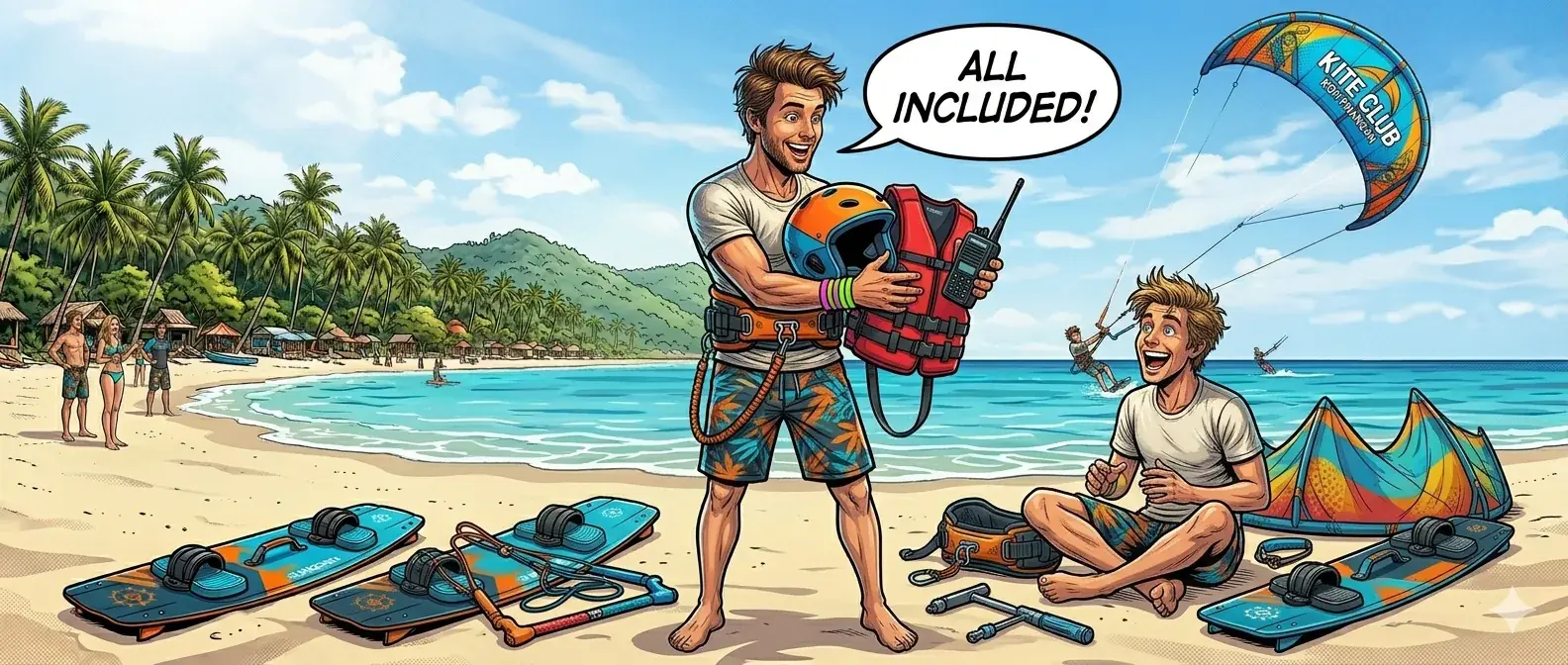
Four kitesurfing locations on Koh Phangan — each with different wind angles, seasons, and skill level requirements. Local instructor knowledge from daily sessions at every spot.
📖 12 min read · Updated May 2026 · By Sergei Sharvarok · Founder & Head Instructor
Spot Overview & Quick Reference
| Spot | Season | Wind Direction | Level | GPS |
|---|---|---|---|---|
| Thong Sala Beach | Feb–Apr (SE) / Jun–Oct (SW) | SE 110–140° / SW 210–230° | All levels | 9.932°N, 100.065°E |
| Baan Tai | Jun–Oct (SW — best) | SW 200–230° | Intermediate+ | 9.915°N, 100.073°E |
| Chaloklum | Dec–Jan (NE) | NE 020–040° | Advanced only | 10.008°N, 100.058°E |
| Haad Rin | SE season (occasional) | SE 120–150° | Advanced | 9.871°N, 100.070°E |
Thong Sala Beach — Main School Spot
Thong Sala Beach is the centre of kitesurfing on Koh Phangan and the home of Kite Club. It is the starting point for 100% of beginner lessons and the preferred spot for most intermediate sessions during both the SE and SW seasons.
Physical Characteristics
The beach runs approximately 400 metres from northeast to southwest, protected on its seaward side by a natural reef 200–300 metres offshore. Between the beach and the reef is the flat-water lagoon: 0.5–2.5 metres deep, sandy bottom, no rocks, no shore break, no current. During the SE season (February–April), the water in this lagoon becomes glassy flat — genuinely comparable to an indoor lake.
| Parameter | Value |
|---|---|
| Beach length | 400 metres (usable kite zone) |
| Water depth (lagoon) | 0.5–2.5 metres |
| Bottom type | Sand — no hidden rocks |
| Shore break | None during SE season; minimal in SW |
| Current | Negligible within lagoon |
| Boat traffic | None within kite zone (flagged area) |
| 5-min walk from | Thong Sala pier (ferry terminal) |
Wind Windows and Seasonal Performance
SE Season (February–April): Wind arrives from 110–140° (southeast to east-southeast). This is a nearly perfect cross-shore angle for the beach orientation. Riders drifting downwind travel parallel to the beach, not offshore. Sessions run 10am–5pm on most days. March delivers the most consistent 18–24 knot afternoons of the year.
SW Season (June–October): Wind arrives from 200–230° (south-southwest). The angle at Thong Sala is side-onshore rather than pure cross-shore. It is usable and safe, but less ideal than the SE season. Baan Tai (3km south) offers a cleaner SW angle for experienced riders who prefer side-shore conditions.
During the SE season, arrive at the beach by 10am. Wind typically begins building at 10–11am, peaks between noon and 3pm, and eases at 4–5pm. The morning calm is ideal for beginners who benefit from lighter pull; the peak is best for water starts and riding.
Hazards and How We Manage Them
Thong Sala Beach is considered one of the safest kite launch sites in Southeast Asia. The primary hazards are swimmers and snorkellers who occasionally enter the kite zone from the south end of the beach, and occasional fishing boats approaching the reef edge outside the lagoon. The kite zone is marked with yellow buoys and orange flags. Instructors conduct visual clearing before all sessions.
The reef outside the lagoon is the natural barrier that makes Thong Sala so flat — but it also means that anything beyond 300 metres from shore is reef country. Riders do not need to go anywhere near the reef during standard sessions. The instructional area stays inside the lagoon perimeter.
Baan Tai — Intermediate Freeriding
Baan Tai is a beach village 3 kilometres south of Thong Sala pier. It is not a school location — Kite Club does not run beginner lessons here — but it is the preferred spot for intermediate and advanced riders during the SW season when the wind angle is cleaner than at Thong Sala.
The beach faces slightly more southwest than Thong Sala, which means SW monsoon wind arrives as a purer side-shore flow rather than side-onshore. The resulting water is still choppy compared to SE season Thong Sala, but the quality of the side-shore angle rewards riders who are at IKO Level 3+ and want extended downwind freeriding runs.
| Month | Conditions at Baan Tai | Recommended Level |
|---|---|---|
| June | 12–16 kts SW, light chop | IKO Level 3+ |
| July | 16–22 kts SW, moderate chop | IKO Level 3–4 — best month |
| August | 14–20 kts SW, moderate chop | IKO Level 3–4 |
| September | 10–15 kts SW, variable | IKO Level 4 — lighter days |
July afternoons at Baan Tai regularly deliver 18–22 knot SW wind with 300+ metre runs possible on a large twin-tip. Experienced riders who want high-speed sessions should base their SW season visits around late July.
The road from Thong Sala to Baan Tai follows the coast. On a scooter it is 8–10 minutes. Kite equipment fits on a scooter with some creativity — board strapped to the side, bag across the seat. Most riders do this combination (lessons at Thong Sala in the morning, freeride at Baan Tai in the afternoon) without difficulty.
Chaloklum — North Shore Advanced Spot
Chaloklum is a traditional fishing village on the north coast of Koh Phangan, 25 minutes from Thong Sala by scooter. It is an expert spot that operates primarily during the NE season (December to mid-January) when northeast winds deliver cross-shore sessions on the north coast before the SE season establishes at Thong Sala.
The conditions here are significantly more demanding than Thong Sala:
- Water depth — 3–6 metres, much deeper than Thong Sala. Falls are further from the bottom.
- Shore break — a shallow reef creates a small shore break that requires confident launching and landing technique.
- Boat traffic — Chaloklum harbour has active fishing boat traffic. The kite zone is positioned to avoid it, but situational awareness is required.
- Wind consistency — NE wind at Chaloklum can be gusty due to the nearby mountainous terrain. Wind speed varies 15–25 knots within a single session.
Minimum level required: IKO Level 4 (full independent riding, ability to read and respond to gusty conditions, confident self-rescue). No exceptions.
December is Chaloklum's best month — the NE flow is usually more consistent than January. Advanced riders who want Chaloklum sessions should WhatsApp us on arrival to check conditions: +66 96 720 3910. We make the call on safety based on day-of wind assessment.
Haad Rin — Seasonal Expert Spot
Haad Rin is the famous Full Moon Party beach at the southeastern tip of Koh Phangan, 25 minutes from Thong Sala. It is not a regular kite spot — the challenges are significant enough that we do not send students here — but experienced independent riders occasionally use it during the SE season when strong southeasterly winds align perfectly with the beach.
Challenges at Haad Rin:
- Heavy ferry and speedboat traffic — the Haad Rin ferry dock is at the south end of the beach
- Crowded beach during Full Moon Party weeks (8 days per month at peak)
- Rocky reef approaches at north and south ends
- Inconsistent wind — the headland creates wind shadow on some angles
When it does work, Haad Rin has 200–300 metre runs in clean SE conditions during March–April. Expert riders (IKO Level 5) use it for jumping sessions when the SE wind is strong and steady at 22–25 knots.
Tides, Wind Angles & Seasonal Timing
Koh Phangan has a diurnal tide pattern with a maximum range of approximately 1.5 metres. This has minimal effect on kitesurfing conditions at Thong Sala (the lagoon remains usable at all tide levels) but has more impact at Baan Tai and Chaloklum.
| Tide | Effect at Thong Sala | Effect at Baan Tai | Effect at Chaloklum |
|---|---|---|---|
| High tide | No significant effect | Shallow areas deeper — better for beginners | Shore break increases |
| Low tide | Lagoon shallower — ideal for beginners | Flat sand exposed — longer run possible | Shore break decreases — easier launch/land |
| Mid tide | Best all-round conditions | Good all-round | Standard |
Wind patterns on Koh Phangan are consistent with regional monsoon cycles. Day-to-day variation within a season is primarily influenced by:
- Diurnal thermal effect: wind builds as the land heats in the morning, peaks mid-afternoon, eases in the evening
- Frontal passages: 2–3 times per SE season, a pressure change brings 2–3 days of lighter wind before conditions rebuild
- Tropical disturbances: rare but possible; the school monitors all tropical activity and cancels sessions if any disturbance is within 500km
Local Safety Information
At Thong Sala Beach specifically:
- Kite zone is marked with yellow buoys and orange flags — stay inside at all times during sessions
- Swimmers share the north end of the beach outside the flagged kite zone
- There is no lifeguard service at Thong Sala — Kite Club instructors carry rescue equipment during all sessions
- Emergency contact: Koh Phangan Hospital in Thong Sala — GPS 9.930°N, 100.060°E, 5 minutes from the beach
- WhatsApp emergency: +66 96 720 3910
All instructors at Kite Club carry a waterproof personal flotation device and a whistle during water sessions. The fastest response to any kite emergency at Thong Sala is the instructor on the water — they are trained in water rescue and know every metre of the kite zone.
How to Choose the Right Spot for Your Visit
| Your Profile | Best Spot | Season |
|---|---|---|
| Complete beginner | Thong Sala Beach | Any season (SE best) |
| IKO Level 1–2 | Thong Sala Beach | SE season (flattest water) |
| IKO Level 3 (first independent sessions) | Thong Sala Beach | SE or SW |
| IKO Level 3–4 (freeriding, improving technique) | Thong Sala + Baan Tai | SW season (Jul–Aug) |
| IKO Level 4–5 (advanced, jumps, high speed) | Baan Tai + Chaloklum | SW season / NE season |
| Expert, NE season visit | Chaloklum | December–January |
Frequently Asked Questions
Yes — it is one of the best beginner kite spots in the world. The natural reef creates a protected flat-water lagoon with depths of 0.5–2.5 metres, no shore break, no current, and no boat traffic inside the kite zone.
No. Baan Tai is for IKO Level 3+ riders. Choppier water, no beginner supervision infrastructure, and a more exposed wind angle make it unsuitable for first-time students.
Chaloklum operates during the NE season, primarily December and early January. It requires IKO Level 4 minimum. WhatsApp us on arrival and we will advise whether conditions are appropriate.
The SE season (February–April) delivers the optimal cross-shore SE wind at 110–140°. The SW season (June–October) has a side-onshore SW wind at 200–230°. Both are usable; SE season conditions are superior for learning.
Book Sessions at Thong Sala Beach
IKO-certified instruction at the best beginner kite spot in Thailand.
Book Now →Koh Phangan Kitesurf Spots: Conditions and Character
The kitesurf spots available around Koh Phangan cover a wider range of conditions and character than the island's modest size would suggest, reflecting the complex interaction between the island's mountainous interior, its varying coastal exposure to the northeast and southwest monsoon systems, and the different sea state environments created by its position within the Gulf of Thailand. Thong Sala Beach on the southern coast is the primary kite spot and the home of Kite Club Koh Phangan, offering the combination of consistent northeast trade wind exposure, shallow sandy bottom extending well offshore, and clean open water free from the reef obstructions and boat traffic hazards that complicate riding at some other island locations. The conditions at Thong Sala are specifically well-suited to beginner and intermediate instruction because the wind arrives as relatively clean trade wind with minimal terrain-induced turbulence, the water depth gradient is gradual enough to allow extensive shallow-water practice, and the surrounding geography provides natural wind channeling that slightly amplifies the trade wind velocity compared to open-ocean measurements in the same general direction. Intermediate and advanced riders benefit from the same qualities that make Thong Sala good for learning — the consistent wind, clean water, and absence of crowding that allow extended free-riding sessions without the territorial pressure that affects popular spots in more densely ridden destinations worldwide. The ability to ride upwind and return to the same beach access point without complex logistics distinguishes Thong Sala from some spots where riders must arrange downwind retrieval transport, a logistical simplification that makes longer sessions more practical and allows independent riders to maximize water time without support infrastructure. Contact the school at +66 96 720 3910 for current spot conditions and instructor-guided session options across all available spots.
Beyond Thong Sala, the island offers several secondary spots that experienced riders explore for variety or to capitalize on wind directions less well-suited to the primary beach. The northern bays around Haad Khom and the Bottle Beach area provide alternative riding when the prevailing northeast wind direction creates better exposure for northward-facing bays than the south-facing Thong Sala Beach orientation. These northern spots require more effort to reach — by boat from Chaloklum pier or by the challenging interior road — but reward that effort with a quality of wild coastal riding environment that the more developed southern beaches cannot replicate. The east coast beaches face the open Gulf and experience stronger onshore swell during the northeast season that creates wave-riding conditions for advanced riders comfortable with strapless surfing or kite surfing in wave environments, though the same swell makes these locations less suitable for beginner instruction where flat water is preferred. The west coast beaches around Ban Tai and Mae Haad benefit from the island's central ridge providing shelter from the northeast trade, creating calmer conditions suitable for paddling, snorkeling, and the non-wind-powered water activities that fill the activity calendar on rest days between kite sessions. Understanding the specific wind direction exposure of each spot and matching the spot choice to current conditions is a local knowledge skill that the school team brings to every session planning conversation, and riders who engage with this knowledge develop a significantly more sophisticated ability to capitalize on whatever conditions the day delivers rather than being locked into a single spot regardless of wind direction or sea state.
Local Insight
Experienced riders visiting during peak season should ask the school team about the less-publicized spots accessible by boat from Thong Sala that provide different wind angles and sea state environments from the main beach. These spots are not consistently suitable for instruction but offer variety for advanced riders who have mastered the skills needed to handle the less controlled conditions they occasionally present.
Frequently Asked Questions — Koh Phangan Kite Spots
Is Thong Sala Beach suitable for all skill levels simultaneously? Yes. The beach's shallow gradient means that beginners can practice in ankle to waist depth water close to shore while intermediate and advanced riders extend into deeper water further from the beach, creating natural spatial separation between skill levels that minimizes the interference between beginners and more experienced riders that can be problematic at spots with more limited shallow-water areas. The school manages the spatial allocation of the session area to ensure that beginner students have sufficient room to practice without disturbance from faster-moving riders at higher skill levels.
What happens to kite sessions when the wind is from an unexpected direction? The school team monitors wind direction daily and adjusts session logistics to capitalize on whatever direction delivers the best conditions. On days when wind direction is atypical for the season, the team may recommend alternative spots around the island that are better positioned for the prevailing direction, or may adjust the session timing to catch the most productive window of the day. This flexibility in response to conditions variation is one of the practical advantages of booking with an established school that has deep local knowledge rather than self-organizing sessions without institutional support.
The diversity of kite spots accessible from Koh Phangan's central location in the Gulf of Thailand creates a riding environment that rewards extended stays and repeat visits — each season brings slightly different conditions, different wind pattern emphases, and the ongoing discovery of conditions nuances that even experienced regular visitors continue to find at spots they have ridden dozens of times. This depth of riding environment, combined with the consistent quality of instruction and the social infrastructure of the beach community, explains why Koh Phangan kite visitors so frequently become regular returners rather than one-time visitors moving through the global kite destination circuit. Book your first or next session via WhatsApp at +66 96 720 3910 and experience the full variety that this island's kite geography offers.
Every regular visitor to the Koh Phangan kite scene develops their own relationship with the specific spots, conditions nuances, and local knowledge that make each location distinctive — knowledge that accumulates through experience and through the informal sharing that occurs naturally within the school community. The school team at +66 96 720 3910 serves as the primary local knowledge resource for visiting riders who want to accelerate their understanding of the island's riding geography beyond what any single visit can reveal through individual exploration alone.
Koh Phangan kite spots reward the rider who takes time to understand each location's specific wind exposure, sea state character, and optimal tide and time-of-day conditions — knowledge that transforms good kite days into exceptional ones and allows even moderate wind days to deliver surprisingly productive sessions when spot selection is calibrated to the available conditions. The school team updates conditions recommendations daily via WhatsApp at +66 96 720 3910 for all booked students and rental riders, ensuring that local knowledge is always available to inform your spot and timing decisions throughout your stay.