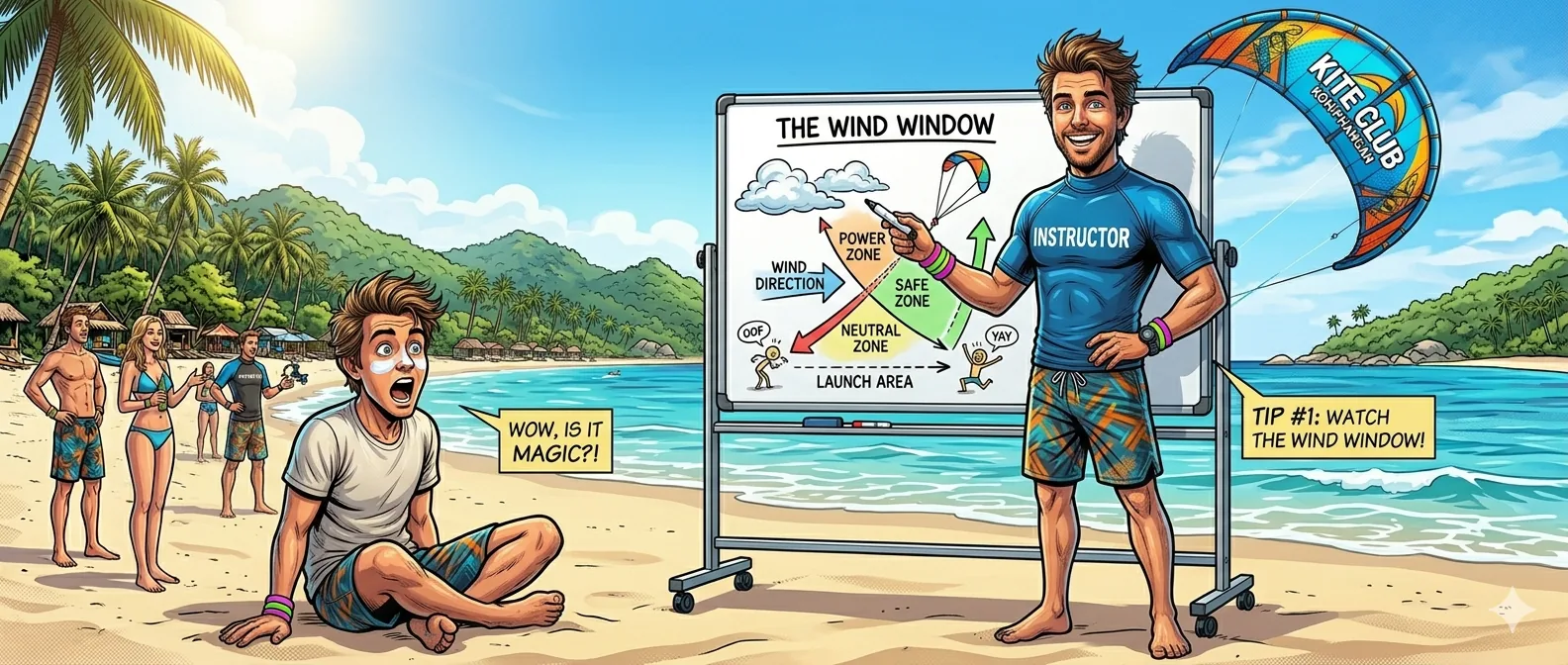
Body drag is the single most underestimated skill in kitesurfing. Every experienced kiter says the same thing: the students who spend the most time body dragging get on the board fastest. This guide covers downwind drag, upwind drag, one-hand technique, and board recovery.
📖 9 min read · Updated May 2026 · By Sergei Sharvarok · Founder & Head Instructor
What Is Body Drag and Why Does It Matter?
Body dragging means allowing the kite to pull your body through the water without a board. You fly the kite in one or both hands while your body — face in the water, arms extended, hips forward — is towed by the kite.
Body drag develops: (1) one-hand kite control, which is required during board retrieval and water starts; (2) confidence with kite power in water; (3) the muscle memory of kite position relative to the wind window. These three things make the difference between a student who struggles with water starts for 10 sessions and one who stands up on Day 3.
Downwind Body Drag
Downwind drag is the first version you learn. Kite is parked at 12 o'clock (directly overhead) for minimal power, then moved gently to 10 or 2 o'clock to generate pull. Your body drags downwind — you travel in the direction the wind is blowing.
Position: face down in the water, arms straight in front of you, hips forward, toes pointed back. This position creates a hydrodynamic shape that is dragged efficiently rather than fighting the water.
Upwind Body Drag — The Critical Skill
Upwind drag means using the kite to pull yourself sideways or even slightly against the wind. This is how you retrieve your board after a fall. Without reliable upwind drag, every fall requires a long swim back to your board.
Technique: kite at 11 or 1 o'clock (edge of the power zone, not overhead). One hand on the bar, other arm extended forward into the water at 45° across the wind direction. Your body is angled across the wind. Done correctly, you move at 20–40° to the wind direction. The arm in the water acts as a keel — it determines your angle of travel.
Practice upwind drag by placing your board 20 metres upwind of you, then dragging back to it. Repeat 10 times per session until it is automatic. Instructors at Kite Club drill this specifically — it is the most time-sensitive skill in the course.
One-Hand Kite Control
One-hand kite control is required for: board retrieval (you carry the board in one hand), water start setup (one hand on bar while other reaches for board), and any moment when a hand needs to be free. Develop it specifically — it does not come automatically from two-hand flying.
Drill: fly the kite at 12 o'clock with both hands, then move one hand to the center of the bar. Hold for 30 seconds. Move the kite to 10 o'clock (one hand). Then 2 o'clock. Then back to 12. Repeat until one-hand kite position feels stable before transitioning to the water.
Most Common Body Drag Mistakes
- Hips sinking — Hips need to be at the water surface, not hanging below. Sinking hips create drag and make upwind movement impossible. Push hips forward deliberately.
- Kite too high — Kite at 12 o'clock has minimal power. Move it to 10 or 2 for pull. Many beginners keep the kite overhead and wonder why they are not moving.
- Looking at kite constantly — You should be able to feel kite position without looking. Eyes forward (or in the water). Kite awareness by feel is the foundation of free body drag.
- Straight-arm overreach — Extended arm in the water during upwind drag should be relaxed, not rigidly extended. A stiff arm creates shoulder fatigue quickly.
Frequently Asked Questions
IKO recommends a minimum of 3 hours body dragging before first water start attempts. At Kite Club, this typically fills Days 1 and 2 of the beginner course. Students who rush past this struggle significantly on Day 3.
No — body drag must be practiced with an instructor present, especially in the early stages. The main risk is the kite pulling you into obstacles or offshore. All body drag practice at Kite Club happens in the supervised session area at Thong Sala Beach.
The most common cause: kite is too high (11–1 o'clock range instead of 10 or 2), or the body is not angled correctly across the wind. Check arm position in the water — the extended arm must be pointing into the wind direction, not downwind.
Body drag is not a strength exercise — it is a technique exercise. Stronger swimmers sometimes struggle more because they try to swim through the drag rather than relax into it. Relaxation and correct position matter far more than physical strength.
Master Body Drag at Koh Phangan
IKO-certified instruction at Thong Sala Beach. Beginner courses from 11,000 THB.
Book Now →Kitesurfing body drag technique guide — downwind drag, upwind drag, one-hand kite control, and board retrieval. Expert tips from IKO-certified instructors at Kite Club Koh Phangan. Kitesurfing lessons from 3,500 THB. Book via WhatsApp +66 96 720 3910.