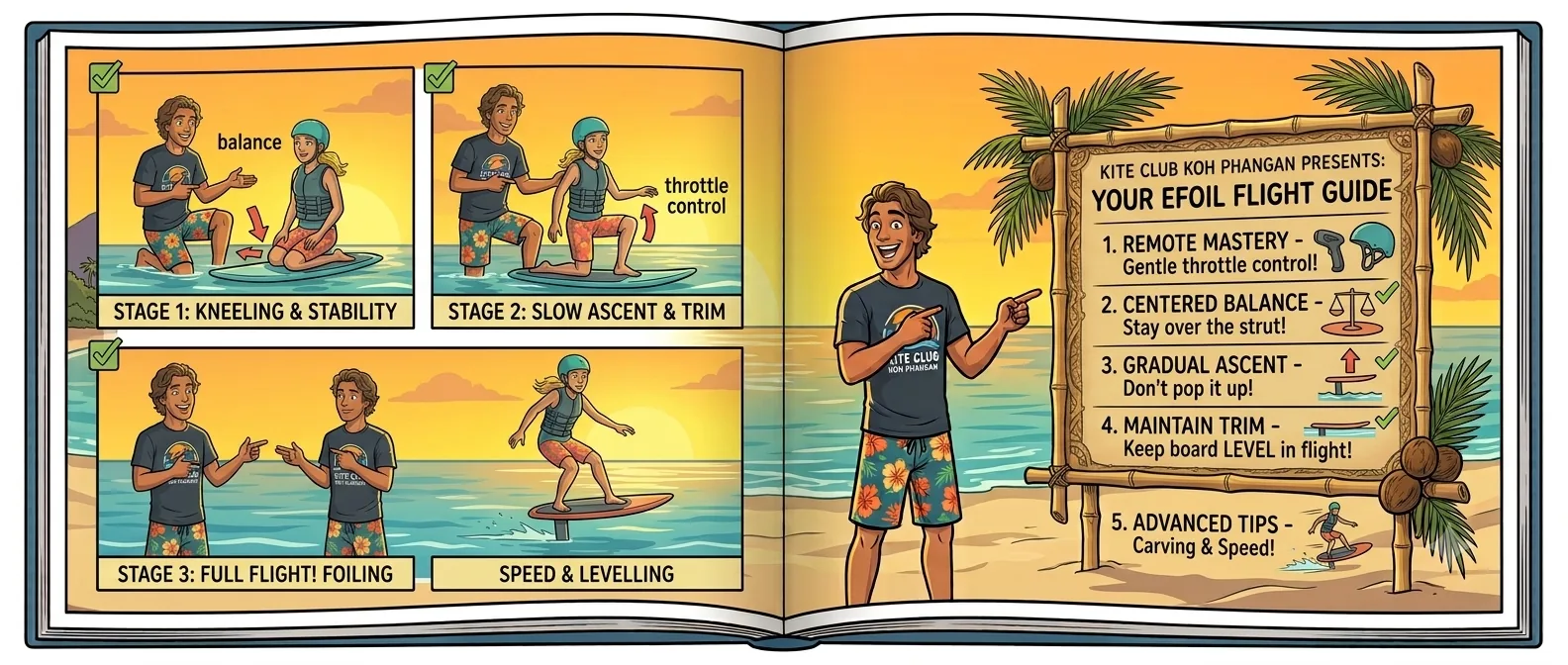
An e-foil consists of five main components: the board, the mast, the foil wings, the motor pod, and the battery. Understanding how each part works helps you choose the right gear and get more from your sessions.
📖 9 min read · Updated May 2026 · By Sergei Sharvarok · Founder & Head Instructor
The Five Components of an E-Foil
- Board — 120–180 cm long, 70–90 cm wide. Larger boards (140cm+) are more stable and recommended for beginners. Carbon construction keeps weight down — most boards weigh 15–25 kg including motor and battery.
- Mast — The vertical aluminium or carbon strut that connects board to foil wings. Standard mast length is 60–80 cm. Shorter masts (60 cm) are better for beginners — less leverage when the foil pitches.
- Front wing — The large horizontal wing under water that generates lift. Larger front wings (1,500–2,000 cm²) generate lift at lower speeds (good for beginners). Smaller wings (800–1,200 cm²) need higher speed but turn more precisely.
- Motor pod — Houses the electric motor and propeller. The motor drives the propeller to generate thrust. Motor power ranges from 5–12 kW. More power = higher top speed and easier take-off.
- Battery — Li-ion battery pack, typically 100–200 Wh. Provides 45–90 minutes of riding per charge. Charging takes 2–4 hours. The battery is the most expensive consumable component.
E-Foil Brands in 2026
| Brand | Top Model | Board Length | Best For |
|---|---|---|---|
| Fliteboard | Ultra L | 148 cm | Premium performance, IKO school choice |
| Lift Foils | eXplorer | 150 cm | High power, advanced riders |
| Waydoo | Flyer One Plus | 130 cm | Budget entry, beginner-friendly |
| Takuma | Hoverboard V3 | 135 cm | Compact, school use in Asia |
Kite Club Koh Phangan uses Fliteboard equipment — the leading brand used by IKO-certified schools worldwide. Fliteboard is known for smooth power delivery, which is important for beginners who are learning to balance lift and speed through the remote controller.
The Hand Controller
The wireless remote is what you use to control speed. It connects to the motor via Bluetooth or a proprietary signal. Squeeze the trigger gently to increase speed and lift; release to slow down and descend. The learning curve on the remote is short — most beginners find intuitive control within the first 10–15 minutes.
Modern e-foil remotes include a safety kill switch (usually a foam float) — if you drop the remote, the motor stops. This prevents the board from running away. All sessions at Kite Club use remotes with this safety feature active.
The most common beginner mistake with the remote is making large, fast movements. Small, smooth trigger adjustments maintain stable foil height. Think of the remote as a volume dial, not an on/off switch.
Buying Your Own E-Foil: What to Know
A complete new e-foil setup from Fliteboard or Lift Foils costs 10,000–15,000 USD. Budget brands (Waydoo, Takuma) start at 4,000–6,000 USD but have shorter battery life, less power, and fewer replacement parts available in remote locations like Koh Phangan.
For most visitors to Koh Phangan, renting through Kite Club sessions (2,000–3,500 THB per session) is the better choice than buying. The equipment at the school is maintained, insured, and appropriate for the local conditions. Buying makes sense once you are riding regularly at home.
Frequently Asked Questions
Typically 45–90 minutes depending on rider weight, speed, and foil height. Riding at moderate height and speed uses less battery than aggressive riding. The 60-minute Foiling session at Kite Club uses approximately 60–70% of a full battery charge.
The board is 15–25 kg and the mast/foil assembly adds another 5–8 kg. Plus the battery (10–15 kg). Total kit weight is 30–45 kg — significantly over airline baggage limits. Most e-foilers who travel rent at their destination rather than travel with equipment.
Not directly from Kite Club — we use our equipment for instruction. For purchases, we can advise on brands and connect you with suppliers. Shipping e-foil equipment to Thailand involves import duty — factor this into the total cost.
After each session: rinse with fresh water, especially the motor pod and connections. Store battery at 50% charge if not using for more than a week. Inspect prop for dings before each session. A properly maintained e-foil requires minimal professional service — the motor has no gearbox or oil to change.
Try E-Foil at Koh Phangan
Premium Fliteboard equipment. IKO-certified instruction. Sessions from 2,000 THB.
Book Now →E-foil equipment guide 2026: board components, mast length, front wing size, motor power, battery life, and hand remote operation. Brand comparison including Fliteboard, Lift Foils, Waydoo, and Takuma. Kite Club Koh Phangan uses Fliteboard equipment for all e-foil sessions at Thong Sala Beach. Sessions from 2,000 THB. Contact +66 96 720 3910.