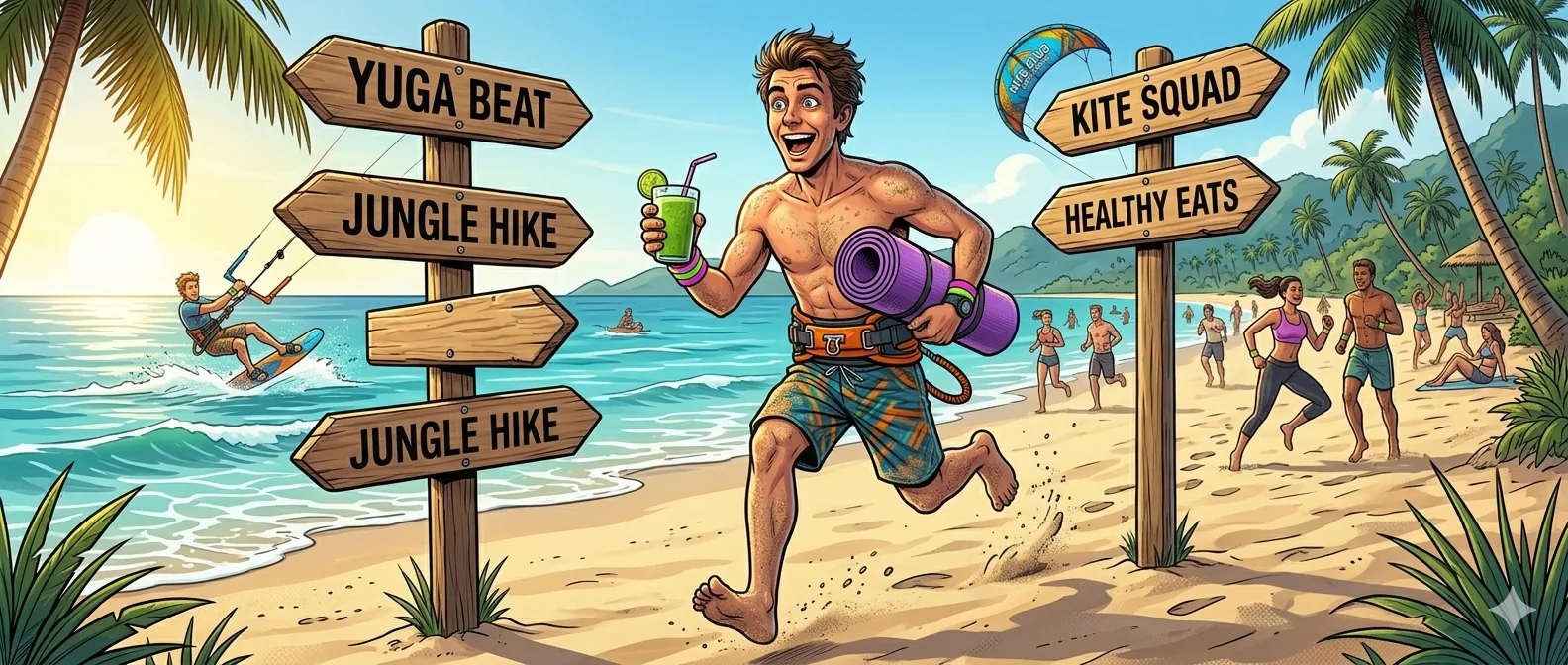
You do not need to be an athlete to learn kitesurfing. But specific preparation over 4–6 weeks before your trip reduces fatigue on Day 1 and accelerates your learning. This guide covers exactly what to train — and what to skip.
📖 8 min read · Updated May 2026 · By Sergei Sharvarok · Founder & Head Instructor
What Physical Qualities Actually Matter
- Swimming endurance — You will be in the water for 2–3 hours. Being comfortable floating and swimming 200m is the base requirement. Not speed — endurance and calm.
- Forearm and grip endurance — Bar control requires sustained light grip. Forearm fatigue is the #1 complaint on Day 1. Building grip endurance in the 6 weeks before your trip makes a significant difference.
- Core stability — Water starts and board riding engage the core constantly. Not six-pack strength — stability and bracing under load.
- Hip flexor and thoracic flexibility — The body drag and water start positions require forward hip flexion and thoracic extension. Tight hip flexors make these positions painful and less efficient.
- Lower body endurance — Riding on a board is a sustained squat position for your quads. Hiking, stair climbing, or cycling all prepare this.
Grip and Forearm Training
The single most impactful pre-trip training for kitesurfing is forearm grip endurance. The kite bar is held lightly but continuously for 2–3 hours per session. Most beginners whose forearms fail by hour 2 see their kite control deteriorate significantly.
Training: use a grip strengthener (available for 5–10 EUR online) for 3 sets of 20 reps, 3 days per week. Add dead hangs (hang from a pull-up bar for 30–60 seconds) to build forearm endurance rather than just grip strength. 4–6 weeks of this preparation is sufficient.
Core Stability Training
The best core exercises for kitesurfing are not crunches or sit-ups — they are anti-rotation and anti-extension exercises. Plank (60 seconds, 3 sets), pallof press, and single-arm carrying (a farmer walk with one heavy dumbbell) prepare the core for the asymmetric loads in kiting.
Yoga is also highly effective preparation. A 30-minute yoga flow 3 times per week for 6 weeks dramatically improves hip flexibility, thoracic mobility, and body awareness in unstable positions — all directly transferable to kitesurfing balance.
If you can only do one form of fitness preparation for kitesurfing, do yoga. A regular yoga practice develops the hip flexibility for water starts, the core control for board riding, the shoulder stability for bar control, and the body awareness for kite feel — all in one discipline.
Cardio: What Level?
Kitesurfing sessions are 2–3 hours of low-to-moderate intensity with occasional bursts of higher effort (water start attempts, swimming to retrieve board). The cardio demand is similar to 2–3 hours of snorkeling or stand-up paddleboarding.
You do not need high-intensity fitness. Regular walking, cycling, or swimming for 30–45 minutes, 3–4 times per week, provides sufficient cardiovascular base. If you are currently sedentary, start this 8 weeks before your trip.
The students who arrive at Koh Phangan most prepared are typically yoga practitioners — not gym athletes. Yoga develops exactly the qualities kitesurfing demands. Gym strength without flexibility is less useful than moderate fitness with good mobility.
Frequently Asked Questions
You need to be able to swim 200m comfortably, walk for 2–3 hours without fatigue, and have no active joint injuries. There is no strength requirement — the harness does the heavy work. The most important physical quality is being relaxed in the water.
General strength training helps but is not the priority. Grip endurance, core stability, and hip flexibility deliver more benefit per training hour than general lifting. If you are already training, add grip work and yoga. If you are not training, start with yoga and swimming.
Yes — particularly after Days 1–3. Lower back, forearms, and core are the main soreness areas. This passes by Day 4–5 as your body adapts. Stretching after each session and staying hydrated reduces recovery time significantly.
4–6 weeks of targeted preparation (grip work, yoga, swimming) is sufficient for most beginners. Starting 8 weeks out is ideal. Starting the week before is better than nothing — even one week of yoga and grip training will reduce Day 1 fatigue.
Book Your Kitesurfing Course
Arrive prepared. Leave riding. Courses at Thong Sala Beach from 3,500 THB.
Book Now →Kitesurfing fitness training guide — grip endurance, core stability, hip flexibility, and cardio preparation. How to prepare your body for kitesurfing lessons at Koh Phangan. Courses from 3,500 THB at Kite Club Koh Phangan. Book via WhatsApp +66 96 720 3910.